Nadda hails Cabinet nod for Rs 3,936 cr Bihar NH-31, NH-231 four-laning
Synopsis
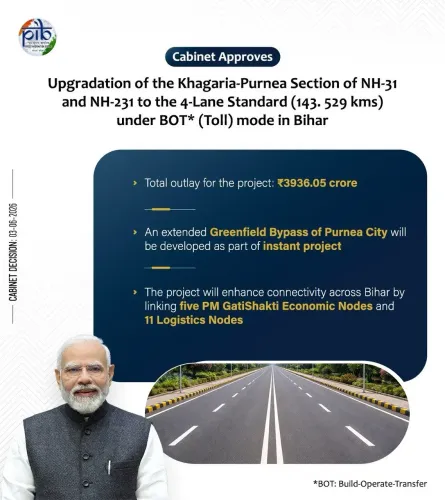
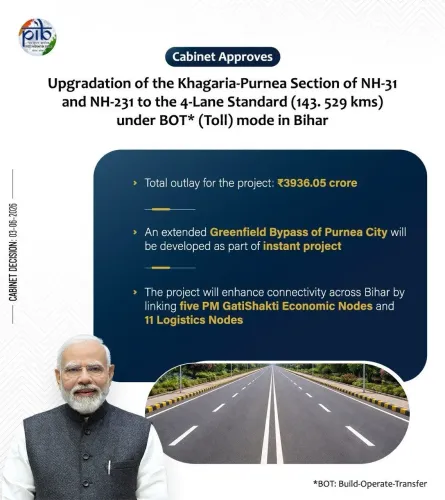
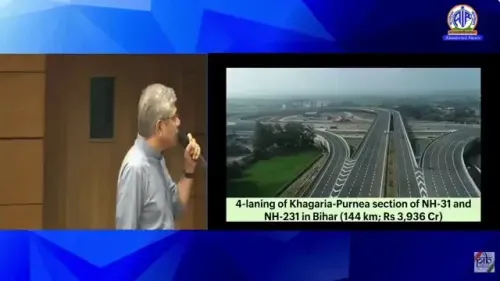
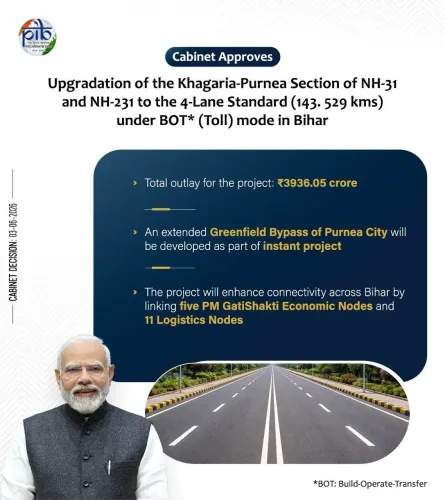
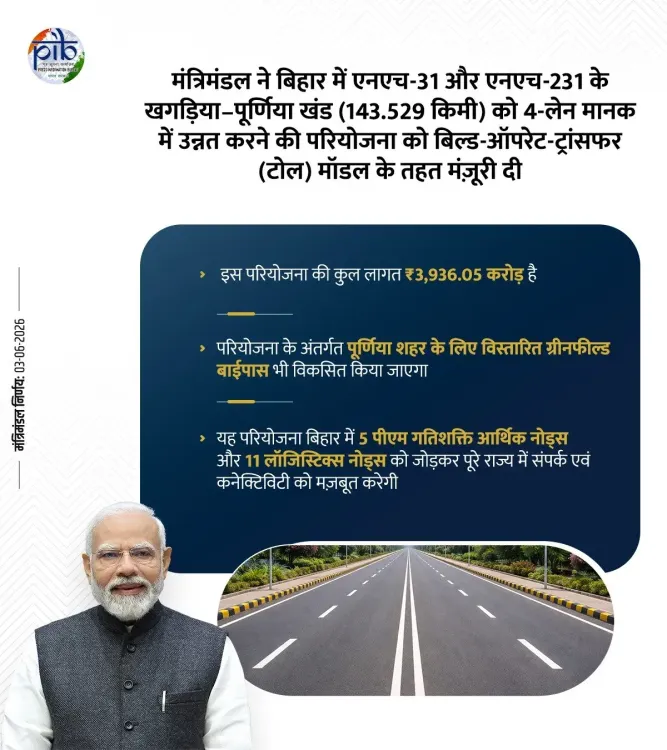
Union Health Minister J. P. Nadda announced Union Cabinet approval to upgrade the 143.529 km Khagaria-Purnia section of NH-31 and NH-231 in Bihar to four lanes on BOT (Toll) mode at Rs 3,936.05 crore, crediting PM Narendra Modi and citing wider connectivity and safer transit for lakhs of residents in eastern Bihar.
Key Takeaways
Union Cabinet has approved four-laning of the 143.529 km Khagaria-Purnia section of NH-31 and NH-231 in Bihar.
Project cost is pegged at Rs 3,936.05 crore on BOT (Toll) mode.
Nadda announced the decision on X, crediting PM Narendra Modi's leadership.
The corridor links the Kosi belt with the Seemanchal region in northeastern Bihar.
Implementation will be steered by NHAI through tendering and financial closure.
The package extends the Bharatmala-era push to upgrade Bihar highways to four-lane standards.
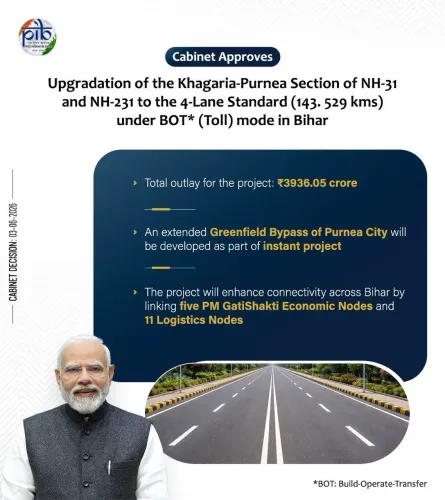
Union Health Minister J. P. Nadda on Wednesday welcomed the Union Cabinet's approval for upgrading a 143.529-km stretch of National Highway-31 and NH-231 in Bihar's Khagaria-Purnia section to four lanes on Build-Operate-Transfer (BOT) toll mode at a cost of Rs 3,936.05 crore. In a post on X, Nadda credited the decision to the leadership of Prime Minister Narendra Modi and said the project would deepen connectivity across eastern Bihar.
'The Union Cabinet, under the leadership of respected Prime Minister Shri Narendra Modi ji, has today approved the upgradation of the 143.529 km Khagaria-Purnia section of NH-31 and NH-231 in Bihar to 4-lane standard on BOT (Toll) mode at a cost of Rs 3,936.05 crore,' Nadda wrote, translating his Hindi message. He added that the project would benefit lakhs of people through smoother transit and safer travel, and thanked the Prime Minister for the decision.
Context
The Khagaria-Purnia corridor links the agriculturally dense Kosi belt with the Seemanchal region in northeastern Bihar. Both stretches currently see heavy mixed traffic — long-distance freight, intercity buses and local farm vehicles — on alignments that are largely two-lane.
The four-laning is being routed through the BOT (Toll) model, under which a private concessionaire finances construction, operates the highway and recovers investment through user fees before transferring it back to the government. The Ministry of Road Transport and Highways has used this format for several Bihar highway packages over the past decade.
Policy backdrop
The approval sits within the broader thrust of Bharatmala Pariyojana, the umbrella national highways programme approved by the Union Cabinet in 2015 with a target of 34,800 km of upgraded corridors. Bihar has featured repeatedly in successive cabinet notes seeking to convert single- and two-lane national highways into four-lane standards.
NH-31 has historically been a key artery running through Bihar's northern districts, while NH-231 feeds into the wider east-west grid serving Purnia and onward links to West Bengal and the Northeast. Upgrading both in a single package is aimed at producing a contiguous four-lane spine through the Khagaria-Purnia belt.
Stakeholders and impact
The most direct beneficiaries are residents and businesses along the corridor in districts including Khagaria, Madhepura, Saharsa (adjoining belt) and Purnia. Faster road movement is expected to ease the transport of perishables such as maize, makhana and dairy produce for which the region is known.
Nadda said the project would also encourage 'paryavaran ke anukool parivahan' (environment-friendly transport) by reducing congestion-led emissions, and would play a role in the 'overall development' of the area. For highway users, four-laning typically translates into shorter travel times and lower accident risk on what are currently mixed-traffic stretches.
That the announcement came from the Health Minister rather than the road transport portfolio reflects the BJP's practice of cabinet-wide social-media dissemination of major decisions, with Nadda also serving as the party's national president.
What's next
Attention now shifts to the National Highways Authority of India (NHAI), which will steer the tendering process, bidder shortlisting and financial closure for the package. The concession agreement under BOT (Toll) will set toll rates, construction milestones and the operating period before the asset reverts to the government.
Further cabinet notes on adjoining Bihar stretches are likely to follow, given the state's electoral salience and the centre's stated aim of building out a continuous four-lane network across the Ganga plains. For commuters and freight operators in Seemanchal, the test will be how quickly ground-breaking follows the paperwork.
Point of View
BOT-mode highway package routed through Bihar ahead of a politically sensitive electoral cycle in the state. By relying on private concessionaires, the centre conserves budgetary headroom while still claiming a visible infrastructure win in Seemanchal, a region long flagged for connectivity deficits. Nadda's amplification — from the health portfolio and as BJP president — underlines how cabinet decisions are now broadcast as party messaging as much as governance updates. The real test will be tendering speed and the concessionaire's risk appetite for a corridor with mixed traffic economics.
NationPress
17 Oct 2026
Frequently Asked Questions
What has the Union Cabinet approved for Bihar's NH-31 and NH-231?
The Union Cabinet has approved four-laning of a 143.529 km stretch covering the Khagaria-Purnia section of NH-31 and NH-231 in Bihar at a cost of Rs 3,936.05 crore on BOT (Toll) mode.
What is BOT (Toll) mode in highway projects?
BOT (Toll) is a public-private partnership model where a private concessionaire builds and operates the highway, recovers costs through user tolls for a fixed period, and then transfers the asset back to the government.
Which regions of Bihar will benefit from the Khagaria-Purnia four-laning?
Districts along the Kosi and Seemanchal belt, including Khagaria and Purnia, will benefit through faster connectivity, easier freight movement and safer travel on a currently mixed-traffic corridor.
Why did J. P. Nadda announce a highways decision?
J. P. Nadda, who is Union Health Minister and BJP national president, posted the update as part of the government's cabinet-wide social-media dissemination of major decisions, thanking PM Narendra Modi for the approval.
What is the cost of the Khagaria-Purnia highway upgrade?
The sanctioned cost of the project is Rs 3,936.05 crore, to be implemented on BOT (Toll) mode.