Gadkari: Cabinet clears 4-laning of Khagaria-Purnea NH stretch
Synopsis
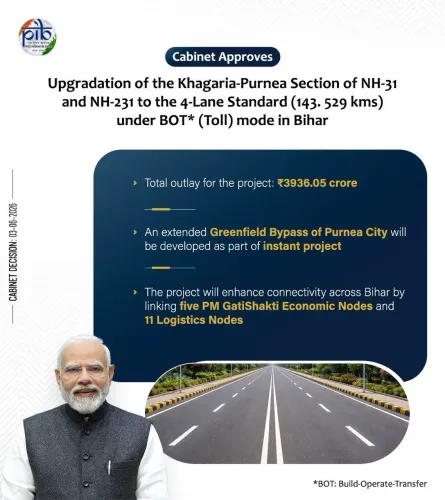
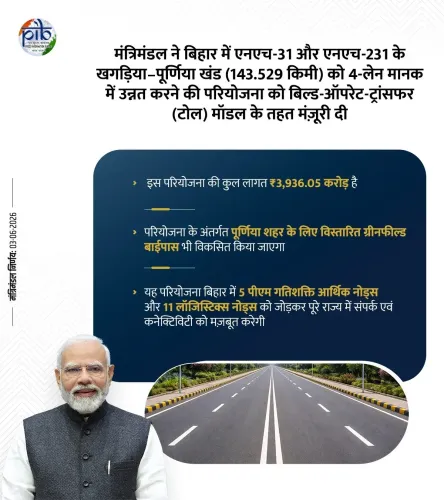
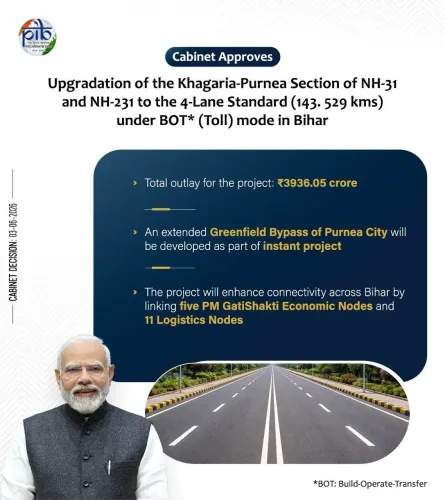
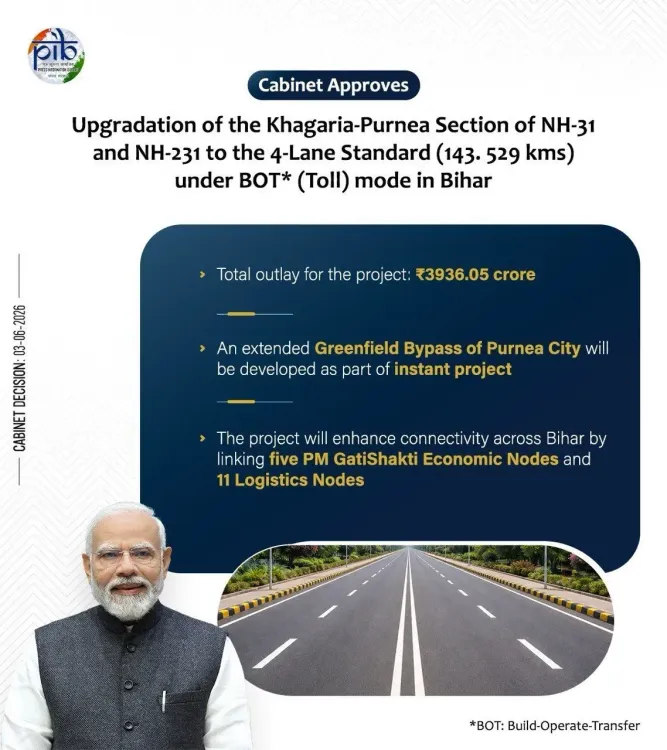
Union Road Transport and Highways Minister Nitin Gadkari announced that the Union Cabinet has cleared the four-laning of the 143.529 km Khagaria-Purnea section of NH-31 and NH-231 in Bihar under the BOT (Toll) mode at ₹3,936.05 crore, including a 6.729 km greenfield bypass around Purnea city.
Key Takeaways
Union Cabinet approved 4-laning of the Khagaria-Purnea stretch of NH-31 and NH-231 in Bihar.
Project length is 143.529 km at an estimated cost of ₹3,936.05 crore.
To be built under the Build-Operate-Transfer (Toll) mode.
Includes a 6.729 km greenfield bypass around Purnea city.
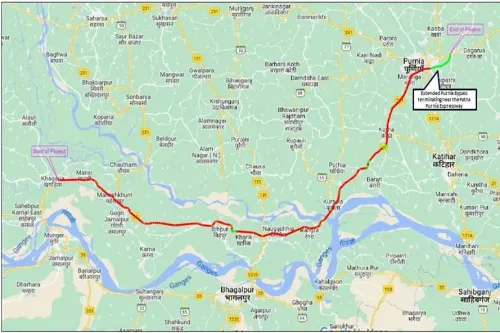
Covers Khagaria, Bhagalpur, Katihar and Purnia districts.
Travel time on the corridor is expected to fall to about two hours.
Union Road Transport and Highways Minister Nitin Gadkari on Wednesday announced that the Union Cabinet, chaired by Prime Minister Narendra Modi, has approved the upgradation of the Khagaria–Purnea section of NH-31 and NH-231 in Bihar to a four-lane standard. The project will be executed under the Build-Operate-Transfer (Toll) mode, covering 143.529 km at an estimated cost of ₹3,936.05 crore.
Context
In his post on X, Gadkari said the upgrade 'aims to address critical geometric deficiencies, including sharp curves and congestion in built-up areas' across the districts of Khagaria, Bhagalpur, Katihar and Purnia. He added that the project would include a 6.729 km greenfield bypass around Purnea city to ease urban traffic and improve connectivity.
Once operational, the corridor is expected to cut travel time on the stretch to roughly two hours, while improving road safety, fuel efficiency and vehicle operating costs, the minister said. He framed the upgrade as a step toward 'strengthening regional mobility and contributing to socio-economic development'.
Policy backdrop
NH-31 is a major arterial corridor that links eastern Bihar with West Bengal and the northeast, carrying significant freight and passenger traffic from the Kosi and Seemanchal belts. The Khagaria–Purnea segment has historically suffered from narrow carriageways, sharp bends and bottlenecks through dense township sections, making it a long-standing candidate for capacity augmentation.
The approval continues the central government's push under the Bharatmala Pariyojana, the umbrella highways programme cleared in 2015 to develop roughly 34,800 km of national corridors, with a pronounced focus on eastern India. Successive cabinet approvals since then have prioritised four-laning of geometrically deficient stretches in Bihar, often using the BOT (Toll) mode for corridors expected to generate steady toll revenue.
Stakeholders and impact
For commuters across Khagaria, Bhagalpur, Katihar and Purnia, the upgrade promises smoother movement on a stretch that today sees frequent slowdowns through built-up bazaar areas. The greenfield bypass around Purnea is designed to separate long-distance highway traffic from city movement, easing congestion within the urban core.
Regional traders and logistics operators stand to benefit from faster turnaround times and lower vehicle operating costs on a corridor that feeds agricultural produce, including maize and jute from the Seemanchal region, to markets further east. A more reliable highway is also expected to improve last-mile access for industrial clusters and educational hubs around Purnea and Bhagalpur.
The use of the BOT (Toll) structure means a private concessionaire will finance, build and operate the stretch for a fixed period, recovering investment through user tolls before transferring the asset back to the government. The mode has seen renewed traction in recent years for high-traffic corridors after a phase dominated by hybrid annuity and EPC contracts.
What's next
Attention will now shift to the tendering process led by the National Highways Authority of India, including bid parameters, concession period and the identity of bidders willing to take on traffic risk on the corridor. Detailed project reports, land acquisition status across the four districts, and environmental clearances for the Purnea bypass will determine how quickly construction can begin on the ground.
If executed on schedule, the four-laned Khagaria–Purnea corridor would mark another link in a broader effort to knit together Bihar's national highway grid, with implications for connectivity between the state's interior districts and gateways to the northeast.
Point of View
Where geometrically deficient legacy corridors are being progressively four-laned under the Bharatmala umbrella. Choosing the BOT (Toll) route for Khagaria-Purnea signals renewed confidence that traffic on the Seemanchal corridor can sustain private toll-based financing, after years in which hybrid annuity dominated awards. Politically, a high-visibility Bihar project sustains the Centre's narrative of focused infrastructure delivery in the state. Execution risk, particularly on land acquisition for the Purnea bypass, will be the real test.
NationPress
18 Oct 2026
Frequently Asked Questions
What has the Union Cabinet approved on NH-31 in Bihar?
The Union Cabinet has approved upgradation of the Khagaria-Purnea section of NH-31 and NH-231 in Bihar to a four-lane standard, covering 143.529 km at an estimated cost of ₹3,936.05 crore.
How long is the Khagaria to Purnea highway project?
The project covers a total length of 143.529 km, including a 6.729 km greenfield bypass around Purnea city.
Under which mode will the Khagaria-Purnea highway be built?
It will be implemented under the Build-Operate-Transfer (Toll), or BOT (Toll), mode, where a concessionaire builds and operates the road and recovers cost through tolls.
Which districts will the Khagaria-Purnea four-lane highway pass through?
The corridor passes through the districts of Khagaria, Bhagalpur, Katihar and Purnia in Bihar.
How much travel time will the upgraded Khagaria-Purnea highway save?
According to the announcement, travel time on the stretch is expected to come down to approximately two hours after the four-laning is completed.