China submarine missile test timed as US fought Iran war: Report
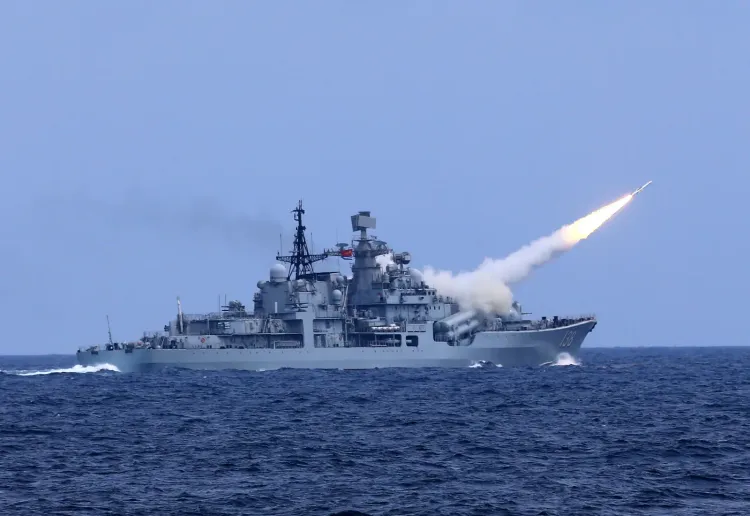
Synopsis
A new report flags that China's submarine-launched nuclear-capable missile test landed while the US was fighting a war with Iran — its attention, assets and diplomatic capital all absorbed by the Gulf. Whether or not the timing was deliberate, the signal reached every regional capital from Tokyo to New Delhi at precisely the moment Washington was least positioned to respond.
Key Takeaways
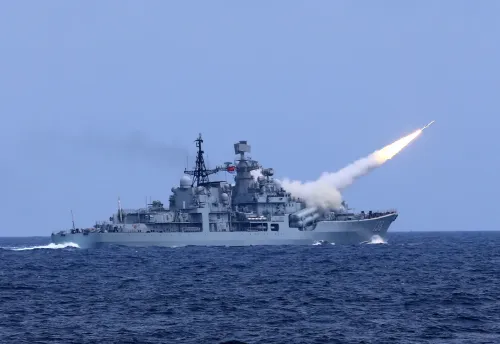
China conducted a nuclear-capable missile launch from a submarine into the South Pacific , raising strategic concerns about its timing.
The launch occurred while the United States was actively at war with Iran , with Washington striking dozens of Iranian targets in the same week.
The Asia Media Centre report, authored by Divya Malhotra , stops short of calling the test opportunistic but notes Beijing cites its annual training calendar.
The test follows China's September 2024 ICBM launch into the Pacific — the first in international waters in 44 years — and silo-based launches in December 2024 .
Analysts say the pattern points toward China building a continuous at-sea deterrence capability similar to that of the US , France , and the UK .
A nuclear-capable missile launched from a Chinese submarine into the South Pacific deserves far more strategic scrutiny than it has received, according to a report by the Asia Media Centre — a resource hub for New Zealand journalists. The analysis, authored by Divya Malhotra, argues that the launch occurred at a moment when Washington was deeply consumed by its conflict with Iran, raising pointed questions about the test's geopolitical context.
The Timing Question
Since late February, the United States has been engaged in an active war with Iran — a conflict that escalated sharply in the very week of China's submarine missile launch, with Washington striking dozens of Iranian targets following attacks on shipping in the Strait of Hormuz. 'American attention, military assets and diplomatic capital have been absorbed by the Gulf for months,' the report noted.
Malhotra stopped short of concluding the test was deliberately opportunistic. Beijing has maintained that the timing reflects its annual training calendar. However, the report observed that 'the demonstration landed at a moment when the one power capable of a serious response to Chinese nuclear signalling was least able to devote sustained attention to it' — a calculation that regional planners in Tokyo, Canberra, and New Delhi are unlikely to have missed.
A Pattern of Escalating Nuclear Signalling
The report was careful to frame this launch not as an isolated event but as part of a broader, accelerating pattern. In September 2024, China conducted an Intercontinental Ballistic Missile (ICBM) test into the Pacific — the first such test in international waters in 44 years. That was followed by a rapid sequence of silo-based ICBM launches in December 2024.
'Together, these episodes describe a state moving from a minimal, opaque deterrent toward one that is larger, more redundant, and increasingly comfortable demonstrating itself in public,' the Asia Media Centre report stated. Malhotra characterised this shift as China choosing to openly validate its arsenal rather than develop it in secrecy — a meaningful doctrinal signal.
Implications for the Indo-Pacific
The missile landed inside the South Pacific Nuclear Free Zone, making it, as Malhotra noted, 'first and foremost, an event in New Zealand's own strategic neighbourhood.' The report underscored that the region's deepening nuclear instability was already a concern well before this particular test.
Analysts reading the submarine test alongside China's wider undersea build-out see a more structural intent. 'Set against China's wider submarine build-out, the test looks less like a one-off demonstration and more like a deliberate step toward continuous at-sea deterrence — the kind of standing, always-on undersea patrol long practised by the United States, France and the United Kingdom,' the report emphasised.
What This Means for Regional Capitals
For strategic planners across the Indo-Pacific — from New Delhi to Tokyo to Canberra — the convergence of US distraction and Chinese nuclear demonstration represents a data point that cannot be set aside. Whether or not the timing was calculated, the effect is the same: a major nuclear signal was sent at a moment of diminished Western bandwidth to respond. How regional powers recalibrate their own deterrence postures in the months ahead will be closely watched.
Point of View
The December 2024 silo launches, and now a submarine-launched test during peak US distraction in the Gulf. Each individually can be explained away; the sequence cannot. For India, the implications are acute — a China moving toward continuous at-sea deterrence fundamentally changes the nuclear calculus in the Indian Ocean, where the absence of a comparable Indian undersea deterrence posture is already a known vulnerability. New Delhi's silence on this test is itself a strategic signal worth examining.
NationPress
20 Jul 2026
Frequently Asked Questions
What did China's submarine missile test involve?
China launched a nuclear-capable missile from a submarine into the South Pacific. The test is part of a broader pattern of Chinese nuclear demonstrations that includes an ICBM test into the Pacific in September 2024 — the first in international waters in 44 years — and silo-based ICBM launches in December 2024.
Why is the timing of China's missile test significant?
The launch occurred while the United States was engaged in an active war with Iran, with Washington striking dozens of Iranian targets in the same week. According to the Asia Media Centre report, American military attention and diplomatic capital were heavily absorbed by the Gulf conflict, leaving limited bandwidth to respond to Chinese nuclear signalling.
Did China deliberately time the missile test to coincide with the US-Iran war?
The report by Divya Malhotra does not conclude the test was deliberately opportunistic. Beijing maintains the timing reflects its annual training calendar. However, the report notes that regardless of intent, the demonstration occurred when the US was least positioned to mount a sustained response.
How does this test fit into China's broader nuclear strategy?
Analysts cited in the report argue the submarine test, viewed alongside China's wider undersea build-out, signals a shift toward continuous at-sea deterrence — the kind of always-on undersea patrol long maintained by the US, France, and the UK. China appears to be moving from a minimal, opaque deterrent to a larger, more publicly demonstrated nuclear posture.
Why does this matter for the South Pacific and Indo-Pacific region?
The missile landed inside the South Pacific Nuclear Free Zone, making it a direct event in New Zealand's strategic neighbourhood. For Indo-Pacific capitals including Tokyo, Canberra, and New Delhi, the convergence of a Chinese nuclear signal and US distraction represents a significant shift in the regional security calculus that is likely to influence defence planning.