MP Cabinet Takes Up Uniform Civil Code: CM Mohan Yadav
Synopsis
The Chief Minister's Office of Madhya Pradesh has flagged the Uniform Civil Code as a cabinet-level agenda item, tagging CM Dr. Mohan Yadav. The move fits a broader BJP pattern of state-level UCC action following Uttarakhand's landmark 2024 legislation.
Key Takeaways
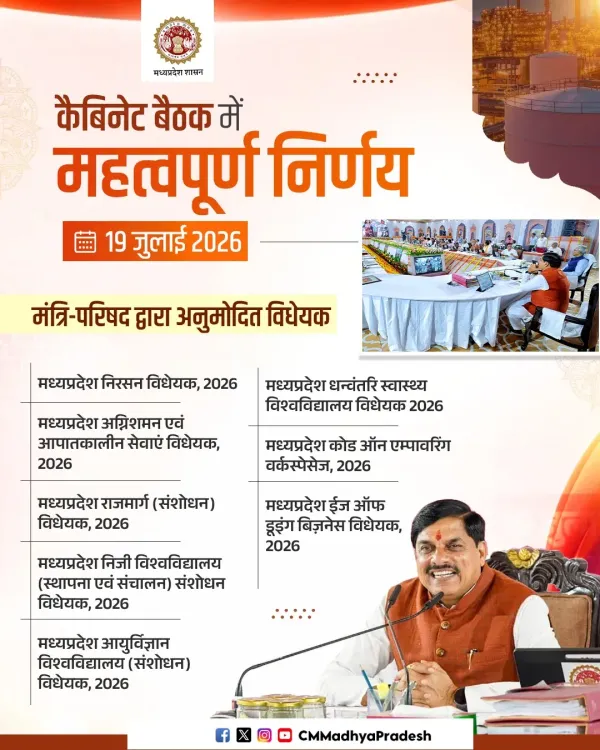
The Chief Minister's Office of Madhya Pradesh officially linked the state cabinet to the Uniform Civil Code agenda on 19 July 2026 .
Mohan Yadav , in office since December 2023 , was directly tagged in the communication under #CabinetMP and #UniformCivilCode .
Uttarakhand enacted India's first state-level UCC in February 2024 , establishing the legislative template other BJP states are examining.
The BJP has carried UCC as a national manifesto commitment since 2014 , and multiple BJP-governed states have since explored their own frameworks.
Primary stakeholders include religious minority communities and women's rights groups , who hold divergent positions on the code's implications.
A potential UCC bill in the Madhya Pradesh Legislative Assembly is the key legislative milestone to watch.
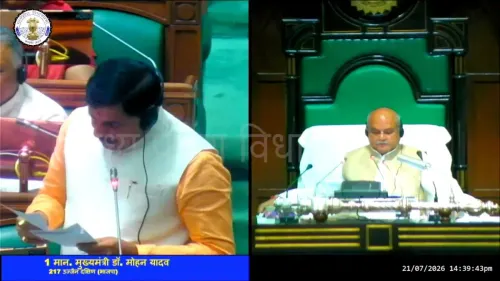
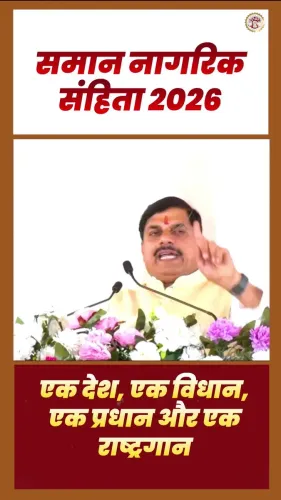
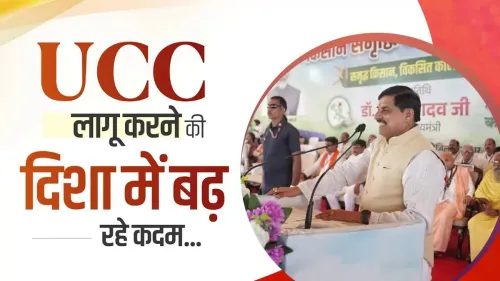
The Chief Minister's Office of Madhya Pradesh posted on Sunday, 19 July 2026, signalling that the Madhya Pradesh Cabinet has taken up the matter of the Uniform Civil Code (UCC), tagging Chief Minister Dr. Mohan Yadav in an official communication under the hashtags #CabinetMP and #UniformCivilCode.
Context
The post, originating from the verified handle of the Chief Minister's Office of Madhya Pradesh, links the state cabinet directly to the UCC agenda. The use of official hashtags #CabinetMP and #UniformCivilCode alongside the Chief Minister's personal handle suggests a formal cabinet-level engagement with the proposal, though the specific decisions or agenda items discussed have not been publicly detailed in this communication.
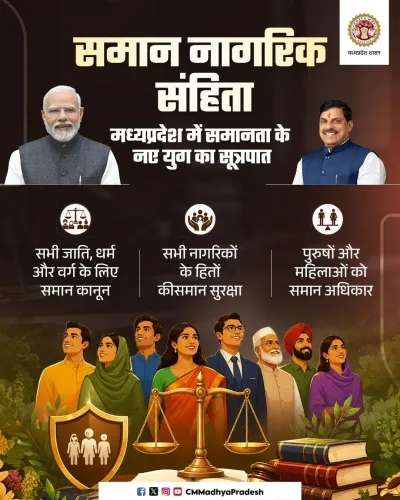
The Uniform Civil Code envisions a single set of civil laws — governing marriage, divorce, inheritance, and adoption — applicable to all citizens regardless of religion, replacing the current system of religion-specific personal laws.
Policy Backdrop
The Bharatiya Janata Party (BJP) has carried the UCC as a core manifesto commitment since at least 2014, reaffirming it in 2019. The promise moved from electoral pledge to legislative reality when Uttarakhand became the first Indian state to enact a UCC law in February 2024, setting a precedent for other BJP-governed states.
Madhya Pradesh, a BJP stronghold led by Dr. Mohan Yadav since December 2023, has been among the states closely watched for similar legislative action. Multiple BJP-ruled states have since explored or advanced their own UCC proposals, reflecting a coordinated push to institutionalise the framework at the state level ahead of any central legislation.
Stakeholders and Impact
Religious minority communities across Madhya Pradesh have historically been the most directly affected constituency in UCC debates, as the code would replace personal laws rooted in religious tradition. Women's rights organisations, by contrast, have largely supported a uniform framework as a vehicle for gender-equal inheritance and divorce rights.
Any formal UCC legislation in Madhya Pradesh — home to a population of over 8.5 crore — would represent one of the most significant state-level implementations of the policy, given the state's demographic and political weight within the BJP's national strategy.
What's Next
Political observers will watch for the introduction of a formal UCC bill in the Madhya Pradesh Legislative Assembly and any advisory or model framework that the central government may issue to guide state-level implementation. The Madhya Pradesh Cabinet's engagement with the issue at this stage suggests the state government is in an active deliberation phase rather than a preliminary one.
Should Madhya Pradesh advance legislation, it would become the second BJP-governed state after Uttarakhand to enact a UCC, potentially accelerating parallel efforts in other states and intensifying the national debate ahead of the next general election cycle.
Point of View
Using Uttarakhand's 2024 law as a replicable model. With a large and politically significant state like Madhya Pradesh now in deliberation, the pressure on other BJP-governed states to follow suit will intensify. The timing — mid-2026, well ahead of the next electoral cycle — suggests the party is building a legislative record on the UCC rather than using it purely as a campaign promise. How the Madhya Pradesh government handles minority community concerns and potential legal challenges will shape the national template for UCC implementation.
NationPress
18 Oct 2026
Frequently Asked Questions
What is the Uniform Civil Code and why is Madhya Pradesh discussing it?
The Uniform Civil Code is a proposed single set of civil laws on marriage, divorce, inheritance, and adoption that would apply to all citizens regardless of religion. Madhya Pradesh's BJP-led cabinet has taken it up as part of the party's long-standing national commitment to replace religion-specific personal laws.
Has any Indian state already enacted a Uniform Civil Code?
Yes. Uttarakhand became the first Indian state to enact a UCC law in February 2024, setting a legislative precedent that BJP-governed states including Madhya Pradesh are now examining.
Who is the Chief Minister of Madhya Pradesh in 2026?
Dr. Mohan Yadav of the BJP has been Chief Minister of Madhya Pradesh since December 2023.
What happens if Madhya Pradesh passes a UCC bill?
Madhya Pradesh would become the second BJP-governed state after Uttarakhand to enact a UCC, significantly expanding the law's geographic reach and likely accelerating similar efforts in other states.
Who are the main stakeholders affected by the Uniform Civil Code in Madhya Pradesh?
Religious minority communities, whose personal laws would be replaced, and women's rights groups, many of whom support the code for its gender-equal provisions on inheritance and divorce, are the principal stakeholders in the UCC debate.