Bihar's ₹3,936 crore Khagaria-Purnea highway to boost farm belt
Synopsis
A ₹3,936 crore CCEA-approved highway project will four-lane the Khagaria–Purnea stretch of NH-31 and NH-231 in Bihar — halving travel times and, critically, giving banana and makhana farmers a fighting chance against spoilage and market delays. The corridor also stitches together five Gati Shakti economic nodes and 11 logistics hubs, making it one of the most consequential road investments in eastern Bihar in years.
Key Takeaways
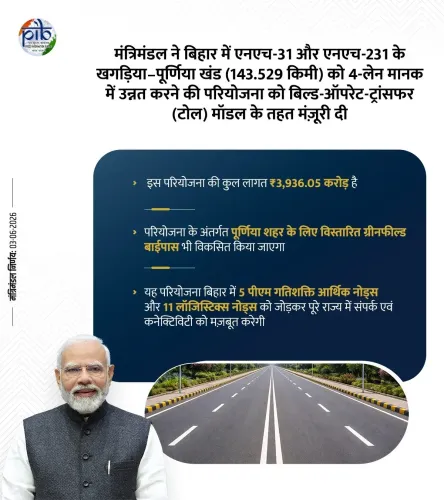
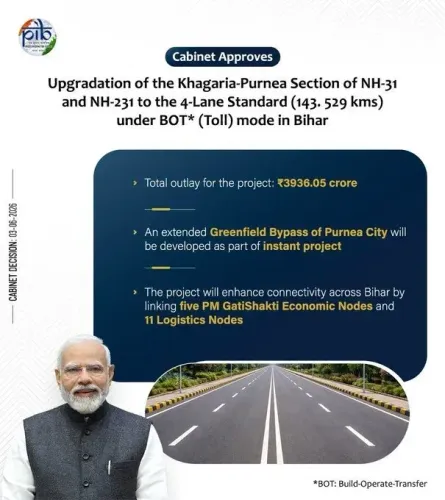
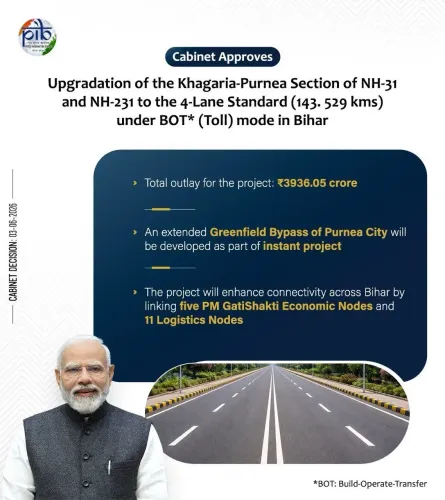
The CCEA has approved a ₹3,936.05 crore project to four-lane the Khagaria–Purnea section of NH-31 and NH-231 in Bihar .
Travel time along the corridor is projected to fall from 3.5–4 hours to 1.5–2 hours once complete.
The highway will directly benefit banana farmers in Khagaria and makhana producers in Purnea by reducing transit times and spoilage.
Flood-resilience features — improved drainage, stronger pavements, better road geometry — address chronic Kosi and Ganga flood disruptions.
The corridor connects 5 PM Gati Shakti Economic Nodes and 11 logistics nodes , including four railway stations and one airport.
The upgraded road will strengthen interstate links between Bihar , West Bengal , and Jharkhand .
The Cabinet Committee on Economic Affairs (CCEA) has approved a ₹3,936.05 crore project to upgrade the Khagaria–Purnea section of NH-31 and NH-231 to a four-lane highway in Bihar, according to a government factsheet released on 19 July. The Ministry of Road Transport and Highways says the corridor will transform agricultural supply chains across the state's eastern heartland, cutting travel times and reducing post-harvest losses for farmers.
What the Project Covers
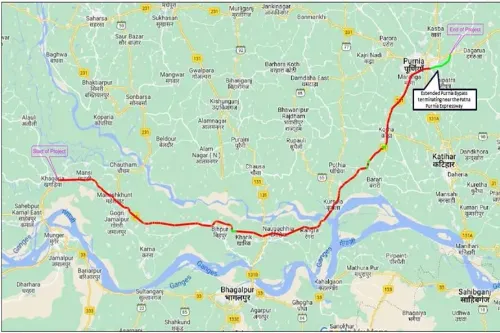
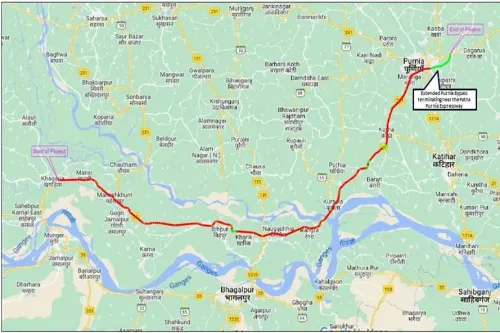
The upgraded corridor will span districts of Khagaria, Bhagalpur, Katihar, and Purnea, converting a congested two-lane stretch into a four-lane highway. The project addresses longstanding bottlenecks — sharp curves, insufficient road geometry, and chronic congestion through densely populated urban and semi-urban stretches — that have long impeded the movement of people and goods.
Once operational, journeys that currently take 3.5 to 4 hours along this corridor are expected to be completed in 1.5 to 2 hours, according to the government's projections.
Why Farmers Stand to Gain
Eastern Bihar's agricultural economy hinges on two highly perishable and high-value commodities: bananas from Khagaria and makhana (fox nuts) from Purnea, one of the country's largest makhana-producing hubs. Pre-dawn truck convoys carrying these crops currently battle traffic snarls and seasonal road damage, inflating transit times and spoilage rates.
For banana growers, where every hour in transit affects shelf life and market price, faster and more reliable road access is expected to minimise spoilage, preserve quality, and improve farm-gate realisations. The government factsheet frames the ₹3,936.05 crore outlay as an investment in the livelihoods of farmers, not merely a road project.
Flood Resilience Built In
Eastern Bihar's transport network has historically been among the most flood-vulnerable in the country, with the Kosi and Ganga river systems regularly disrupting road connectivity during the monsoon. The four-laning plan incorporates engineering interventions — improved road geometry, strengthened pavement structures, and modern drainage systems — specifically designed to enhance the highway's resilience against recurring flood-related disruptions, enabling more reliable year-round movement of goods and people.
Strategic and Multimodal Connectivity
Beyond Bihar, the Khagaria–Purnea corridor carries strategic value for interstate connectivity across eastern India. The upgraded highway will strengthen road links between Bihar and West Bengal while improving access to Jharkhand through the broader National Highway network.
The project will also integrate five PM Gati Shakti Economic Nodes — including one textile cluster, two mega food parks, and two fishing and seafood parks — along with 11 logistics nodes comprising four major railway stations, one airport, four National Highways, and two State Highways. This multimodal integration is central to the government's pitch that the corridor will unlock economic value well beyond the road itself.
Seemanchal's Developmental Dividend
The Seemanchal region — encompassing districts such as Khagaria, Katihar, and their neighbours — has long faced developmental challenges tied to limited connectivity. Residents currently endure significantly longer travel times to administrative, educational, and economic centres compared with other parts of Bihar. The upgraded corridor is expected to reduce this accessibility gap, improving regional mobility and linking Seemanchal more effectively with Patna and markets beyond state borders.
With CCEA approval secured, the project now moves toward tendering and implementation, with the corridor's completion set to reshape eastern Bihar's economic geography.
Point of View
But its value depends on whether the logistics hubs it connects are themselves operational when the road opens — a coordination challenge the government has yet to address publicly.
NationPress
18 Oct 2026
Frequently Asked Questions
What is the Khagaria–Purnea highway project approved by CCEA?
It is a ₹3,936.05 crore project approved by the Cabinet Committee on Economic Affairs to upgrade the Khagaria–Purnea section of NH-31 and NH-231 in Bihar from two lanes to four lanes. The project aims to improve agricultural supply chains, reduce travel times, and strengthen interstate connectivity across eastern India.
How will the highway benefit Bihar's farmers?
The upgraded highway will significantly reduce transit times for perishable crops like bananas from Khagaria and makhana from Purnea, minimising spoilage and improving market realisations. Faster, more reliable connectivity is expected to directly raise farm incomes by reducing post-harvest losses.
How much will travel time reduce on this corridor?
Journeys along the Khagaria–Purnea corridor that currently take 3.5 to 4 hours are expected to be completed in 1.5 to 2 hours once the four-laned highway is operational, according to government projections.
How does the project address flooding in eastern Bihar?
The project incorporates engineering interventions including improved road geometry, strengthened pavement structures, and modern drainage systems designed to enhance resilience against recurring floods from the Kosi and Ganga river systems, enabling more reliable year-round transport.
Which economic nodes and logistics hubs does the corridor connect?
The upgraded corridor links five PM Gati Shakti Economic Nodes — one textile cluster, two mega food parks, and two fishing and seafood parks — along with 11 logistics nodes including four major railway stations, one airport, four National Highways, and two State Highways.