Cabinet Raises MSP for Rabi Crops 2027-28, Safflower Tops Hike
Synopsis
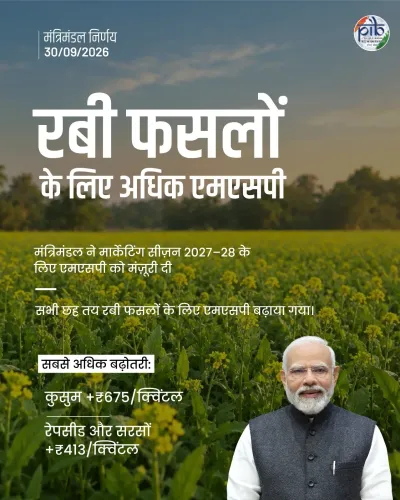
The Union Cabinet, chaired by PM Narendra Modi, has approved MSP hikes for all mandated Rabi crops for Marketing Season 2027–28. Safflower leads with a ₹675/quintal increase, followed by Rapeseed and Mustard at ₹413/quintal, Masur at ₹390, Barley at ₹136, Gram at ₹83, and Wheat at ₹25 per quintal.
Key Takeaways
The Union Cabinet chaired by PM Narendra Modi approved MSP hikes for all mandated Rabi crops for Marketing Season 2027–28 .
Safflower received the highest absolute increase at ₹675 per quintal .
Rapeseed and Mustard MSP was raised by ₹413 per quintal , benefiting oilseed farmers.
Lentil (Masur) was hiked by ₹390/quintal ; Barley by ₹136/quintal ; Gram by ₹83/quintal .
Wheat MSP was raised by ₹25 per quintal , balancing grower returns against public distribution costs.
The government's MSP policy is anchored to a 2018 commitment to set prices at least 1.5 times the cost of production .
Rabi farmers across India woke up to a significant price guarantee on Wednesday, September 30, 2026, as the Union Cabinet, chaired by Prime Minister Narendra Modi, approved higher Minimum Support Prices for all mandated Rabi crops for Marketing Season 2027–28 — a move that directly sets the floor under the incomes of millions of cultivators heading into the sowing season. Union Road Transport and Highways Minister Nitin Gadkari shared the decision on X, flagging the crop-wise breakdown.
Safflower and Mustard Lead the Upward Push
The sharpest absolute jump belongs to Safflower, which received an increase of ₹675 per quintal — the highest of all the Rabi crops covered this cycle. Right behind it, Rapeseed and Mustard saw an increase of ₹413 per quintal, a meaningful boost for farmers in oilseed-growing belts of Rajasthan, Madhya Pradesh, and Haryana. The government's framing is explicit: these increases are designed to ensure 'remunerative prices' and strengthen farmer income security heading into the next marketing season.
Wheat, Gram, Masur, and Barley: The Staple Crops' Numbers
For the crops that define the Rabi calendar at scale, the revisions are more calibrated. Lentil (Masur) received the next-largest hike at ₹390 per quintal, followed by Barley at ₹136 per quintal and Gram at ₹83 per quintal. Wheat — arguably the single most politically and nutritionally consequential Rabi crop in India — was raised by ₹25 per quintal. The relatively modest wheat hike reflects the government's dual obligation: protect grower incomes while managing procurement costs for the public distribution system that feeds hundreds of millions.
The 1.5x Cost Pledge That Frames Every MSP Announcement
This decision sits inside a policy commitment the Cabinet formalised in 2018: MSP must be set at a minimum of 1.5 times the cost of production for covered crops. Each annual revision is, in effect, a renewal of that pledge — calibrated against shifting input costs like fuel, fertiliser, and labour. The MSP mechanism does not compel private buyers to pay the floor price, but it anchors government procurement rates and signals market expectations for the season ahead. Procurement agencies typically begin operations once the harvest arrives, making today's numbers the starting gun for planning across the agricultural supply chain.
What Rabi Farmers and Markets Will Be Watching
The practical test of these MSPs arrives during the 2027–28 marketing season when procurement actually begins. The gap between announced MSP and effective market arrivals at mandis will determine whether the increases translate into real income gains. For oilseed farmers — particularly those growing safflower and mustard — the larger absolute hikes signal government intent to push domestic edible-oil production at a time when India remains significantly import-dependent on vegetable oils. That macro linkage gives today's numbers a weight beyond the fields alone.
MSP revisions are annual arithmetic, but the political and agricultural arithmetic behind them is never simple — and for the farmers sowing in the weeks ahead, these numbers are the only guarantee they have.
Point of View
A procurement commitment, and an electoral message to farming communities. The outsized hike for Safflower and Mustard underscores a strategic priority: reducing India's dependence on imported edible oils by incentivising domestic oilseed cultivation, a push that has been visible across multiple policy cycles. The modest wheat hike, by contrast, reflects the fiscal tightrope the government walks — it must sustain affordable grain procurement for the public distribution system while still claiming to protect farmer incomes. Whether these MSPs deliver real benefit depends entirely on the reach and scale of government procurement operations during the 2027–28 marketing season.
NationPress
30 Sept 2026
Frequently Asked Questions
What is the MSP hike for wheat in 2027-28?
The Union Cabinet approved an increase of ₹25 per quintal in the Minimum Support Price for wheat for Marketing Season 2027–28.
Which Rabi crop got the highest MSP increase in 2027-28?
Safflower received the highest absolute MSP increase at ₹675 per quintal for Marketing Season 2027–28.
What is the MSP hike for mustard in 2027-28?
The MSP for Rapeseed and Mustard was increased by ₹413 per quintal for Marketing Season 2027–28.
What crops are covered under the Rabi MSP announcement?
The Cabinet announcement covers Wheat, Gram, Lentil (Masur), Barley, Rapeseed and Mustard, and Safflower — all mandated Rabi crops for the 2027–28 marketing season.
What is India's government policy on MSP and cost of production?
Since 2018 , the Union Cabinet committed to setting MSP at a minimum of 1.5 times the cost of production for covered crops, a benchmark applied during each annual revision.