Gadkari: Cabinet OKs ₹6,970 Cr Dwarka–Vasant Kunj Tunnel
Synopsis
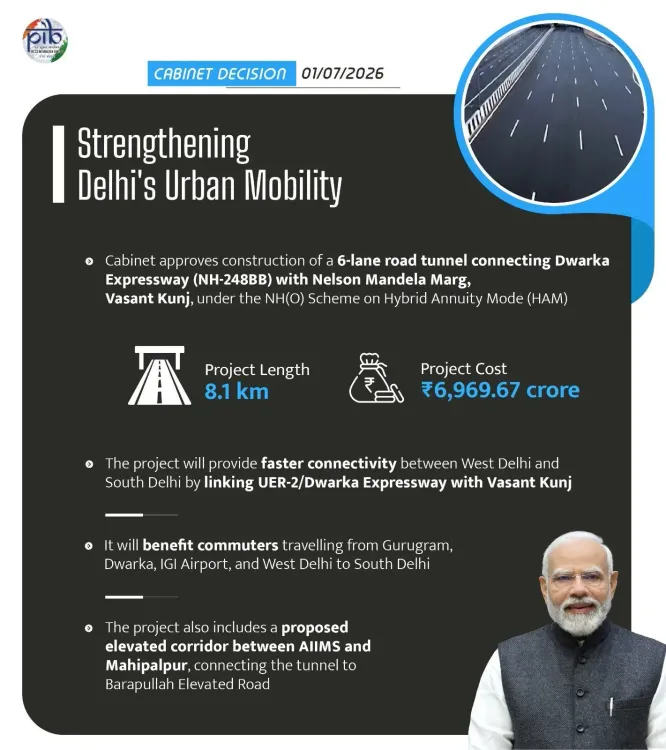
The Union Cabinet has approved an 8.1 km, 6-lane tunnel on NH-148AE connecting Dwarka Expressway to Nelson Mandela Marg, Vasant Kunj at ₹6,969.67 crore under HAM, featuring a 3.1 km twin-tube tunnel and an indigenous 13.8-metre TBM to ease Delhi-NCR congestion.
Key Takeaways
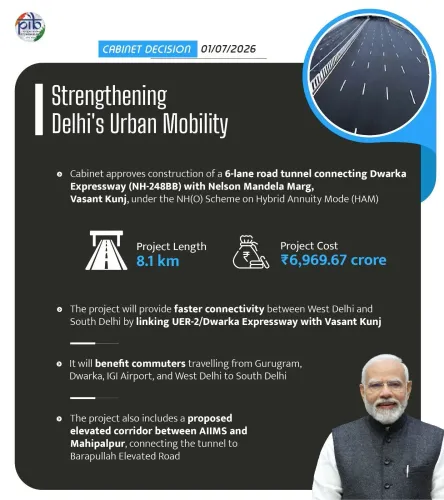
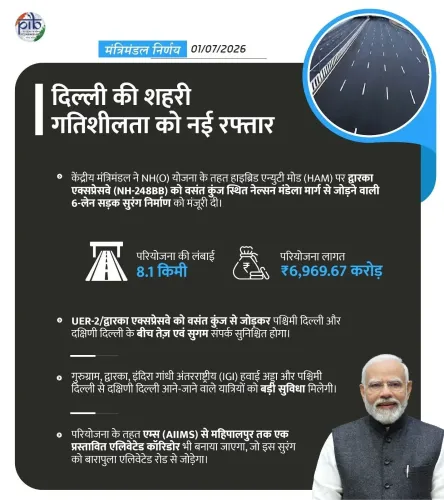
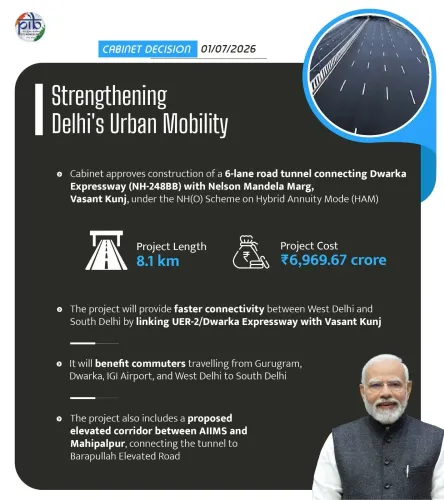
The Union Cabinet approved an 8.1 km, 6-lane tunnel on NH-148AE at a total capital cost of ₹6,969.67 crore .
The project will be executed under the Hybrid Annuity Model (HAM) , combining government and private funding.
It includes five flyovers and a 3.1 km twin-tube tunnel with three lanes per tube.
An indigenous 13.8-metre diameter Tunnel Boring Machine (TBM) will be deployed, reflecting the domestic manufacturing push.
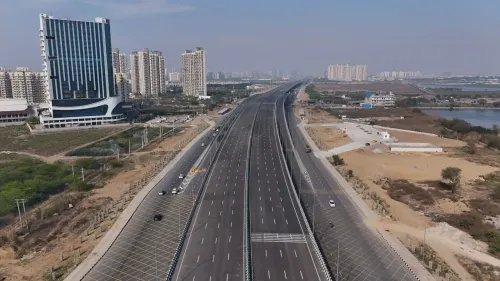
The corridor links Dwarka Expressway to South Delhi , the Outer Ring Road , and Mehrauli–Badarpur Road .
The project aims to divert traffic bound for Noida , Faridabad , Ghaziabad , and East Delhi , reducing NCR-wide congestion.
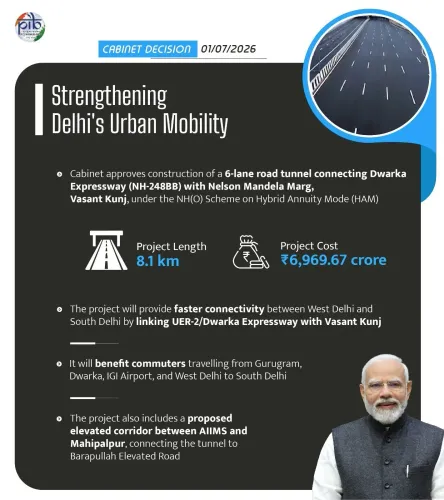
Union Road Transport and Highways Minister Nitin Gadkari announced on Wednesday, 1 July 2026 that the Union Cabinet, chaired by Prime Minister Narendra Modi, has approved the construction of an 8.1 km, 6-lane tunnel on NH-148AE connecting the Dwarka Expressway (NH-248BB) with Nelson Mandela Marg, Vasant Kunj, Delhi, at a total capital cost of ₹6,969.67 crore under the Hybrid Annuity Model (HAM).
Context
Gadkari described the project as 'a transformative step towards seamless, future-ready connectivity in the National Capital Region.' The approved corridor includes five flyovers — among them one elevated U-turn — and a 3.1 km twin-tube tunnel with three lanes in each tube. A key engineering highlight is the deployment of an indigenous 13.8-metre diameter Tunnel Boring Machine (TBM), continuing the government's push for domestic manufacturing in large-scale infrastructure.
The tunnel will directly link the Dwarka Expressway to South Delhi, and further connect to the Outer Ring Road and Mehrauli–Badarpur Road via the Mahipalpur–Mehrauri corridor. It is also designed to divert traffic bound for Noida, Faridabad, Ghaziabad, and parts of East Delhi.
Policy Backdrop
The project sits within the broader Bharatmala Pariyojana, approved in 2015, which targets development of 34,800 km of national highways including urban expressways. The Hybrid Annuity Model, introduced in 2016, splits project funding between government grants and private-sector annuity payments, reducing upfront fiscal burden while attracting private investment.
The clearance also aligns with the PM Gati Shakti National Master Plan, launched in 2021, which mandates multimodal infrastructure planning and inter-ministerial coordination. The National Highways Authority of India (NHAI) has progressively introduced large-diameter indigenous TBMs in highway projects since 2020, and this project extends that trend to one of the country's most congested urban corridors.
Stakeholders and Impact
Daily commuters on the Dwarka Expressway — one of Delhi-NCR's busiest arterial routes — stand to benefit most directly. The corridor serves millions of residents across Dwarka, Gurugram, and South Delhi, and chronic bottlenecks at the expressway's northern terminus have long been a pain point for highway users.
By channelling through-traffic headed to Noida, Faridabad, and Ghaziabad away from surface roads, the tunnel is expected to reduce congestion across multiple arterial corridors simultaneously. Residents of Vasant Kunj, Mahipalpur, and Mehrauli neighbourhoods are likely to see measurable improvements in local traffic flow once the project is operational.
What's Next
The immediate steps will involve NHAI initiating the tendering process under the Hybrid Annuity Model, followed by land acquisition and mobilisation of the TBM. Integration with the Mahipalpur–Mehrauli corridor and any linked Outer Ring Road upgrades will be closely watched as detailed project reports are finalised.
If executed on schedule, the project would represent one of the largest urban tunnel investments in Delhi's road infrastructure history, reinforcing the central government's strategy of deploying grade-separated corridors to future-proof the capital's highway network.
Point of View
Moving beyond surface expressways to expensive but high-capacity grade-separated infrastructure in the heart of the capital. At nearly ₹7,000 crore for a single 8.1 km stretch, it signals that the government is willing to absorb substantial fiscal commitments to resolve structural bottlenecks in Delhi-NCR. The use of HAM and an indigenous TBM simultaneously advances two policy objectives — private-sector leverage and 'Make in India' in heavy engineering — making this a template project. The political timing, announced under the PM Gati Shakti banner, also reinforces the ruling coalition's infrastructure-as-governance narrative ahead of any electoral cycle.
NationPress
30 Sept 2026
Frequently Asked Questions
What is the Dwarka Expressway tunnel project approved by the Cabinet?
The Union Cabinet approved an 8.1 km, 6-lane tunnel on NH-148AE connecting the Dwarka Expressway (NH-248BB) with Nelson Mandela Marg, Vasant Kunj in Delhi at a total cost of ₹6,969.67 crore. The project includes five flyovers and a 3.1 km twin-tube tunnel with three lanes in each tube.
What is the Hybrid Annuity Model used for this tunnel?
The Hybrid Annuity Model (HAM) is a public-private partnership structure introduced in 2016 for highway construction. The government provides a portion of project cost as grants during construction, while the private developer recovers the remainder through annuity payments over the concession period, reducing upfront fiscal pressure.
How will the Dwarka–Vasant Kunj tunnel reduce traffic in Delhi?
The tunnel will provide a direct, grade-separated link between the Dwarka Expressway and South Delhi, diverting through-traffic headed to Noida, Faridabad, Ghaziabad, and East Delhi away from congested surface roads, and connecting to the Outer Ring Road and Mehrauli–Badarpur Road.
What is the indigenous Tunnel Boring Machine being used in this project?
The project will deploy an indigenous 13.8-metre diameter Tunnel Boring Machine (TBM) manufactured in India. NHAI has been progressively introducing large-diameter domestic TBMs in highway projects since 2020 as part of the government's push for self-reliance in heavy infrastructure equipment.
How does this project connect to PM Gati Shakti?
The tunnel project aligns with the PM Gati Shakti National Master Plan, launched in 2021, which coordinates multimodal infrastructure planning across ministries. The Dwarka–Vasant Kunj corridor integrates road connectivity across multiple arterial routes in the NCR within this framework.