Giriraj Singh Backs Cabinet Nod for Delhi Tunnel, UP Highway
Synopsis
The Union Cabinet has approved a 6-lane tunnel linking Dwarka Expressway to Nelson Mandela Marg, Vasant Kunj in Delhi, and an access-controlled national highway on the Kanpur–Kabrai corridor in Uttar Pradesh. Union Textiles Minister Giriraj Singh hailed the decisions as a step toward world-class connectivity under the Viksit Bharat vision.
Key Takeaways
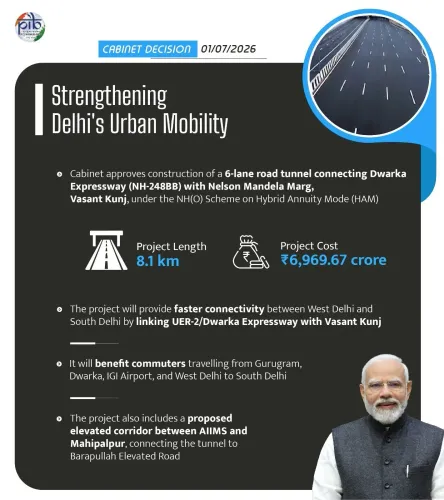
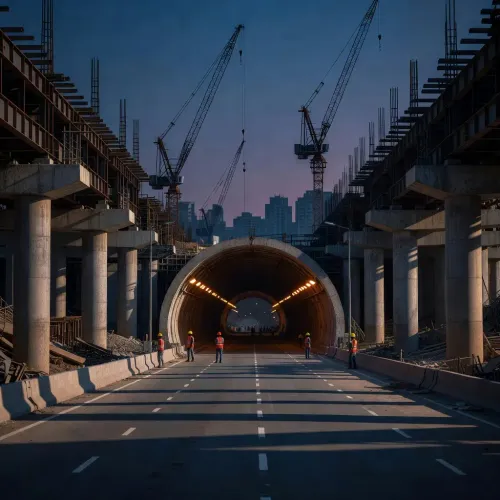
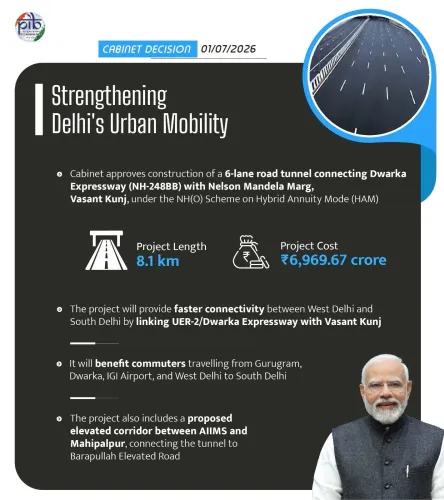
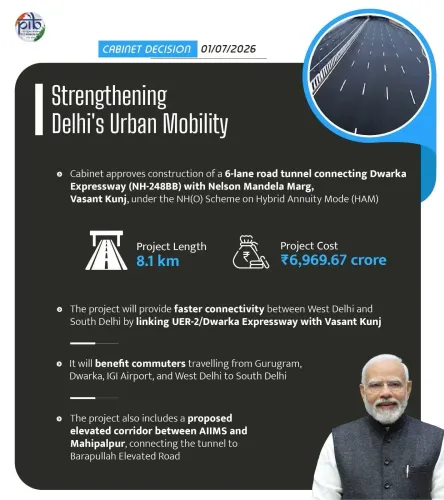
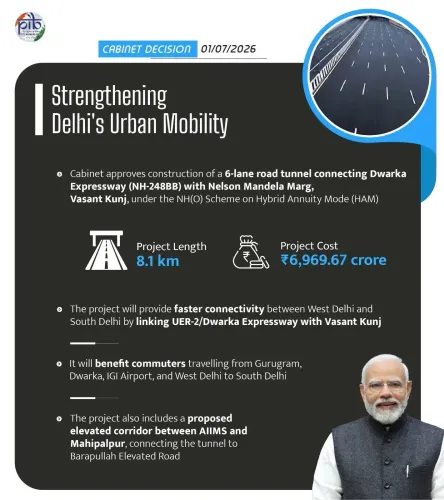
The Union Cabinet approved a 6-lane tunnel connecting Dwarka Expressway to Nelson Mandela Marg, Vasant Kunj in Delhi .
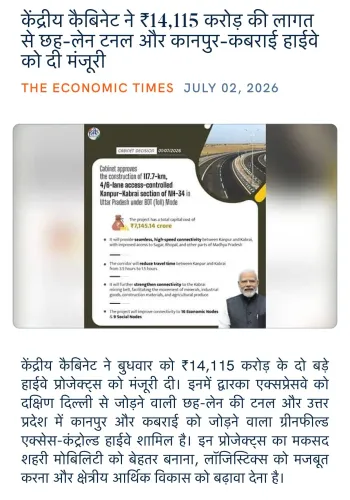
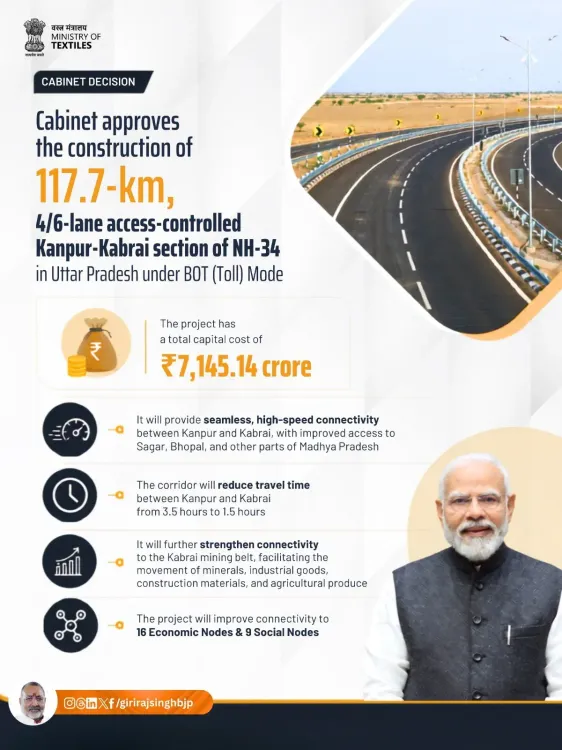
A separate Kanpur–Kabrai access-controlled national highway project in Uttar Pradesh also received Cabinet clearance.
Union Textiles Minister Giriraj Singh welcomed both approvals on 1 July 2026 , linking them to the Viksit Bharat vision.
Both projects align with the Bharatmala Pariyojana framework and the PM Gati Shakti National Master Plan .
The Delhi tunnel targets chronic congestion between Dwarka and South Delhi ; the UP corridor aims to boost connectivity in the Bundelkhand region.
Land acquisition and project sanction letters are the immediate next steps for both corridors.
Union Textiles Minister Giriraj Singh on Wednesday, 1 July 2026 welcomed the Union Cabinet's approval of two major road infrastructure projects: a 6-lane tunnel connecting Dwarka Expressway to Nelson Mandela Marg, Vasant Kunj in Delhi, and an access-controlled national highway on the Kanpur–Kabrai corridor in Uttar Pradesh, calling the decisions a boost to India's modern road network.
Posting on X, the senior BJP leader stated — 'केंद्रीय मंत्रिमंडल द्वारा दिल्ली में द्वारका एक्सप्रेसवे को नेल्सन मंडेला मार्ग, वसंत कुंज से जोड़ने वाली 6-लेन सुरंग परियोजना तथा उत्तर प्रदेश में कानपुर–कबरई एक्सेस-कंट्रोल्ड राष्ट्रीय राजमार्ग परियोजना को मंजूरी देश के आधुनिक सड़क नेटवर्क को नई गति देगी' — ['The Union Cabinet's approval of the 6-lane tunnel project connecting Dwarka Expressway to Nelson Mandela Marg, Vasant Kunj in Delhi and the Kanpur–Kabrai access-controlled national highway project in Uttar Pradesh will give new momentum to the country's modern road network.'] He added that under the leadership of Prime Minister Narendra Modi, the resolve of a Viksit Bharat (Developed India) is being continuously strengthened through world-class connectivity, smooth movement, reduced travel time and robust infrastructure.
Context
The two projects cleared by the Union Cabinet address distinct but complementary connectivity gaps. The Delhi tunnel is designed to ease the chronic bottleneck between the Dwarka Expressway — a key artery linking the capital to Gurugram and Indira Gandhi International Airport — and the southern Delhi neighbourhood of Vasant Kunj via Nelson Mandela Marg. The Kanpur–Kabrai corridor, meanwhile, targets freight and passenger movement in the industrially significant Bundelkhand region of Uttar Pradesh.
The approvals follow an established pattern of the Cabinet greenlighting large-scale road and tunnel projects in the Delhi-NCR region and Uttar Pradesh, both of which have seen sustained central investment in expressway infrastructure over the past decade.
Policy Backdrop
Both projects sit within the broader architecture of Bharatmala Pariyojana, the national highway development programme approved in 2015 to build a network of expressways and economic corridors across India. The programme has since been complemented by the PM Gati Shakti National Master Plan, launched in 2021, which integrates multimodal infrastructure planning — roads, rail, ports and logistics — under a unified digital platform.
The Viksit Bharat framework, the government's overarching vision for a fully developed India by 2047, has placed world-class road connectivity at the centre of its economic integration agenda. Tunnel and access-controlled highway projects are prioritised for their ability to cut travel times, reduce logistics costs and open up hinterland markets.
Stakeholders and Impact
Daily commuters in Delhi's western and southern corridors stand to benefit most directly from the Dwarka–Vasant Kunj tunnel, which is expected to reduce travel time and ease peak-hour congestion on one of the capital's most traffic-dense stretches. Residents of Dwarka, one of Asia's largest planned residential sub-cities, have long sought better road linkages to the rest of South Delhi.
In Uttar Pradesh, the Kanpur–Kabrai access-controlled highway is expected to benefit the logistics sector, agricultural produce movement and industrial freight in the Bundelkhand belt, a region that has historically lagged in road infrastructure relative to western UP. Improved connectivity here could accelerate the state government's ongoing efforts to attract investment to the region.
What's Next
Following Cabinet sanction, the Ministry of Road Transport and Highways is expected to issue project sanction letters and initiate land acquisition proceedings for both corridors. Construction timelines and detailed project costs will be disclosed through official Ministry notifications and project-specific tenders.
For the Delhi tunnel, alignment finalisation and environmental clearances will be key milestones to watch. For the Kanpur–Kabrai corridor, land acquisition in Uttar Pradesh — historically a complex and time-consuming process for highway projects — will determine how quickly construction can begin. Both projects will be benchmarks for the government's ability to translate Cabinet approvals into on-ground progress ahead of the 2047 Viksit Bharat target.
Point of View
Making land acquisition timelines the critical variable to watch.
NationPress
30 Sept 2026
Frequently Asked Questions
What is the Delhi tunnel project approved by the Cabinet?
The Union Cabinet approved a 6-lane tunnel connecting Dwarka Expressway to Nelson Mandela Marg, Vasant Kunj in Delhi, aimed at reducing travel time and easing congestion between western and southern Delhi.
What is the Kanpur–Kabrai highway project?
The Kanpur–Kabrai project is an access-controlled national highway in Uttar Pradesh approved by the Union Cabinet to improve freight and passenger connectivity in the Bundelkhand region.
What is Viksit Bharat and how does it relate to these projects?
Viksit Bharat is the Indian government's vision for a fully developed India by 2047. Road connectivity projects like the Delhi tunnel and Kanpur–Kabrai corridor are cited as steps toward achieving this goal through reduced travel times and stronger infrastructure.
What is Bharatmala Pariyojana?
Bharatmala Pariyojana is a national highway development programme approved in 2015 to build expressways and economic corridors across India. Both the Delhi tunnel and Kanpur–Kabrai highway fall within its broader framework.
Why did Giriraj Singh comment on road infrastructure when he is the Textiles Minister?
Giriraj Singh is a senior BJP leader and Lok Sabha MP, and Cabinet decisions on national infrastructure are routinely welcomed by ministers across portfolios as part of the party's collective governance communication.