Karnataka's Shakti Scheme Crosses ₹14,875 Cr Spend
Synopsis
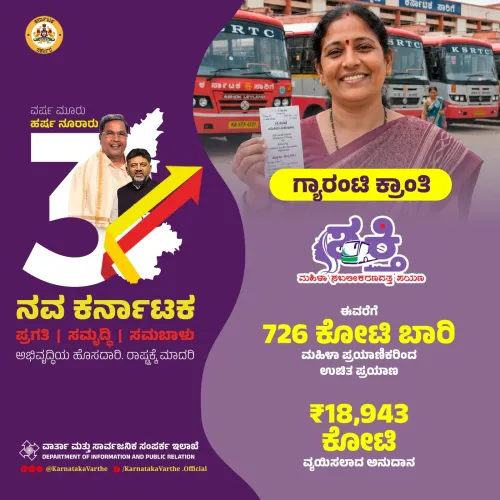
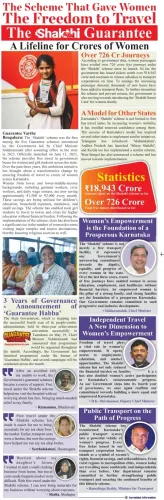
The Chief Minister's Office of Karnataka announced on Independence Day 2026 that the Shakti scheme — which provides free bus travel to women across the state — has crossed ₹14,875 crore in cumulative spending since its June 2023 launch, marking a major milestone in the Congress government's women's empowerment agenda.
Key Takeaways
The Shakti scheme has spent a cumulative ₹14,875 crore since its launch, as announced by the Chief Minister's Office of Karnataka on 15 August 2026 .
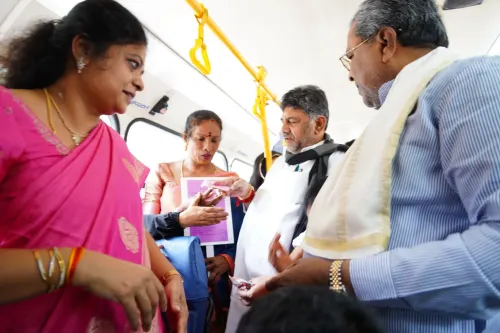
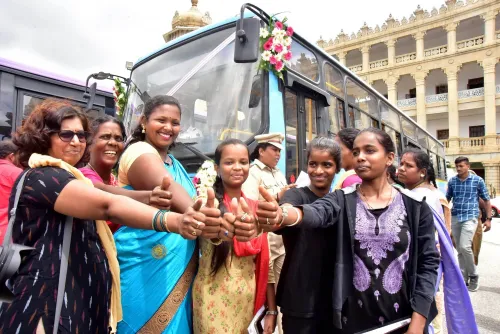
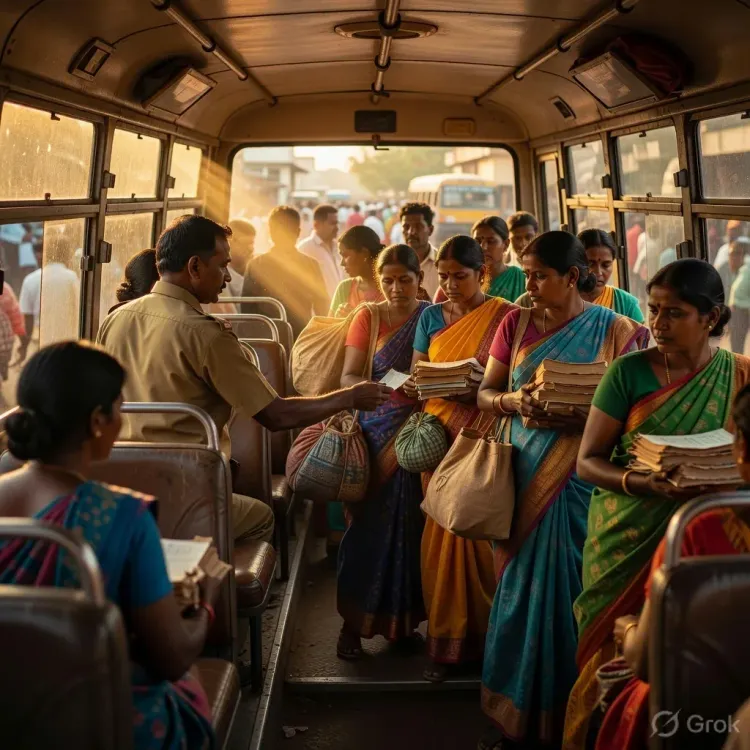
The scheme provides free travel for women on Karnataka's state-run buses , targeting students, working women, and daily commuters.
It was launched in June 2023 by the Siddaramaiah-led Congress government as part of the 2023-24 state budget.
Karnataka's model focuses on state road transport corporations , making it particularly impactful in semi-urban and rural areas.
Similar gender-targeted transport subsidies have been rolled out in Delhi, Tamil Nadu, and Telangana since 2019.
Independent evaluations of ridership growth and impact on women's workforce participation remain a key metric to watch in Karnataka's 2026-27 budget cycle .
Three years after it reshaped how millions of women move across Karnataka, the state's flagship Shakti scheme has crossed a cumulative expenditure of ₹14,875 crore — a figure the Chief Minister's Office of Karnataka announced on Independence Day, 15 August 2026, framing the milestone as freedom of a different kind: freedom from the cost of getting somewhere.
The post, shared in both Kannada and English, declared the scheme is advancing 'ಸ್ತ್ರೀ ಸಬಲೀಕರಣಕ್ಕೆ' ('women's empowerment') by enabling women to 'travel with greater freedom and participate more fully in education, employment and everyday life.' The Independence Day timing was deliberate — linking mobility to the larger promise of self-determination.
What Shakti actually does — and who it reaches
Launched in June 2023 by the Siddaramaiah-led Congress government as a centrepiece of its first state budget, the Shakti scheme provides free travel for women on Karnataka's state-run buses. The beneficiaries are specific and concrete: the college student who can now commute daily without calculating fare, the garment worker who pockets what she once spent on transport, the woman making a hospital visit she might otherwise have skipped.
Unlike comparable programmes in Delhi, Tamil Nadu, and Telangana — which extended subsidies to metro networks or private operators — Karnataka's model is anchored entirely in the state road transport corporations, making it most relevant in semi-urban and rural corridors where buses remain the primary mode of public transit.
A national pattern, a Karnataka price tag
The gender-targeted public transport subsidy is now a well-established policy instrument across Indian states. Beginning around 2019, several governments moved to address two overlapping problems at once: the safety concerns that discourage women from using public transit, and the stubborn gap in female labour-force participation. Karnataka's version is among the most expensive in absolute terms, with the ₹14,875 crore figure signalling both the scheme's scale and the state's fiscal commitment.
What independent evaluations of actual ridership growth or workforce impact look like — whether the spending has meaningfully shifted commuting patterns or employment numbers — will be a key question when Karnataka's 2026-27 budget documents are scrutinised.
For now, the number stands as a statement: in three years, Karnataka has spent more on women's mobility than most states spend on entire transport budgets. The question the next audit must answer is whether that investment is moving the needle — not just moving passengers.
Point of View
000 crore, Shakti is now one of the most expensive gender-targeted transport subsidies in Indian state history, and it signals that the Congress government is doubling down on its 'guarantee' model of welfare as an electoral and governance identity. The scheme fits a broader national pattern where female mobility is increasingly treated as a proxy metric for women's economic participation — but Karnataka's exclusive reliance on state bus networks means its impact is geographically uneven, strongest where private transport alternatives are weakest. The real test will come when independent ridership and labour-force data is placed alongside the expenditure figure.
NationPress
30 Sept 2026
Frequently Asked Questions
What is the Shakti scheme in Karnataka?
The Shakti scheme is a Karnataka government initiative launched in June 2023 that provides free travel for women on state-run buses, aimed at improving mobility, safety, and access to education and employment across the state.
How much has Karnataka spent on the Shakti scheme?
As of the announcement on 15 August 2026, Karnataka has spent a cumulative ₹14,875 crore on the Shakti scheme since its launch in June 2023.
Who benefits from the Shakti scheme?
The scheme benefits all women commuters in Karnataka, including female students, working women, and daily travellers who use Karnataka's state-run road transport corporation buses.
When was the Shakti scheme launched?
The Shakti scheme was formally launched in June 2023 by the Siddaramaiah-led Congress government, following its announcement in the 2023-24 Karnataka state budget.
Which other Indian states have similar free bus schemes for women?
Delhi, Tamil Nadu, and Telangana have rolled out comparable gender-targeted public transport subsidies since 2019, though Karnataka's scheme is focused specifically on state road transport corporation buses rather than metro or private operators.