CM Siddaramaiah Marks 3 Years of Shakti Scheme for Women
Synopsis
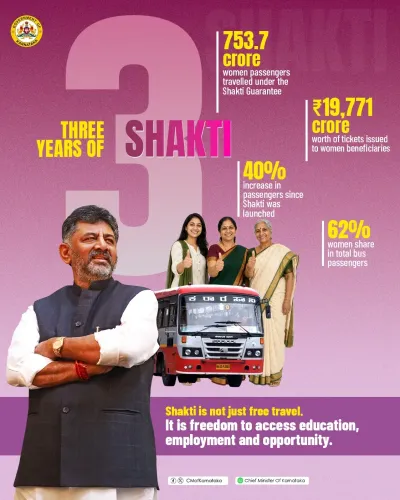
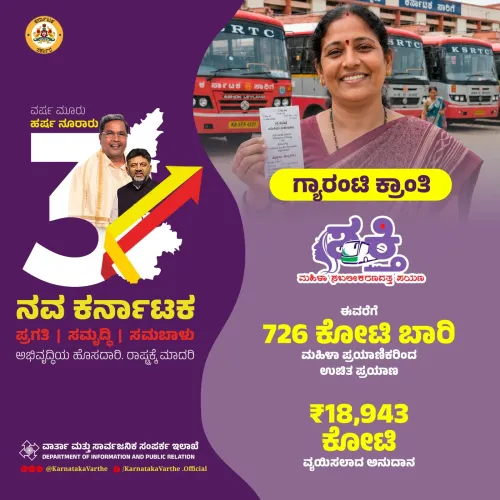
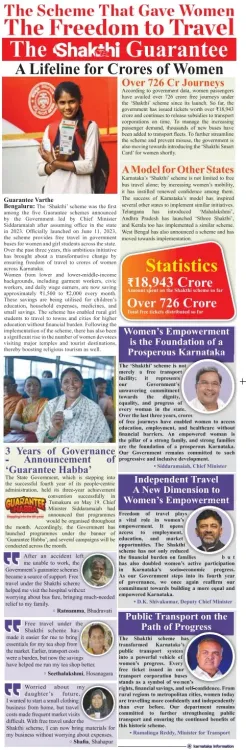
Karnataka Chief Minister Siddaramaiah marked three years of the Shakti Scheme on 22 May 2026, citing over 726 crore free journeys for women and ₹18,943 crore utilised. The Congress government's flagship welfare programme provides free bus travel to women across the state, aiming to boost mobility and economic independence.
Key Takeaways
Karnataka Chief Minister Siddaramaiah marked the third anniversary of the Shakti Scheme on 22 May 2026 .
The scheme has enabled over 726 crore free journeys for women on state-run buses since its 2023 launch.
Total expenditure under the programme stands at ₹18,943 crore as cited by the Chief Minister.
The Shakti Scheme is one of five guarantee schemes launched by the Karnataka Congress government after its 2023 assembly election victory.
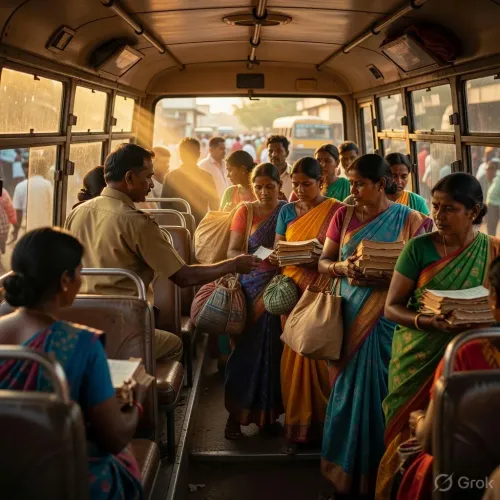
The programme is designed to improve women's mobility, safety, and access to economic opportunities across Karnataka .
Fiscal sustainability of the scheme and its impact on state transport corporations remain key points of public debate.
Karnataka Chief Minister Siddaramaiah on Friday, 22 May 2026 highlighted the Shakti Scheme's third anniversary, citing over 726 crore free journeys enabled for women across the state and a total expenditure of ₹18,943 crore under the programme since its launch in 2023.
Context
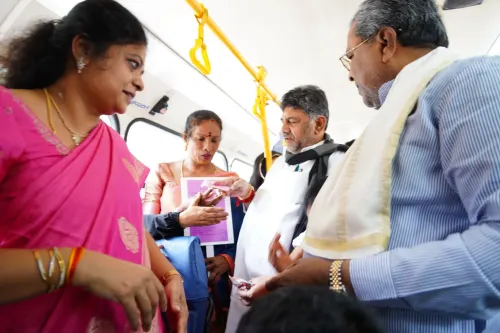
The Shakti Scheme was introduced by the Indian National Congress government in Karnataka as one of five guarantee schemes promised in its 2023 assembly election manifesto. The programme provides women with free travel on state-run buses, aiming to improve daily mobility, safety, and access to economic opportunities. Chief Minister Siddaramaiah stated that the scheme has 'given women the freedom to travel with dignity, safety and confidence.'
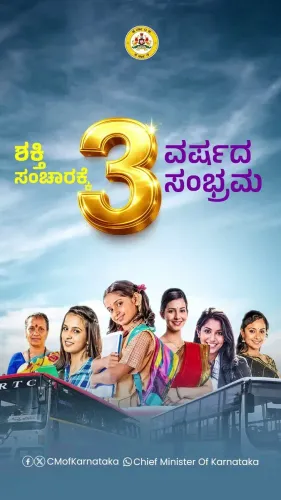
The anniversary falls under the campaign hashtag #3YearsOfNavaKarnataka, marking three years of the Congress government's welfare-focused agenda in the state. The ruling party has positioned the five guarantee schemes — of which Shakti is among the most visible — as a cornerstone of its governance record.
Policy Backdrop
Free and subsidised public transport for women has emerged as a significant policy instrument across several Indian states in recent years. Karnataka joins states such as Delhi and Tamil Nadu in deploying this model to advance gender equity and reduce household travel expenditure for lower-income families. The approach reflects a broader competitive dynamic in Indian electoral politics around women-focused welfare benefits.
The Shakti Scheme operates through Karnataka's state transport corporations, which bear the cost of free rides subsequently reimbursed by the state government. This model has sparked ongoing debate among fiscal analysts and opposition voices about long-term sustainability and the financial health of the transport undertakings involved.
Stakeholders and Impact
Women commuters — particularly daily wage earners, students, and domestic workers — form the primary beneficiary group of the Shakti Scheme. For many in semi-urban and rural parts of Karnataka, the programme has reduced a meaningful portion of monthly household transport costs. State transport corporations, meanwhile, have had to manage increased ridership alongside questions about fleet capacity and route coverage.
The Congress government has consistently framed the scheme as an empowerment measure rather than a subsidy, arguing that mobility is a prerequisite for women's participation in the workforce and public life. Critics, including opposition parties, have at various points raised concerns about the fiscal burden on state finances and the need for transparent accounting of reimbursements to transport bodies.
What's Next
Attention will now turn to forthcoming Karnataka state budget discussions and whether allocations for Shakti are maintained, expanded, or restructured. Any announcement extending the scheme to additional modes of transport — such as suburban rail or metro services — would mark a significant policy step. With the next Karnataka assembly elections on the horizon, the scheme's political salience is likely to grow, making its fiscal and operational performance a key point of scrutiny for all parties.
Point of View
Using the three-year mark to reinforce the Congress government's welfare narrative ahead of the next electoral cycle in Karnataka. By anchoring the message in large, tangible numbers — journeys enabled and rupees spent — the party signals delivery on its 2023 manifesto promises to women voters, a demographic that proved decisive in that election. The Shakti Scheme sits within a national pattern of state governments using free transport as a low-friction, high-visibility welfare instrument, and Karnataka's scale of rollout is among the more ambitious. Whether the scheme's fiscal trajectory becomes a liability or a continued asset will depend heavily on how the state manages transport corporation finances in upcoming budget cycles.
NationPress
20 Sept 2026
Frequently Asked Questions
What is the Shakti Scheme in Karnataka?
The Shakti Scheme is a Karnataka government initiative that provides free travel for women on state-run buses. It was launched in 2023 by the Indian National Congress government as one of five guarantee schemes to improve women's mobility, safety, and economic access.
How many free journeys have been made under Karnataka's Shakti Scheme?
According to Chief Minister Siddaramaiah , over 726 crore free journeys have been enabled for women under the Shakti Scheme since its launch in 2023 .
How much has Karnataka spent on the Shakti Scheme?
Chief Minister Siddaramaiah stated that ₹18,943 crore has been utilised under the Shakti Scheme since the programme began in 2023 .
Who benefits from the Shakti Scheme?
All women travelling on Karnataka state-run buses are eligible to travel free of charge under the Shakti Scheme . The programme particularly benefits daily wage earners, students, and domestic workers in urban, semi-urban, and rural areas.
Is the Shakti Scheme available in other states besides Karnataka?
The Shakti Scheme is specific to Karnataka . However, similar free or subsidised public transport schemes for women have been introduced in other Indian states, reflecting a wider national trend of gender-focused welfare programmes.