Smriti Irani Hails Pralay Missile Test as Leap in Defence Self-Reliance
Synopsis
BJP leader Smriti Irani praised the successful test of DRDO's indigenously developed Pralay solid-fuel quasi-ballistic missile on 6 November 2026, calling it a milestone in India's Aatmanirbhar Bharat push and congratulating DRDO scientists and the armed forces.
Key Takeaways
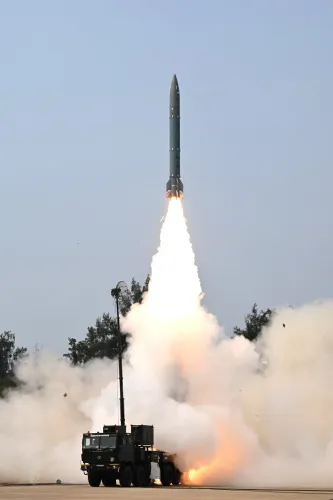
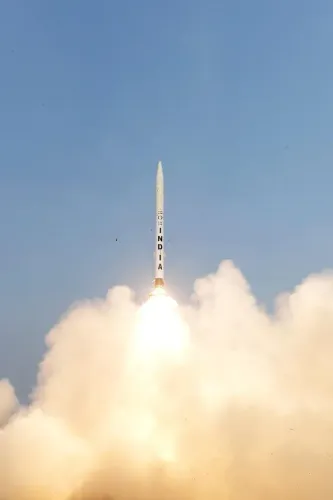
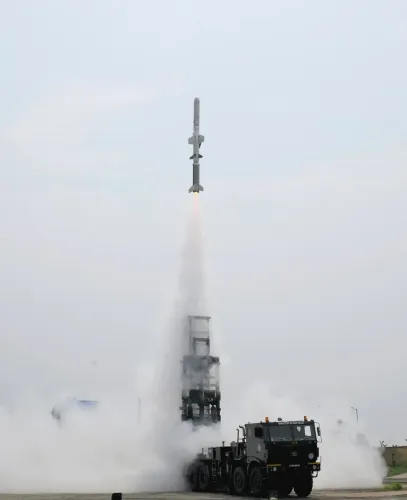
Pralay is a solid-fuel quasi-ballistic missile developed entirely by DRDO for short-range precision strikes from mobile launch platforms.
BJP leader Smriti Irani hailed the successful test on 6 November 2026 as a milestone in India's self-reliance drive.
Developmental trials of Pralay date to 2021 , with this test marking continued progress along the system's qualification arc.
The Aatmanirbhar Bharat Abhiyan , launched in May 2020 , set explicit targets for indigenous defence manufacturing that Pralay's development directly supports.
India's indigenous missile programme traces back to the Integrated Guided Missile Development Programme of the 1980s , with pace accelerating significantly post- 2014 .
Next milestones include Indian Army user trials, formal induction decisions, and possible private-sector technology transfer.
India's homegrown Pralay missile has cleared a successful test — and BJP leader Smriti Irani wasted no time marking the moment as a milestone in the country's drive toward strategic independence. In a post on X on 6 November 2026, the former Union Minister called the achievement 'a testament to scientific excellence, technological progress, and strategic preparedness' powering a stronger, self-reliant India.
What the Pralay Missile Means for India's Strike Arsenal
Pralay is a solid-fuel quasi-ballistic missile developed entirely within India, designed for short-range precision strikes and capable of being launched from a mobile platform — a critical tactical advantage in fast-moving battlefield scenarios. The Defence Research and Development Organisation (DRDO) conducted developmental trials of the system as far back as 2021, demonstrating its propulsion system and mobile-launch credentials. A successful test now marks measurable forward movement along that developmental arc.
Solid-fuel propulsion means the missile can be stored launch-ready for extended periods and deployed rapidly — exactly the kind of responsiveness modern armies demand. That design choice also shrinks the logistics tail, making Pralay distinctly more battlefield-practical than older liquid-fuelled alternatives.
Pralay Inside the Bigger Story of India's Missile Programme
India's indigenous missile journey stretches back to the Integrated Guided Missile Development Programme (IGMDP) of the 1980s, the ambitious effort that eventually produced Prithvi, Agni, Akash, Nag, and Trishul. Post-2014, policy incentives for domestic defence production accelerated the pace, drawing private-sector partners alongside DRDO's laboratories. Pralay fits neatly into the latest chapter of that decades-long story — a tactical precision-strike capability built entirely at home, without dependence on foreign suppliers.
The Aatmanirbhar Bharat Abhiyan, announced in May 2020, gave this trajectory an explicit policy frame, setting targets for indigenous defence manufacturing and slashing the list of items India would import. Tactical ballistic systems sat squarely on that import-substitution agenda. Every successful domestic test chips away at that dependence.
DRDO Scientists and Armed Forces Draw the Congratulations
Irani's post directed its warmest words at DRDO scientists and the armed forces — the two communities whose sustained, unglamorous work turns a blueprint into a fielded weapon. It is a reminder that behind every successful missile test are years of propulsion engineering, guidance-system calibration, and integration trials that rarely make headlines until the moment of success.
What comes next matters just as much as the test itself: user trials by the Indian Army, formal induction decisions, and potential technology-transfer arrangements with private-sector manufacturers will determine whether Pralay moves from a successfully tested system to a frontline operational capability at scale.
Point of View
And the political endorsement it draws, reinforces how indigenous defence capability has become a cross-cutting political asset in India — no longer the preserve of technical ministries but a headline achievement claimed across the government. For the BJP, every successful DRDO milestone is a data point in the larger Aatmanirbhar Bharat narrative, one that blends economic nationalism with hard-power credibility. The real test of that narrative, however, will come at the induction stage: a missile that completes trials but stalls on production orders or Army integration would leave the story half-told. Irani's congratulations signal political ownership of the achievement — which also means political accountability for what follows.
NationPress
6 Nov 2026
Frequently Asked Questions
What is the Pralay missile?
Pralay is an indigenously developed solid-fuel quasi-ballistic missile built by India's DRDO for short-range precision strike missions. It can be launched from mobile platforms, allowing rapid deployment, and was first tested in developmental trials in 2021.
What did Smriti Irani say about the Pralay missile test?
Smriti Irani called the successful test a 'testament to scientific excellence, technological progress, and strategic preparedness,' and offered heartiest congratulations to DRDO, its scientists, the armed forces, and all those involved in the achievement.
What is Aatmanirbhar Bharat in defence?
The Aatmanirbhar Bharat Abhiyan, launched in May 2020, includes an explicit focus on indigenous defence manufacturing. It set targets to reduce India's reliance on foreign weapons imports and promote domestic development of military platforms, missiles, and equipment.
What is DRDO and what role does it play in Indian defence?
DRDO, the Defence Research and Development Organisation, is India's primary agency for military technology development. It has built platforms ranging from missiles like Agni and Prithvi to radar systems and armoured vehicles, and is the lead developer of the Pralay missile.
What comes after the Pralay missile test?
Following a successful test, the next steps for Pralay typically include user trials conducted by the Indian Army, a formal induction decision, and potential technology-transfer agreements with private-sector defence manufacturers for large-scale production.