Rijiju: Cabinet clears 6-lane tunnel for Delhi connectivity
Synopsis
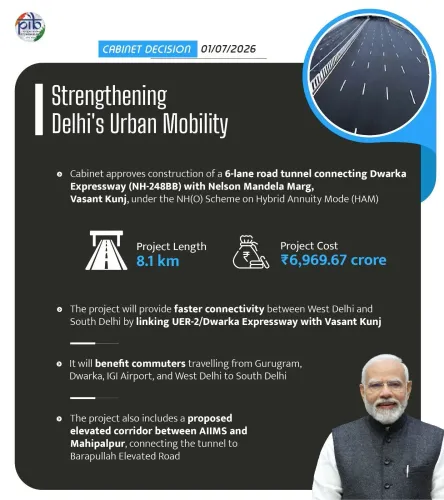
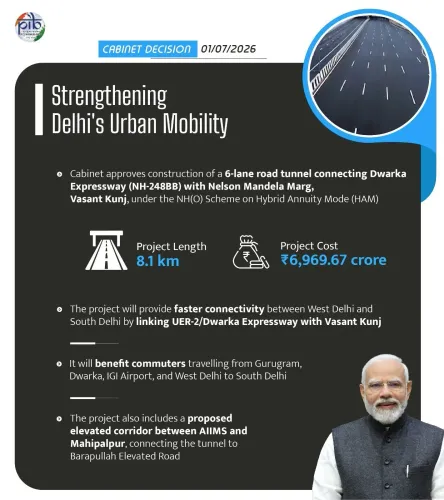
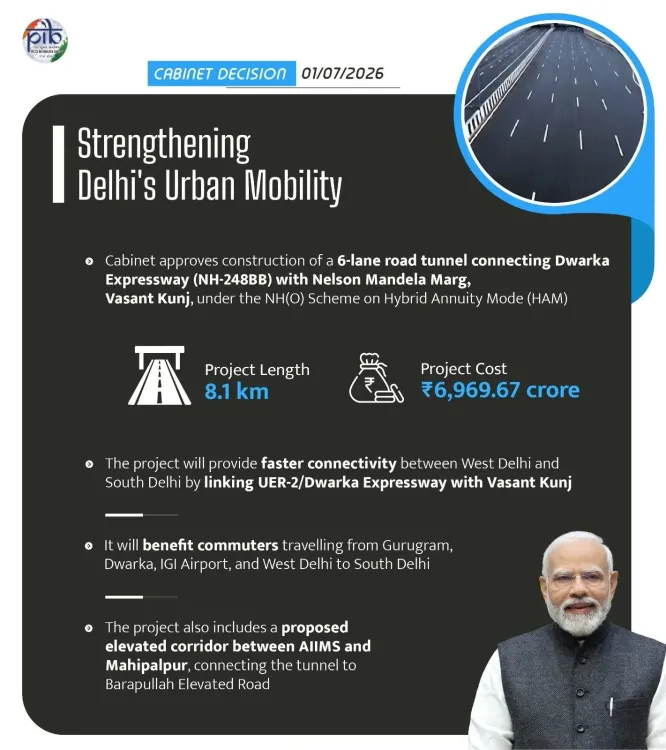
The Union Cabinet, under PM Narendra Modi, has approved a 6-lane tunnel connecting Dwarka Expressway with Nelson Mandela Marg in Vasant Kunj. The project aims to cut travel time, ease congestion, and preserve the Southern Ridge Forest in south Delhi, Union Minister Kiren Rijiju announced on 1 July 2026.
Key Takeaways
The Union Cabinet approved a 6-lane tunnel connecting Dwarka Expressway with Nelson Mandela Marg, Vasant Kunj on 1 July 2026 .
The project is designed to reduce travel time and ease congestion along a key Delhi-NCR corridor.
An underground alignment is intended to preserve the Southern Ridge Forest , a protected green belt in south Delhi.
The approval aligns with the Bharatmala Pariyojana framework for national expressway and tunnel development.
Environmental clearance and project tendering are the immediate next steps before construction can begin.
Union Minister Kiren Rijiju announced the Cabinet decision on X , attributing it to PM Narendra Modi's leadership.
Union Parliamentary Affairs Minister Kiren Rijiju announced on Wednesday, 1 July 2026 that the Union Cabinet has approved the construction of a 6-lane tunnel connecting Dwarka Expressway with Nelson Mandela Marg, Vasant Kunj, in a move the government says will ease congestion and protect the Southern Ridge Forest in south Delhi.
Context
Posting on X, Rijiju credited the decision to the leadership of Prime Minister Narendra Modi, stating the project would 'improve connectivity, reduce travel time, ease congestion and support sustainable urban development by preserving the Southern Ridge Forest.' The Cabinet approval marks a significant addition to the Delhi-NCR road infrastructure network, which has seen sustained investment over the past decade.
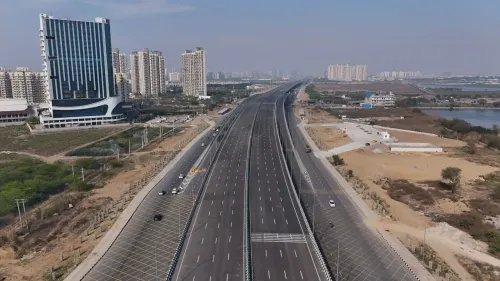
The tunnel will serve as a direct link between the Dwarka Expressway — a 29-km arterial corridor connecting Dwarka to Gurugram — and Nelson Mandela Marg, one of south Delhi's key arterial roads passing through Vasant Kunj. By routing traffic underground, the project aims to sidestep surface-level encroachment on the ridge forest, which has been the subject of environmental litigation for years.
Policy Backdrop
The approval fits within the broader Bharatmala Pariyojana framework, launched in 2015, which targets the development of expressways, tunnels, and multimodal corridors across India to improve freight and passenger movement. The Dwarka Expressway itself received Cabinet approval for Phase 1 in 2016, with elevated corridors and interchanges added progressively, sections of which opened from 2021 onward.
Urban planners have long identified the Dwarka–Vasant Kunj corridor as a congestion pinch point, with surface-level road expansion constrained by the Southern Ridge Forest, a protected green belt forming part of the Aravalli range. A tunnel solution has been discussed in planning circles as a way to reconcile mobility demands with conservation obligations.
Stakeholders and Impact
Delhi commuters travelling between the western Dwarka sub-city, Gurugram, and the south Delhi commercial and residential belt stand to benefit most directly from reduced travel times. The Southern Ridge Forest, which has faced pressure from urban sprawl and earlier road-widening projects, is positioned in the government's framing as a beneficiary of the underground alignment.
Environmental groups and urban planners will closely watch the Environmental Impact Assessment process that must precede construction. Past projects in the ridge vicinity have drawn scrutiny from the National Green Tribunal, making regulatory clearance a critical milestone before ground is broken.
What's Next
The project now moves toward tendering, detailed project report finalisation, and mandatory environmental clearances. Integration with existing Dwarka Expressway interchanges and the broader Delhi road network will determine the tunnel's operational effectiveness once complete. The government's stated dual objective — faster urban connectivity alongside ridge preservation — will be tested through the clearance and construction phases that follow this Cabinet green light.
Point of View
The announcement is also a political signal ahead of continued focus on the National Capital Region, where infrastructure delivery has been a key electoral talking point. The project's credibility will hinge on how swiftly it clears environmental scrutiny, given that the National Green Tribunal has historically been an active check on ridge-adjacent construction. If executed as framed, the tunnel could serve as a template for resolving similar urban-forest conflicts in other Indian cities.
NationPress
30 Sept 2026
Frequently Asked Questions
What is the 6-lane tunnel approved by the Union Cabinet for Delhi?
The Union Cabinet has approved a 6-lane tunnel connecting Dwarka Expressway with Nelson Mandela Marg in Vasant Kunj, south Delhi, aimed at reducing congestion and travel time while preserving the Southern Ridge Forest.
Where exactly will the Delhi tunnel be built?
The tunnel will link the Dwarka Expressway — a major 29-km corridor connecting Dwarka to Gurugram — with Nelson Mandela Marg near Vasant Kunj in south Delhi.
Why is a tunnel being built instead of a surface road?
A tunnel alignment allows the project to avoid encroaching on the Southern Ridge Forest, a protected green belt in south Delhi that has been the subject of environmental litigation related to road-widening projects.
What is the status of the Dwarka Expressway tunnel project?
As of 1 July 2026, the project has received Union Cabinet approval. It must still undergo environmental impact assessment clearance and project tendering before construction can begin.
Who announced the Delhi tunnel Cabinet approval?
Union Parliamentary Affairs Minister Kiren Rijiju announced the Cabinet decision on X on 1 July 2026, crediting the project to Prime Minister Narendra Modi's leadership.