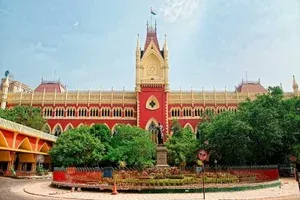
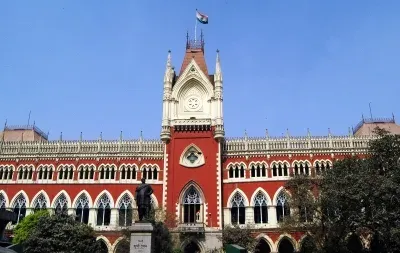
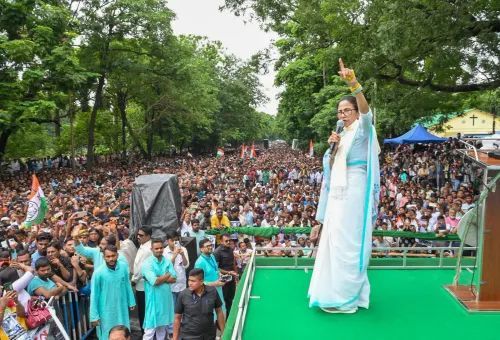
Calcutta HC warns Mamata-led TMC faction over July 21 rally order breach
Synopsis
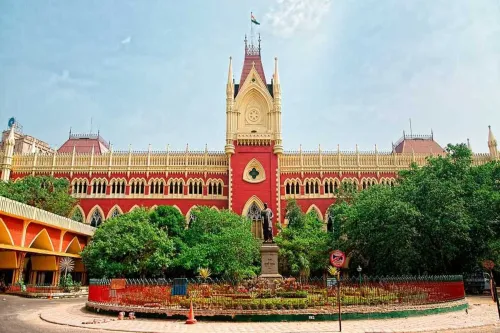
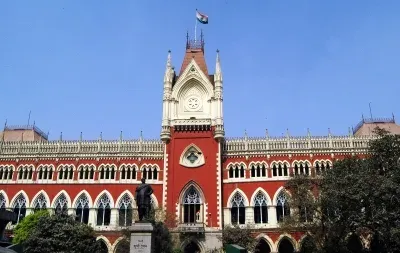
The Calcutta High Court has cautioned the Mamata Banerjee-led TMC faction for allegedly violating two court-imposed conditions at the 21 July Martyrs' Day rally — a participant cap of 2,500 and a requirement to keep one lane open near Birla Planetarium. Justice Saugata Bhattacharyya warned of strong action if future orders are breached, in a case that also lays bare TMC's deepening internal split.
Key Takeaways
The Calcutta High Court cautioned the Mamata Banerjee -led TMC faction on 31 July over violations at the 21 July Martyrs' Day rally .
The court had capped participation at 2,500 and required one lane near Birla Planetarium to stay open — both conditions were allegedly breached.
Justice Saugata Bhattacharyya expressed dismay and warned of strong action for any future non-compliance.
Kolkata Police had initially denied permission; the faction approached the court, which granted conditional approval.
The case also reflects a reported internal split within the Trinamool Congress , with the Mamata Banerjee - Abhishek Banerjee camp described as the 'original but minority' faction in court filings.
A single-judge Bench of the Calcutta High Court on Friday, 31 July issued a sharp caution to the Mamata Banerjee-led faction of the All India Trinamool Congress (TMC) — described in court proceedings as the 'original but minority' faction — over its alleged violation of court-imposed conditions at the Martyrs' Day rally held on 21 July in front of Birla Planetarium in central Kolkata. The court made clear that any future breach of its orders would invite strong legal action.
What the Court Said
Justice Saugata Bhattacharyya, presiding over the single-judge Bench, expressed dismay during Friday afternoon's hearing over two specific violations: the number of participants at the rally allegedly far exceeding the court-mandated ceiling, and the blocking of both lanes in front of Birla Planetarium — contrary to the explicit order that at least one lane be kept free for vehicular movement. The Bench stopped short of punitive action on this occasion but warned that continued non-compliance would leave it no choice but to intervene firmly.
Background: How the Rally Got Court Permission
Kolkata Police had initially refused to grant the Mamata Banerjee faction permission to hold the 21 July rally at the traditional venue near CESC House at Esplanade Crossing in central Kolkata. The faction, which includes Mamata Banerjee, former Chief Minister of West Bengal, and her nephew Abhishek Banerjee, then approached the Calcutta High Court, which permitted the rally subject to two strict conditions: participation capped at 2,500 persons, and one of the two lanes in front of Birla Planetarium to remain open for traffic at all times.
Alleged Violations and the Petition
A petition filed at the Calcutta High Court last week alleged that the actual number of participants on 21 July substantially exceeded the 2,500 limit, forcing both lanes in front of Birla Planetarium to be blocked and causing significant traffic congestion in that busy stretch of central Kolkata. The petitioner contended that the rally organisers had flouted both conditions imposed by the court.
Significance and What Comes Next
The case spotlights a deepening internal fracture within the Trinamool Congress, with the Mamata Banerjee-Abhishek Banerjee camp characterised in legal filings as a minority faction — a framing that itself carries political weight in West Bengal. The Martyrs' Day rally on 21 July is a decades-old TMC tradition marking the 1993 police firing on Youth Congress workers, and the dispute over its organisation this year reflects the broader power struggle within the party. The court's warning signals that it will scrutinise compliance closely if future gatherings are sought under similar permissions.
Point of View
But for the language embedded in the case itself — the Mamata-Abhishek camp being tagged 'original but minority' in legal filings signals how far the TMC's internal fracture has gone public. Courts do not typically wade into intra-party nomenclature; that this framing has entered the record is telling. More broadly, the pattern of approaching courts after police denials — and then allegedly exceeding court-set limits — raises questions about whether judicial permissions are being treated as a formality rather than a binding constraint. If the court is forced to act in a future instance, the political fallout in West Bengal could be significant.
NationPress
15 Sept 2026
Frequently Asked Questions
Why did the Calcutta High Court caution the Mamata Banerjee-led TMC faction?
The court cautioned the faction for allegedly violating two conditions it had set for the 21 July Martyrs' Day rally in Kolkata — the number of participants reportedly exceeded the court-mandated cap of 2,500, and both lanes in front of Birla Planetarium were blocked instead of one being kept free for traffic. Justice Saugata Bhattacharyya warned of strong action if such violations recur.
What conditions did the Calcutta High Court impose on the July 21 rally?
The court permitted the rally subject to two strict conditions: no more than 2,500 participants, and at least one of the two lanes in front of Birla Planetarium to remain open for vehicular movement at all times. Both conditions were allegedly breached on the day of the rally.
Why was the rally not held at the traditional venue near CESC House?
Kolkata Police initially refused to grant permission for the rally at the traditional venue near CESC House at Esplanade Crossing. The Mamata Banerjee faction then approached the Calcutta High Court, which granted conditional permission for an alternate venue in front of Birla Planetarium.
What is the Martyrs' Day rally and why does it matter politically?
The Martyrs' Day rally on 21 July is a decades-old Trinamool Congress tradition commemorating the 1993 police firing on Youth Congress workers in Kolkata. It is one of the party's most significant annual events, and the dispute over its organisation this year reflects a reported internal power struggle within the TMC.
What happens if the TMC faction violates court orders again?
Justice Saugata Bhattacharyya cautioned that the court would be compelled to take strong action in the event of any future violation of its orders. The nature of such action was not specified, but the warning signals the court will scrutinise future compliance closely.