Is the Centre Finally Allowing Farmers to Cultivate Near the Pak Border?
Click to start listening
Synopsis
In a transformative development for Punjab's farmers, CM Bhagwant Mann announces government support to move the BSF closer to the border, enabling access to lost farmland. This decision, along with addressing other regional issues, promises to impact the agricultural landscape significantly.
Key Takeaways
- Punjab farmers gain access to previously inaccessible farmland.
- BSF relocation aims to enhance agricultural productivity.
- Ongoing concerns about the Seeds Bill and river water allocations persist.
- CM Mann's advocacy highlights the importance of farmer representation.
- Risks from imported seeds could threaten local agriculture.
New Delhi, Jan 17 (NationPress) In a significant announcement, Punjab Chief Minister Bhagwant Mann revealed a crucial relief measure for farmers situated in the state's border region after the Central Government consented to relocate the Border Security Force (BSF) closer to the International Border. This pivotal decision will facilitate the cultivation of thousands of acres of farmland that are currently inaccessible due to fencing.
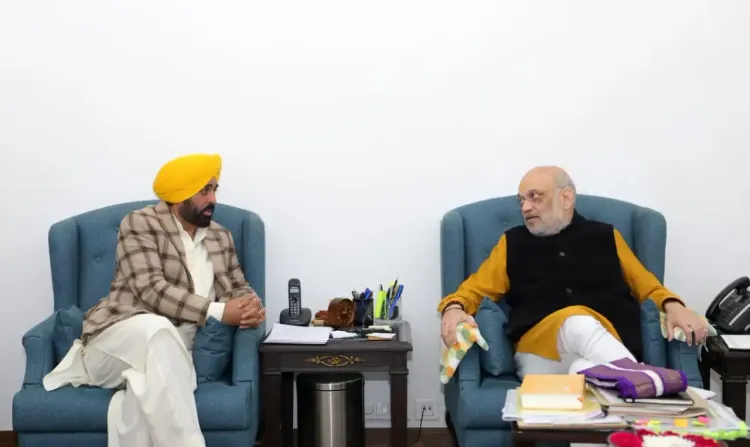
During a meeting with Union Home Minister Amit Shah, the Chief Minister highlighted the long-standing struggles faced by farmers who are compelled to navigate the border fence with identity verification and under BSF supervision, encountering daily challenges along the 532-km India-Pakistan border, where fencing is situated deep within Punjab's territory.
He mentioned that the Home Minister assured him that the issue is actively being reviewed and that the fencing will be adjusted towards the border, thereby restoring accessibility to Punjab's land while ensuring national security is not compromised.
In addition to discussing border matters, CM Mann addressed several longstanding concerns, including the state's objections to the proposed Seeds Bill 2025, the unresolved Sutlej Yamuna Link (SYL) dispute, delays in the movement of food grains by the Food Corporation of India, freezing of the Arthiya Commission, non-payment of the Rural Development Fund (RDF) and Mandi Fund, and the diminishing role of the state in the governance of Chandigarh, advocating for timely resolutions.
Criticizing the proposed Seeds Bill 2025, the Chief Minister emphasized, "Punjab is an agrarian state and one of the nation's major grain producers, yet the draft Seed Bill fails to ensure proper representation for the state as per the relevant schedule. The zone-based system introduced in the Bill does not guarantee Punjab's representation in the Central Seed Committee, unlike the current framework, thus limiting the state's influence in seed sector decisions."
He elaborated, "The proposed legislation also limits the powers of the State Seed Committee, as it does not include a role for the state-level committee in seed registration, and it neglects to establish a robust compensation mechanism for farmers who experience losses due to underperforming registered seeds."
He raised concerns about foreign-tested seed varieties being permitted for import and sale in Punjab and other states without necessary multi-location testing under state-specific agro-climatic conditions, which endangers farmers.
Reaffirming the state's position regarding river waters, the Chief Minister stated, "Punjab has no surplus water to distribute among other states. There has been a significant reduction in the availability of Sutlej, Ravi, and Beas waters, making the construction of the Sutlej-Yamuna Link (SYL) canal unfeasible."
He pointed out that out of the 34.34 mean annual flow (MAF) of water from these rivers, Punjab was allocated only 14.22 MAF—around 40 percent—while the remaining 60 percent was allocated to Haryana, Delhi, and Rajasthan, even though none of these rivers flow through those states."
"This is a gross injustice against Punjab, and there is no question of constructing this canal as it is entirely against the interests of the state and its citizens," he asserted, reaffirming Punjab's firm stance before the Supreme Court that there is no water available to spare.
Point of View
It is essential to recognize the implications of this announcement on Punjab's agricultural landscape and the empowerment of farmers. This development not only addresses immediate concerns but also sets a precedent for future negotiations between state and central authorities.
NationPress
17/01/2026
Frequently Asked Questions
What is the significance of the BSF relocation?
The relocation will allow farmers to access thousands of acres of farmland that were previously unreachable due to fencing along the border.
What concerns did CM Mann raise with Amit Shah?
He addressed several issues, including the proposed Seeds Bill 2025, the SYL dispute, and the allocation of river waters.
How does the proposed Seeds Bill affect Punjab farmers?
The Bill may limit Punjab's representation in seed sector decisions and curtail the powers of the State Seed Committee.
What is Punjab's stand on the SYL canal?
CM Mann asserted that Punjab has no surplus water to share and that constructing the SYL canal is not viable.
What are the potential risks associated with imported seed varieties?
Imported seeds may not be adequately tested for Punjab's specific agro-climatic conditions, posing risks to local farmers.