Is Gender-Based Violence Escalating Ahead of Bangladesh's February Elections?
Click to start listening
Synopsis
As Bangladesh's elections approach, a troubling rise in gender-based violence and attacks on minorities raises alarms about the protection of human rights under the interim government. This situation highlights the urgent need for reform and accountability in safeguarding the rights of all citizens.
Key Takeaways
- Alarming increase in gender-based violence and attacks on minorities in Bangladesh.
- The interim government has been criticized for failing to protect human rights.
- Upcoming elections may see the lowest female representation in history.
- Activists demand merit-based political participation for women.
- Reports highlight the exclusion of women by major political parties.
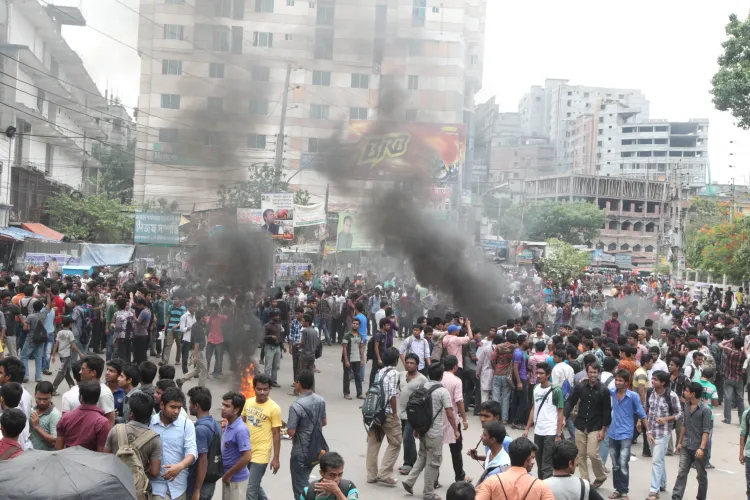
Dhaka, Jan 17 (NationPress) As Bangladesh approaches its General Elections scheduled for next month, there has been a disturbing increase in attacks against women, girls, and religious minorities. This surge highlights the inability of the interim government, led by Chief Advisor Muhammad Yunus, to uphold the fundamental human rights of its citizens.
According to police records, the New York-based Human Rights Watch (HRW) has reported a significant rise in gender-based violence from January to June 2025, compared to the same period in 2024.
Dr. Fauzia Moslem, President of the Bangladesh Mahila Parishad (Women’s Council of Bangladesh or BMP), points to intensified activities and rhetoric from religious factions aiming to limit women's freedoms and roles in society. In May 2025, hardline groups protested against the interim government's initiatives to promote gender equality, labeling them as 'anti-Islamic.' Consequently, women and girls have faced increased verbal, physical, and online harassment, which stifles their voices due to fear of violence, reported Subhajit Saha, a Senior Coordinator in HRW's Women's Rights Division.
The upcoming General Election on February 12 marks the first since the democratically elected government, led by former Prime Minister Sheikh Hasina, was dissolved in August 2024.
HRW's findings also reveal a rise in violence against Hindus and ethnic minorities in recent months.
For instance, in December, a 27-year-old garment worker, Dipu Chandra Das, was brutally killed by a mob over alleged blasphemy. Rights organizations have documented at least 51 violent incidents against Hindus, including 10 fatalities. Ethnic minorities in the Chittagong Hill Tracts continue to endure mistreatment by security forces following the revolution, Saha noted.
Despite Bangladesh having had two female Prime Ministers and numerous women involved in the 2024 student-led protests, political participation for women remains severely limited. Of the 51 political parties participating in the upcoming elections, 30 have no female candidates. The Jamaat-e-Islami, a leading Islamist party, has nominated 276 candidates, none of whom are women.
Describing the situation as a source of shame, various reports indicate that the February election will witness the lowest representation of women candidates in the history of Bangladesh.
Recently, local media in Dhaka reported on a forum entitled 'Nomination Crisis of Women Candidates: Gap between Parties' Commitments and Implementation and the Accountability of the Election Commission.' Many speakers voiced concerns that while the election commission frequently promotes a 'gender-inclusive election', this commitment is not reflected in practice.
As reported by United News Bangladesh (UNB), representatives from various organizations, including Gonoshasthaya Abhijan, Durbaar Network Foundation, and Feminist Alliance of Bangladesh, participated in the event.
During the discussions, forum leaders expressed their disapproval of reserved seats for women, advocating instead for direct electoral participation based on merit.
One speaker raised an important question: 'If political parties fail to adhere to their own promises, why should women place their trust in them moving forward?' UNB also quoted Samina Yasmin, a forum leader, who highlighted that women voters constitute nearly 50% of the electorate in the country.
She posed a crucial question: 'Can a government truly gain power by excluding 51% of the population while depending only on 49%?' This raises fundamental concerns about representation.
Previously, Bangladesh's Election Commission disclosed alarming statistics demonstrating the underrepresentation of women among candidates. Of the 2,568 individuals vying for election on February 12, only 109 (4.24%) are women, with only 72 nominated by political parties, while the remainder are independent candidates, as reported by The Daily Star.
Reports further indicate stark exclusions within radical Islamist parties, such as Jamaat-e-Islami, fielding 276 candidates without any female representation, followed by Islami Andolan Bangladesh with 268 male candidates.
Even the Bangladesh Nationalist Party (BNP), which was led by a woman for over four decades, has only nominated 10 women out of 328 candidates for the 300 available seats.
Several other parties, including Bangladesh Khilafat Majlis and the Bangladesh Islami Front (BIF), have entirely excluded women from their candidate lists, presenting only male candidates.
Point of View
It is crucial to emphasize that the current situation in Bangladesh is not only a matter of political concern but also a humanitarian crisis. The alarming rise in violence against women and minorities must be addressed urgently to ensure a fair and just electoral process. The nation must unite to protect the fundamental rights of every citizen.
NationPress
17/01/2026
Frequently Asked Questions
What is the current situation regarding gender-based violence in Bangladesh?
There has been a notable increase in gender-based violence in Bangladesh, particularly against women and girls, as the country prepares for its upcoming General Elections.
How are religious minorities affected in Bangladesh?
Religious minorities, particularly Hindus, have faced a rise in violent attacks, with numerous incidents reported in recent months.
What is the status of female candidates in the upcoming elections?
The upcoming elections will witness the lowest representation of women candidates in Bangladesh's history, with 30 out of 51 parties not nominating any women.
What organizations are advocating for women's rights in Bangladesh?
Various organizations, including Gonoshasthaya Abhijan and the Feminist Alliance of Bangladesh, are actively advocating for women's rights and representation in politics.
What calls to action are being made regarding women's political participation?
Advocates are calling for direct electoral participation for women based on merit, rather than reserved seats, emphasizing the need for genuine representation.