How is the Rajasthan government empowering villages?
Synopsis
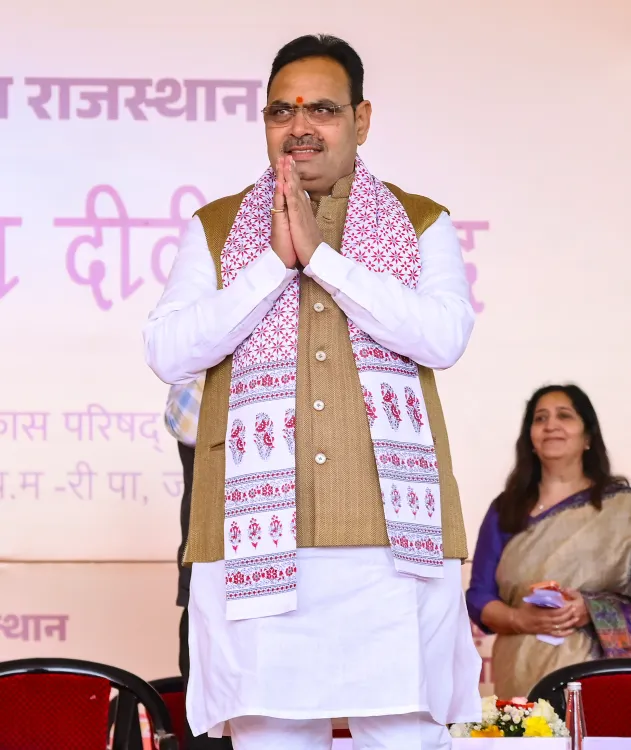
In a recent dialogue with outgoing sarpanches, Rajasthan CM Bhajan Lal Sharma emphasized the pivotal role of panchayats in village governance. With a focus on development through transparency and community engagement, the government aims to uplift all societal sections, ensuring that welfare schemes effectively reach every villager.
Key Takeaways
Strengthening Gram Panchayats is essential for state development.
Outgoing sarpanches continue to contribute their experience.
New initiatives focus on transparency and accountability.
Women's empowerment programs are being significantly enhanced.
Over 1.44 lakh government job recruitments are underway.
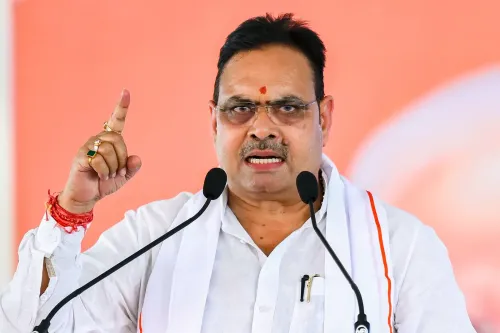
Jaipur, Jan 17 (NationPress) Rajasthan Chief Minister Bhajan Lal Sharma stated on Saturday that a sarpanch embodies the voice of the village and represents the initial stage of Gram Panchayat governance. He emphasized that the strength of panchayats is essential for the state's overall fortitude, asserting that the trajectory of development is interwoven with the villages.
The Chief Minister highlighted that the state government is dedicated to actualizing Prime Minister Narendra Modi's fundamental principle of ‘Sabka Saath, Sabka Vikas’.
During a discussion with the Gram Panchayat leaders (outgoing sarpanches) from all seven divisions of the state at the Chief Minister’s residence, he remarked that the role of the sarpanch goes beyond holding a title; it is a conduit of service and dedication. Villagers innately turn to their sarpanch in times of need.
Be it the Kisan Samman Nidhi, pensions, drinking water, electricity, housing, sanitation, roads, schools, Anganwadi centres, health facilities, or access to various welfare schemes, the villagers primarily rely on the Gram Panchayat and their sarpanch.
He noted that sarpanches are ideally positioned to evaluate how effectively government policies and beneficial decisions reach the grassroots level, rendering their insights immensely significant.
The Chief Minister stated that the government is reinforcing Gram Panchayats to create a transparent, accountable, and corruption-free Panchayati Raj system. Ongoing construction and renovation of Gram Panchayat buildings, alongside the establishment of Atal Gyan Kendras (knowledge hubs) in every Gram Panchayat, are part of this initiative.
He also mentioned that new Zila Parishads have been formed in the eight newly established districts. In addition, the reorganization and formation of Panchayati Raj institutions have led to the creation of 85 new Panchayat Samitis and 3,417 new Gram Panchayats.
Even after their terms, outgoing sarpanches have been designated as administrators to ensure villages continue to benefit from their expertise.
Sharma further noted that the central government has devised a new framework for rural development by revising the existing MGNREGA structure and introducing the ‘Developed India Guarantee for Employment and Livelihood Mission (Rural)’.
The Chief Minister emphasized the state government's unwavering commitment to uplifting all societal segments, including youth, women, the poor, and farmers.
He mentioned that the youth have been liberated from the scandal of paper leaks that plagued previous administrations, ensuring that recruitment tests are now conducted transparently. Over one lakh government positions have already been filled, with recruitment for an additional 1.44 lakh posts currently in progress.
For women's empowerment, an incentive of Rs 1.5 lakh is being provided under the Ladli Protsahan Yojana. Farmers are being economically fortified through the Chief Minister Kisan Samman Nidhi Yojana, while livestock farmers receive support via the Gopal Credit Card, the Chief Minister Mangala Pashu Bima Yojana, and a milk subsidy of Rs 5 per litre.
The Chief Minister urged outgoing sarpanches to actively promote information regarding the welfare schemes from both the central and state governments, ensuring that their benefits reach the most disadvantaged.
During the event, the Gram Panchayat leaders provided their suggestions for developmental projects and the upcoming budget. Sharma assured them that their feedback would be considered in accordance with regulations.
Present at the occasion were MLA Shatrughan Gautam, State President of the Rajasthan Sarpanch Association Banshidhar Garhwal, along with a significant number of Gram Panchayat administrators (outgoing sarpanches).
Point of View
It is crucial to recognize the importance of local governance in fostering development. This dialogue led by CM Bhajan Lal Sharma reflects a significant step towards strengthening rural empowerment. By prioritizing community engagement and transparency, the Rajasthan government is setting a precedent for inclusive governance, which is essential for holistic national progress.
NationPress
25 Sept 2026
Frequently Asked Questions
What is the role of a sarpanch?
A sarpanch serves as the voice of the village and is the first point of contact for villagers seeking support and services.
How is the Rajasthan government supporting Gram Panchayats?
The government is enhancing Gram Panchayats by constructing new buildings, establishing knowledge centers, and ensuring transparency and accountability.
What initiatives are in place for women's empowerment?
The Rajasthan government offers an incentive of Rs 1.5 lakh under the Ladli Protsahan Yojana to empower women.
How many new Gram Panchayats have been established?
The government has formed 3,417 new Gram Panchayats as part of the recent reorganization.
What is the purpose of the Developed India Guarantee for Employment and Livelihood Mission?
This mission aims to revamp rural development by providing employment and livelihood opportunities through improved frameworks.