Centre releases dataset report for State Finance Commissions
Synopsis
The Centre's new dataset report for State Finance Commissions is more than a technical exercise — it recommends a CAG audit of 33 years of constitutional devolution and backs ₹87,000 crore in performance-linked Panchayat grants. If implemented, it could fundamentally reset how India measures and funds grassroots governance.
Key Takeaways
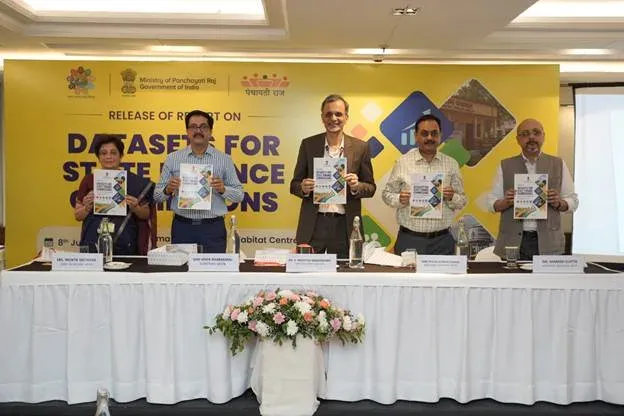
The Centre released the Committee on Datasets for State Finance Commissions report on 8 June , prepared by the Ministry of Panchayati Raj .
Chief Economic Advisor V.
Anantha Nageswaran said better data leads to better governance and described the report as a key step in strengthening local governance information architecture.
The report recommends the CAG conduct a performance audit of the 73rd Constitutional Amendment to assess devolution to Panchayati Raj Institutions .
The Sixteenth Finance Commission has proposed an Urbanisation Premium of ₹10,000 crore for local bodies managing peri-urban transitions — the first such dedicated national initiative.
A performance-based grant of ₹87,000 crore has been allocated exclusively for Panchayats, tied to annual own-source revenue growth of at least 2.5 per cent .
The Centre on Monday, 8 June released the report of the Committee on Datasets for State Finance Commissions, prepared by the Ministry of Panchayati Raj (MoPR), marking a significant push towards data-driven fiscal decentralisation and stronger grassroots governance across India.
Key Remarks at the Release
Chief Economic Advisor V. Anantha Nageswaran said that citizens experience governance through the availability of basic services — drinking water, roads, street lighting, and Anganwadi services — making empowered Panchayats central to effective delivery. He described fiscal decentralisation as 'bringing governance close enough to people that it actually touches their lives.'
Nageswaran stressed that State Finance Commissions (SFCs) can only make sound recommendations when they have access to reliable, timely, and granular data. He described the report as 'an important step towards strengthening the information architecture for local governance,' adding that the quality of resource-allocation decisions is directly determined by the quality of data and analysis available.
CAG Performance Audit Recommended
A notable recommendation in the report calls on the Comptroller and Auditor General (CAG) to undertake a performance audit of the implementation of the 73rd Constitutional Amendment across states. The audit would assess the extent of functional, financial, and administrative devolution to Panchayati Raj Institutions (PRIs) — an initiative aimed at reinforcing accountability and deepening constitutional decentralisation.
MoPR Secretary on Institutional Reforms
Secretary, Ministry of Panchayati Raj, Vivek Bharadwaj, called for greater coordination between State Finance Commissions and Central Finance Commissions. He said reliable and accessible data is fundamental to improving the quality and timeliness of SFC recommendations, and that sustainable decentralisation requires not only financial transfers but also robust institutional reforms.
Bharadwaj highlighted two outcomes from the Ministry's engagement with the Sixteenth Finance Commission. First, the Commission has proposed an Urbanisation Premium of ₹10,000 crore to support local bodies managing the transition of census towns into urban entities — described as the first dedicated national initiative addressing peri-urban transformation challenges. Second, the Commission has reintroduced a performance-based grant framework allocating ₹87,000 crore exclusively for Panchayats, linked to annual growth in own-source revenues of at least 2.5 per cent.
Why This Matters
India's three-tier Panchayati Raj system, constitutionally mandated since 1992, has long faced criticism over uneven devolution of funds, functions, and functionaries. This report directly addresses the data gap that has historically weakened SFC recommendations. Notably, the performance-based grant linkage signals a shift toward incentivising fiscal self-reliance at the local level, rather than unconditional transfers. With rapid peri-urban growth straining local bodies, the ₹10,000 crore Urbanisation Premium is also a first-of-its-kind acknowledgment of that structural challenge.
What Comes Next
Implementation of the report's recommendations will depend on state governments strengthening their own data ecosystems and coordinating with SFCs. The proposed CAG audit, if conducted, will provide the first systematic national assessment of devolution outcomes under the 73rd Amendment. Stakeholders in local governance and public finance will watch closely whether the ₹87,000 crore performance-linked grants translate into measurable improvements in PRI financial capacity.
Point of View
Yet devolution of funds, functions, and functionaries remains deeply uneven across states. The real value of this report is not in its data recommendations alone — it is in the implicit admission that SFCs have been making fiscal recommendations in an information vacuum. The proposed CAG audit of 73rd Amendment implementation is overdue and potentially explosive: it could surface how far states have actually deviated from constitutional intent. The ₹87,000 crore performance-linked grant is a welcome incentive shift, but the 2.5 per cent own-source revenue growth threshold is modest and risks being gamed without independent verification mechanisms — the same accountability gap that has undermined PLI and MGNREGS outcome reporting.
NationPress
26 Oct 2026
Frequently Asked Questions
What is the Committee on Datasets for State Finance Commissions report?
It is a report prepared by the Ministry of Panchayati Raj and released by the Centre on 8 June, aimed at improving the data ecosystem for State Finance Commissions so they can make more reliable fiscal recommendations for local governments. It covers data standards, coordination between SFCs and Central Finance Commissions, and institutional reforms for Panchayati Raj Institutions.
Why has a CAG audit of the 73rd Constitutional Amendment been recommended?
The report recommends the Comptroller and Auditor General conduct a performance audit to assess how effectively states have devolved functions, finances, and administration to Panchayati Raj Institutions since the 73rd Amendment came into force in 1992. The audit is intended to reinforce accountability and identify gaps in constitutional decentralisation.
What is the ₹87,000 crore performance-based grant for Panchayats?
The Sixteenth Finance Commission has reintroduced a performance-based grant framework allocating ₹87,000 crore exclusively for Panchayats, linked to annual growth in own-source revenues of at least 2.5 per cent. It is designed to incentivise fiscal self-reliance at the local government level.
What is the Urbanisation Premium of ₹10,000 crore?
The Sixteenth Finance Commission has proposed an Urbanisation Premium of ₹10,000 crore to support local bodies managing the transition of census towns into urban entities. According to MoPR Secretary Vivek Bharadwaj, it is the first dedicated national initiative addressing the challenges of peri-urban transformation in India.
Who are State Finance Commissions and why do they matter?
State Finance Commissions are constitutional bodies mandated under the 73rd and 74th Amendments to recommend the distribution of financial resources between state governments and local bodies — Panchayats and municipalities. Their recommendations directly affect the funding and capacity of grassroots governance institutions serving rural and urban populations.