Chhattisgarh CMO announces Sushasan Tihar samadhan shivirs across state
Synopsis
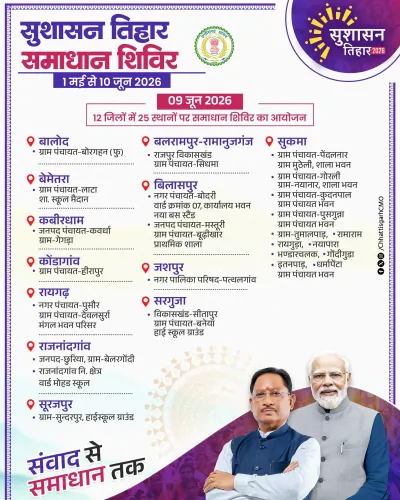
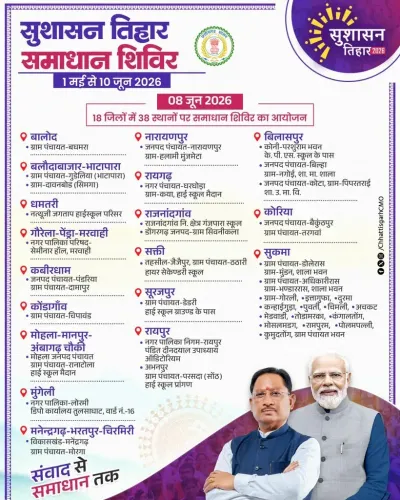
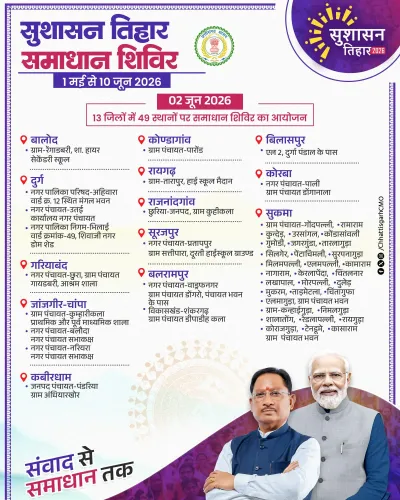
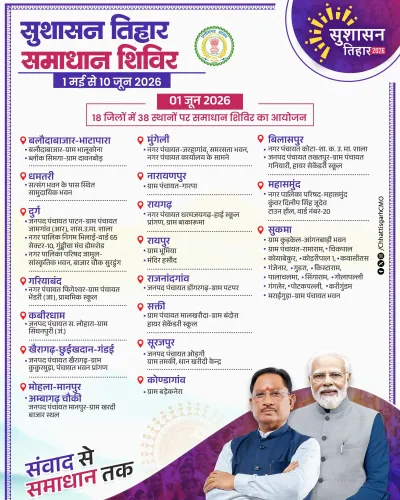
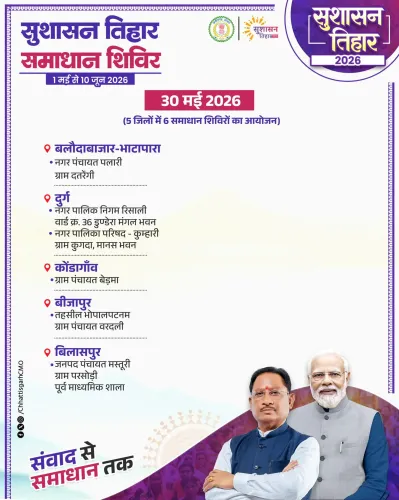
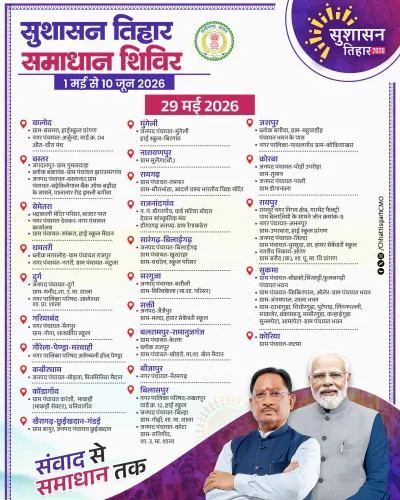
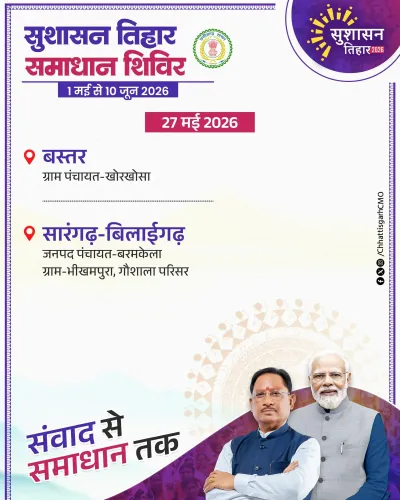
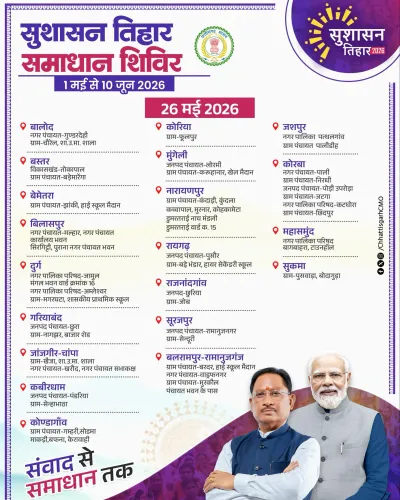
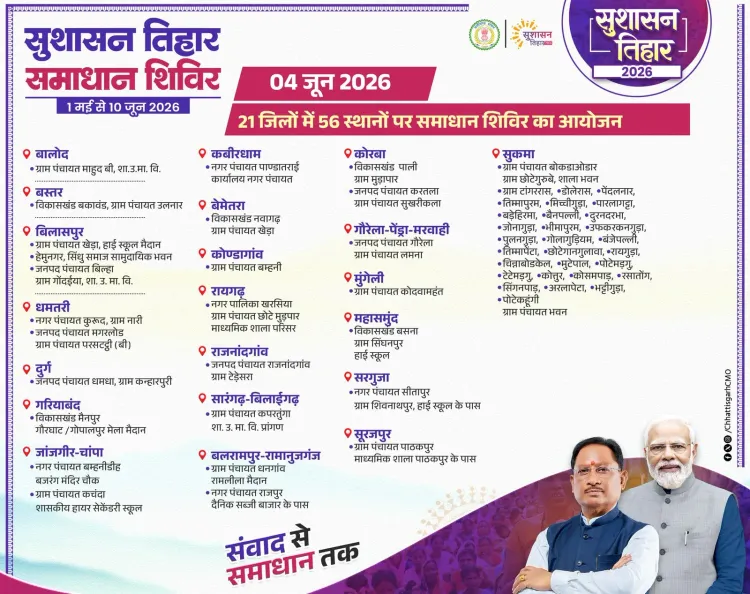
The Chief Minister's Office of Chhattisgarh announced that samadhan shivirs will be held at various locations across the state on 4 June 2026 under Sushasan Tihar 2026, continuing the governance festival's drive to bring grievance redressal and scheme delivery closer to citizens.
Key Takeaways
Chhattisgarh CMO announced samadhan shivirs at various state locations on 4 June 2026.
Camps are part of the ongoing Sushasan Tihar 2026 governance outreach campaign.
Shivirs typically handle land records, certificates, pensions and scheme enrolment.
Rural and tribal-district residents are the primary intended beneficiaries.
Line departments deploy jointly under district collectors' supervision.
Disposal rates and district-wise attendance will be the key metrics to watch.
The Chief Minister's Office of Chhattisgarh on Wednesday, 3 June 2026, announced that samadhan shivirs (grievance redressal camps) will be held at various locations across the state on Thursday, 4 June 2026, under the ongoing Sushasan Tihar 2026 outreach. The announcement, made through the official handle of the state's top executive office, signals the next phase of a flagship governance festival that takes administration directly to citizens' doorsteps.
In the post, the CMO stated in Hindi, 'Sushasan Tihar ke tahat kal pradesh ke vibhinn sthanon par samadhan shivirot ka aayojan hoga' ('Under Sushasan Tihar, samadhan shivirs will be organised tomorrow at various locations in the state'). The message was accompanied by a creative carrying the campaign hashtag #SushasanTihar2026.
Context
Sushasan Tihar, literally the 'good governance festival', is a recurring Chhattisgarh state initiative designed to compress grievance redressal, scheme enrolment and public-service delivery into a concentrated calendar of camps across districts. The format relies on samadhan shivirs where line departments set up counters to receive applications and dispose of them on the spot wherever feasible.
The 2026 edition continues this template, with the CMO using its social-media reach to publicise the daily camp schedule. By flagging that camps will run at 'various locations' the next day, the office is effectively asking residents to check district-level notifications and walk in with their documents.
Policy backdrop
Chhattisgarh, carved out as a separate state in 2000, has periodically rolled out governance outreach programmes aimed at narrowing the distance between the secretariat in Raipur and citizens in remote blocks. Such camps typically handle land-record corrections, ration-card updates, pension applications, caste and income certificates, and grievances against local administration.
The samadhan shivir model is not unique to Chhattisgarh — several Indian states run analogous grievance camps — but the 'tihar' or festival branding distinguishes the state's approach by setting a fixed window of intensive activity rather than a year-round, low-tempo schedule. It also pairs physical camps with digital portals where applications can be tracked.
Stakeholders and impact
The primary beneficiaries are rural residents and citizens in tribal-majority districts, where access to block and tehsil offices can involve long travel. For these groups, a camp in or near the gram panchayat headquarters can collapse multiple trips into a single visit.
Line departments — revenue, panchayat and rural development, women and child development, food and civil supplies, social welfare, and health — are typically deployed together so that overlapping cases can be cleared in one sitting. District collectors and sub-divisional magistrates usually oversee the camps, while frontline staff such as patwaris and anganwadi workers handle case intake.
For the state government, the camps double as a feedback mechanism: aggregated grievance data can flag which schemes are under-delivering and which offices are accumulating backlogs.
What's next
The CMO's announcement points to 4 June 2026 as the next active day of camps, with locations to be notified at the district level. Attention will turn to the volume of applications received, the share disposed of on the spot, and any directives the Chief Minister's Office issues after reviewing the day's reports.
As Sushasan Tihar 2026 progresses, the broader test will be whether the festival format translates into durable improvements in service delivery — or whether grievances reappear once the camps wind down. The campaign's running tally of disposed cases, expected to be released by the state administration, will be the most-watched metric in the coming weeks.
Point of View
Sushasan Tihar serves both as a service-delivery mechanism and as a public signal that the state is actively reaching citizens rather than waiting for them to navigate the bureaucracy. The real measure of success, however, lies less in camp footfall and more in the share of grievances actually resolved and the durability of those fixes once the festival ends.
NationPress
18 Oct 2026
Frequently Asked Questions
What is Sushasan Tihar in Chhattisgarh?
Sushasan Tihar is a Chhattisgarh state government governance outreach campaign that organises samadhan shivirs across districts to receive and resolve citizens' grievances and scheme applications. It uses a festival format to concentrate administrative activity within a defined window.
When will the next samadhan shivirs be held under Sushasan Tihar 2026?
According to the Chhattisgarh CMO's announcement on 3 June 2026, samadhan shivirs will be held at various locations across the state on 4 June 2026. Exact venues are notified at the district level.
What kind of issues are addressed at samadhan shivirs?
Samadhan shivirs typically address land-record corrections, ration-card updates, pension applications, caste and income certificates, and complaints against local administration. Multiple line departments set up counters at the same venue.
Who can attend a Sushasan Tihar samadhan shivir?
Any resident of Chhattisgarh with a grievance or scheme-related application can attend. Applicants are typically advised to carry identity proof and any relevant documents such as Aadhaar, ration card or land papers.
How do I find the samadhan shivir venue in my district?
District-level venue lists are usually circulated by the office of the district collector and publicised through panchayat and block offices. The Chhattisgarh CMO also amplifies key announcements on its official channels.