Uttarakhand CMO Spotlights Chamoli's Kiwi Farming Rise
Synopsis
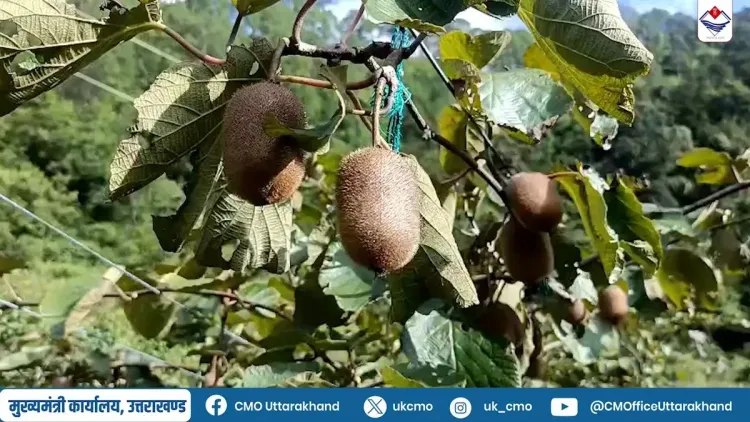
The Chief Minister's Office of Uttarakhand has spotlighted Chamoli district's rising kiwi cultivation as a high-value livelihood opportunity for hill farmers, reflecting the state's broader push to diversify mountain agriculture and curb rural out-migration through commercial horticulture.
Key Takeaways
The Chief Minister's Office of Uttarakhand highlighted kiwi farming in Chamoli district on 16 October 2026 , calling it an emerging 'golden picture' for the state.
Chamoli's high-altitude Himalayan terrain provides ideal cool-climate conditions for kiwi vines.
Kiwi cultivation offers hill farmers a high-value cash crop alternative to subsistence agriculture.
Uttarakhand sees commercial horticulture as a tool to check rural out-migration from remote districts.
Similar exotic-fruit transitions are under way across Himachal Pradesh , Sikkim , and Arunachal Pradesh , reflecting a pan-Himalayan pattern.
Post-harvest market linkages and cold-chain infrastructure remain the key challenge for sustained growth.
High in the Himalayas, a fruit once considered exotic is quietly reshaping the fortunes of hill farmers. The Chief Minister's Office of Uttarakhand highlighted on Friday, 16 October 2026, the emerging story of kiwi cultivation in the state, calling it a 'sunehri tasveer' — a golden picture — for Chamoli district and Uttarakhand at large.
Chamoli's high-altitude advantage
Chamoli district sits deep in the Garhwal Himalayas, its terrain and climate offering precisely the cool temperatures and well-drained slopes that kiwi vines thrive in. Farmers here have found in the crop a viable alternative to subsistence agriculture — one that commands far better prices in urban markets than traditional cereals or vegetables grown at altitude.
The district is part of a broader horticultural belt that Uttarakhand has been cultivating as a strategic economic lever, positioning remote communities closer to commercial value chains rather than leaving them dependent on grain farming alone.
Why kiwi, why now
Uttarakhand has long grappled with rural out-migration — young people leaving villages for plains cities in search of income. Commercial horticulture in high-value crops like kiwi, apple, and walnut offers a counter-pull: income that doesn't require leaving the hills. Kiwi in particular has seen demand surge across Indian cities as health-conscious consumption grows, making the timing of Chamoli's expansion well-judged.
Similar transitions are playing out across other Himalayan states — Himachal Pradesh, Arunachal Pradesh, and parts of Sikkim — where limited flat arable land pushes farmers toward high-value, low-volume crops suited to mountain micro-climates. Uttarakhand's pitch is that its own terraced valleys are no less capable.
The road from orchard to market
The real test for any orchard economy is not the harvest — it is what happens after. Market linkages, cold-chain infrastructure, and processing facilities determine whether a farmer's kiwi earns a premium or rots on a mountain road waiting for a truck. The state horticulture department's next moves on post-harvest support will be watched closely by growers who have already made the switch.
For now, the CMO's post signals official enthusiasm — an important signal that policy attention and, potentially, budgetary backing will follow the farmers who took the first risk.
If the orchards of Chamoli deliver on their promise, Uttarakhand's hills may yet keep their people home.
Point of View
Not just an agrarian trend. Framing Chamoli kiwi as a 'golden picture' ahead of any formal scheme announcement is a classic pre-budget softening exercise — shaping public and farmer expectations before policy muscle follows. Across India's Himalayan arc, states that have cracked post-harvest logistics for exotic fruits have seen genuine income gains; Uttarakhand's challenge is to move from photogenic orchards to functioning supply chains. The political dividend of keeping hill communities economically viable — and therefore electorally present — gives this agricultural story real urgency.
NationPress
16 Oct 2026
Frequently Asked Questions
Is kiwi grown in Uttarakhand?
Yes. Kiwi is grown in the high-altitude districts of Uttarakhand, including Chamoli, where cool Himalayan temperatures and well-drained slopes provide suitable conditions for the crop.
Why is kiwi farming important for Chamoli farmers?
Kiwi is a high-value cash crop that fetches significantly better market prices than traditional subsistence crops, helping hill farmers improve incomes without migrating to the plains.
Which districts in Uttarakhand grow kiwi?
Chamoli is among the prominently identified districts for kiwi cultivation in Uttarakhand due to its Himalayan micro-climate, though other hilly districts with suitable terrain also support the crop.
What is Uttarakhand doing to promote horticulture?
Uttarakhand promotes diversification into high-value fruits — including kiwi, apple, and walnut — as part of efforts to raise rural incomes and reduce out-migration from remote hill districts.
What challenges do kiwi farmers in Uttarakhand face?
The primary challenges are post-harvest market linkages, cold-chain infrastructure, and reliable transport connectivity — without which high-altitude farmers struggle to realise premium prices for their produce.