CM Bhupendra Patel Reviews Dholera Semicon City Build-Out
Synopsis
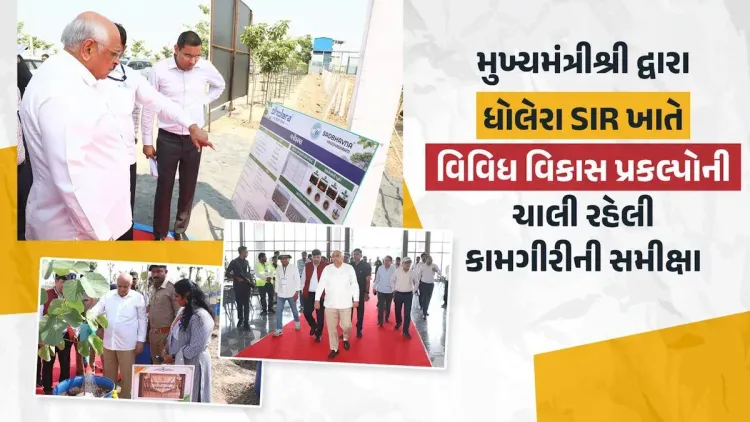
Chief Minister Bhupendra Patel visited Dholera SIR on 16 October 2026, reviewing construction of a 200-bed hospital, integrated school, guest house, food court, and over 1.11 lakh saplings across 53 hectares as India's first Semicon City accelerates its build-out.
Key Takeaways
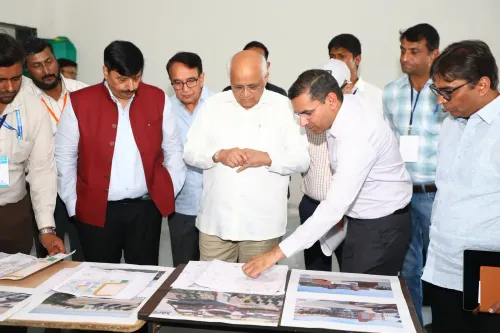
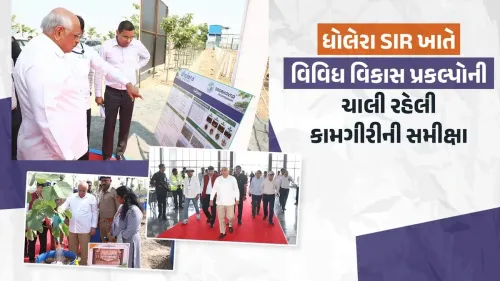
CM Bhupendra Patel conducted a personal site inspection of Dholera SIR on 16 October 2026 , reviewing flagship project progress.
A 200-bed multi-speciality hospital , integrated school , fire station , and 42-room guest house are under construction in Dholera's activation area.
A food court for 600 people and a 50-tent tent city are also being built to support incoming industrial workers and visitors.
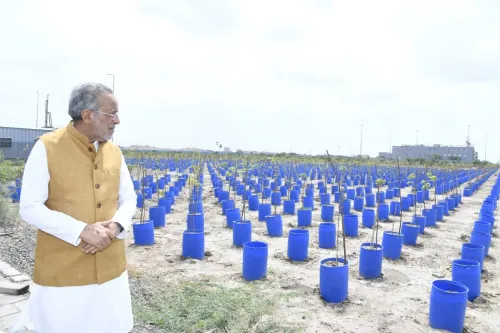
More than 1.11 lakh saplings are being planted across 53 hectares using the 'Drum Plantation' technique in partnership with the Forest Department and Sadbhavna Trust.
Dholera SIR, notified in 2009 under the Delhi-Mumbai Industrial Corridor, is being developed as India's first 'Semicon City' under the India Semiconductor Mission launched in 2021 .
Patel directed all construction work to be completed in a time-bound and quality-oriented manner.
India's first 'Semicon City' is taking shape on the Gujarat flatlands, and Chief Minister Bhupendra Patel walked its construction sites personally on Friday, 16 October 2026 — inspecting everything from a 200-bed multi-speciality hospital to a 50-tent tent city rising inside Dholera Special Investment Region (SIR). The Chief Minister's Office of Gujarat confirmed the visit, noting that Patel reviewed flagship project timelines and issued directions to ensure all work is completed on schedule and to quality standards.
What Patel saw on the ground at Dholera's Activation Area
The inspection covered the full sweep of social infrastructure being built inside Dholera's activation zone — the live construction envelope closest to readiness. Alongside the 200-bed multi-speciality hospital, Patel reviewed an integrated school, a fire station, a 42-room guest house, and a food court with capacity for 600 people. Residential and commercial projects also featured in the walkthrough, signalling that Dholera is being planned not just as a factory cluster but as a self-contained industrial township.
The CMO post, originally in Gujarati, noted that all these facilities are intended for workers arriving with incoming industries as well as for the broader community. The message was clear: semiconductor investment demands semiconductor-grade liveability to attract and retain a skilled workforce.
Dholera SIR's road from industrial corridor to Semicon City
Dholera SIR was notified in 2009 as a flagship node of the Delhi-Mumbai Industrial Corridor, sitting roughly 100 km south-west of Ahmedabad on low-lying saline land that successive Gujarat governments have steadily reclaimed for industry. The site gained national strategic weight when Prime Minister Narendra Modi anchored India's semiconductor ambitions there — the CMO post explicitly credits Modi's inspiration for positioning Dholera as the country's first 'Semicon City'. That framing tracks directly to the India Semiconductor Mission, launched in 2021, which deployed fiscal incentives to pull chip fabrication and assembly investments into India. Dholera, with its master-planned greenfield layout and dedicated power and water infrastructure, became the most prominently cited destination under that mission.
53 hectares of green cover and the 'Drum Plantation' technique
Patel's visit had an environmental dimension that received equal billing in the official account. In collaboration with the Forest Department and Sadbhavna Trust, workers are planting more than 1.11 lakh (111,000) saplings across 53 hectares of green space inside the region. The CMO highlighted a specific method being used: 'Drum Plantation' — a technique designed to raise the survival rate of saplings in the arid, saline soil conditions that characterise the Dholera landscape. Patel commended the effort as a concrete expression of the state's goal of industrial development in balance with ecological sustainability.
The detail matters politically: semiconductor fabs are power-hungry and water-intensive, and the optics of large-scale afforestation alongside them answers a predictable criticism before it fully forms.
Timelines and what the activation area must deliver next
The Chief Minister's direction to complete all work in a 'time-bound and quality-oriented manner' signals that completion targets are now a governance priority, not just a planning aspiration. The 200-bed hospital and integrated school are the highest-visibility milestones — they will serve as proof-of-concept that Dholera can sustain a resident workforce rather than merely attract one on paper. New investment announcements under the semiconductor policy will likely follow once those anchor facilities reach operational status.
Dholera is no longer a concept on a master-plan slide deck. It is a construction site with a Chief Minister walking it — and a deadline attached.
Point of View
The state is pre-emptively reframing a capital-intensive industrial zone as an ecologically responsible township, a narrative useful both domestically and for ESG-conscious foreign chipmakers evaluating India as a fab destination. The visit also reinforces the BJP's standard political choreography: Modi sets the vision, a state CM visibly delivers execution on the ground. With semiconductor supply-chain realignment still accelerating globally, the pace at which Dholera's activation area becomes genuinely liveable will determine whether India converts policy intent into actual silicon.
NationPress
16 Oct 2026
Frequently Asked Questions
What is Dholera SIR and why is it called India's first Semicon City?
Dholera Special Investment Region is a greenfield industrial township in Gujarat, notified in 2009 under the Delhi-Mumbai Industrial Corridor. It has been designated India's first 'Semicon City' because it is the primary destination under the India Semiconductor Mission launched in 2021, offering fiscal incentives and dedicated infrastructure to attract chip fabrication and electronics manufacturing.
What did CM Bhupendra Patel inspect at Dholera on 16 October 2026?
Patel inspected construction of a 200-bed multi-speciality hospital, an integrated school, a fire station, a 42-room guest house, a food court for 600 people, a 50-tent tent city, and residential and commercial projects — all in Dholera SIR's activation area. He also reviewed a 53-hectare afforestation drive involving over 1.11 lakh saplings.
What is the 'Drum Plantation' technique being used at Dholera?
Drum Plantation is a tree-planting method adopted at Dholera SIR to improve sapling survival rates in the region's arid, saline soil. It is being implemented across 53 hectares by the Forest Department and Sadbhavna Trust, with over 1.11 lakh saplings planted.
What is the India Semiconductor Mission and how does it relate to Dholera?
The India Semiconductor Mission was launched in 2021 to attract semiconductor fabrication and assembly investment into India through fiscal incentives. Dholera SIR is the flagship greenfield site earmarked for this mission, with PM Modi's vision cited as the inspiration for its designation as the country's first Semicon City.
When is the Dholera SIR hospital and school expected to be completed?
No specific completion date has been officially announced. CM Patel's October 2026 site inspection included a directive for all work to be completed in a time-bound and quality-oriented manner, indicating that firm timelines are a current governance priority.