Dholera Airport targets year-end launch; ₹20,667 crore rail line approved
Synopsis
Dholera's transformation is accelerating fast. Gujarat CM Bhupendra Patel's on-site review revealed an airport ready to open by year-end, a ₹20,667 crore railway corridor linking it to Ahmedabad, and a Tata Electronics semiconductor plant under active construction — all converging to make Dholera India's most ambitious greenfield industrial city.
Key Takeaways
Dholera International Airport is expected to become operational by year-end 2026 ; a calibration flight has already landed successfully.
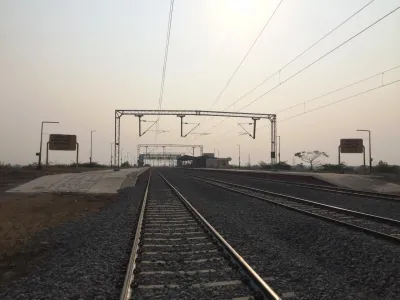
A 134-km Ahmedabad-Dholera semi-high-speed double railway line costing ₹20,667 crore has been approved, connecting the city, SIR, airport, and Lothal .
A separate 23-km Bhimnath-Dholera Logistics Hub railway line is also under development.
The Tata Electronics Semiconductor Fabrication Facility is under construction as the centrepiece of Dholera's semiconductor ecosystem.
Social infrastructure including a 200-bed hospital , integrated school, and food court for 600 people is being developed in the SIR's activation area.
Over 1.11 lakh saplings are being planted across 53 hectares using the 'drum plantation' technique to offset industrial growth's environmental footprint.
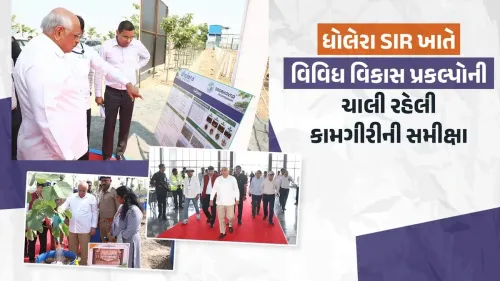
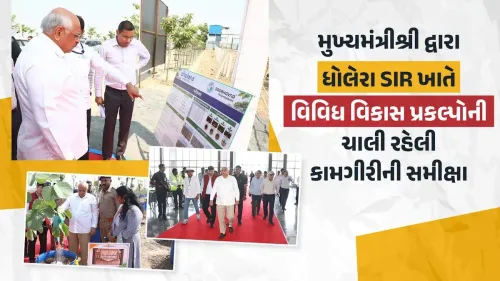
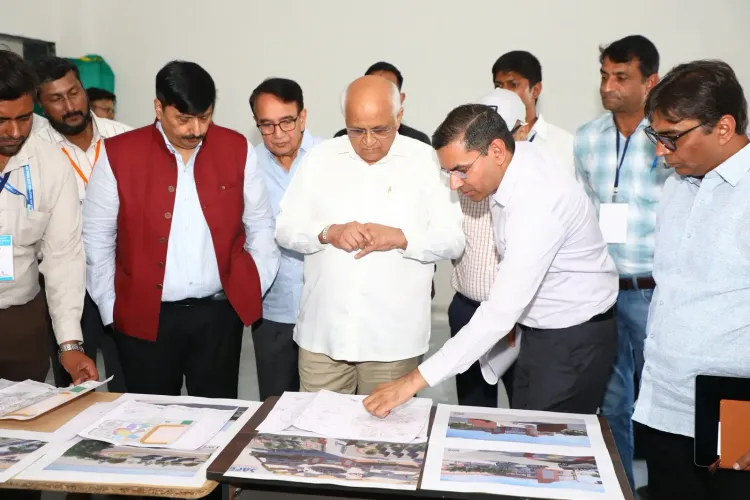
Gujarat Chief Minister Bhupendra Patel on 16 October 2026 reviewed the progress of infrastructure projects at Dholera Special Investment Region (SIR) in Ahmedabad district, where the Dholera International Airport is expected to become operational by year-end and a ₹20,667 crore semi-high-speed railway line connecting Ahmedabad with the emerging industrial hub has received approval. The visit also covered the Tata Electronics semiconductor fabrication facility and a suite of social infrastructure projects taking shape in the region.
Airport Nears Operational Status
A calibration flight has already landed successfully at Dholera International Airport, marking a significant milestone on the path to operationalisation. The airport, alongside the Ahmedabad-Dholera Expressway, is positioned to anchor multimodal connectivity for a region being developed as a centre for advanced manufacturing and emerging technologies. Officials informed Chief Minister Patel that the facility is on track to open before the close of this calendar year.
₹20,667 Crore Railway Corridor Approved
The approved 134-km Ahmedabad-Dholera semi-high-speed double railway line, estimated at ₹20,667 crore, will provide faster rail connectivity between Ahmedabad, Dholera SIR, the international airport, and the heritage site at Lothal. A separate 23-km Bhimnath-Dholera Logistics Hub railway line is also under development, further reinforcing the freight and passenger network around the SIR. Together, these rail links are designed to reduce logistics costs and attract industrial investment at scale.
Tata Electronics Semiconductor Facility Under Construction
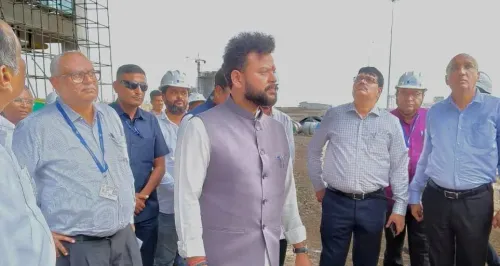
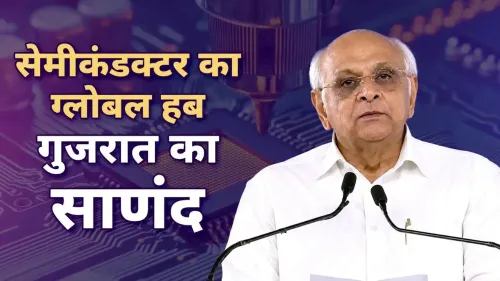
Patel reviewed construction progress at the Tata Electronics Semiconductor Fabrication Facility, a cornerstone of Dholera's planned semiconductor manufacturing ecosystem. The facility is expected to support semiconductor production, ancillary industries, technology firms, and skilled employment generation in the region. Notably, Dholera is being positioned as India's dedicated semiconductor hub, with transport links and residential infrastructure designed in tandem to support a self-sustaining industrial city.
Social Infrastructure and Green Initiatives
The Chief Minister inspected social amenities being built within the SIR's activation area, including a 200-bed multi-speciality hospital, an integrated school, a fire station, a 42-room guest house, a food court with a capacity of 600 people, a 50-tent tent city, a hotel, and residential and commercial projects. Patel also reviewed a plantation drive undertaken by the Forest Department in collaboration with the Sadbhavana Trust, which involves planting more than 1.11 lakh saplings across 53 hectares of green space using the 'drum plantation' technique to improve tree survival rates — an effort to balance industrial growth with environmental sustainability.
National Maritime Heritage Complex and Broader Vision
The review extended to the National Maritime Heritage Complex under construction at Lothal, which forms part of the state government's broader development canvas aligned with Prime Minister Narendra Modi's vision for the region. Dholera Industrial City Development Limited (DICDL) Managing Director Dr Kuldeep Arya presented a detailed briefing on the SIR's industrial and urban infrastructure, connectivity projects, and long-term development roadmap. With the airport, rail corridor, semiconductor plant, and social infrastructure all advancing in parallel, Dholera's transformation from a greenfield site into a functioning industrial city is entering its most consequential phase.
Point of View
And CM Patel's review marks genuine physical progress — a calibration flight landed, a semiconductor plant is rising, and a ₹20,667 crore rail corridor has been approved. Yet the real test is execution speed: India's greenfield industrial city projects have a long history of timeline slippage, and Dholera's value proposition hinges on all its layers — airport, rail, chip plant, housing — arriving together rather than in isolation. The Tata Electronics facility is the high-stakes anchor; if it operationalises on schedule, the rest of the ecosystem has a reason to follow. The government's move to develop social infrastructure in parallel, rather than as an afterthought, is a structural improvement over past industrial corridor playbooks.
NationPress
16 Oct 2026
Frequently Asked Questions
When will Dholera International Airport become operational?
Dholera International Airport is expected to become operational by the end of 2026. A calibration flight has already landed successfully at the facility, signalling that operationalisation is in its final stages.
What is the ₹20,667 crore Ahmedabad-Dholera railway project?
It is a proposed 134-km semi-high-speed double railway line connecting Ahmedabad with Dholera SIR, the international airport, and Lothal, with an estimated cost of ₹20,667 crore. The project has received approval and is intended to provide faster, high-capacity connectivity to the emerging industrial hub.
What is the Tata Electronics semiconductor facility in Dholera?
The Tata Electronics Semiconductor Fabrication Facility is a key component of Dholera's planned semiconductor manufacturing ecosystem, currently under construction. It is expected to support chip manufacturing, ancillary industries, technology companies, and skilled employment in the region.
What social infrastructure is being built in Dholera SIR?
Social amenities under development include a 200-bed multi-speciality hospital, an integrated school, a fire station, a 42-room guest house, a food court with capacity for 600 people, a 50-tent tent city, a hotel, and residential and commercial projects. These are designed to serve residents and workers within the SIR's activation area.
What is the Dholera Special Investment Region?
Dholera SIR is a greenfield industrial city being developed in Ahmedabad district, Gujarat, as a centre for advanced manufacturing, semiconductors, and emerging technologies. It is one of the largest planned industrial regions in India, developed with integrated transport, social infrastructure, and industrial facilities.