Cabinet clears ₹20,667 crore Ahmedabad-Dholera semi-high-speed rail project
Synopsis
India's first indigenously planned semi-high-speed railway corridor has received Cabinet clearance with a ₹20,667 crore outlay, linking Ahmedabad to Dholera SIR, the upcoming Dholera Airport, and the Lothal heritage complex — and setting a template for semi-high-speed rail expansion nationwide.
Key Takeaways
The CCEA approved the Ahmedabad (Sarkhej)–Dholera semi-high-speed double line railway project on Wednesday with an investment of ₹20,667 crore .
The project is the first Indian Railways corridor planned using indigenously developed technology .
The new line will add approximately 134 km to the existing railway network in Ahmedabad district, Gujarat .
Around 284 villages with a population of about 5 lakh will gain enhanced connectivity.
The project is expected to cut CO2 emissions by 2 crore kg and reduce oil imports by 0.48 crore litres .
It will serve as a reference model for phased semi-high-speed rail expansion across India.
The Cabinet Committee on Economic Affairs (CCEA), chaired by Prime Minister Narendra Modi, on Wednesday approved the Ahmedabad (Sarkhej)–Dholera semi-high-speed double line railway project at a total investment of ₹20,667 crore. Notably, this is the first Indian Railways project planned using indigenously developed technology, marking a significant milestone in the country's rail infrastructure push.
What the Project Covers
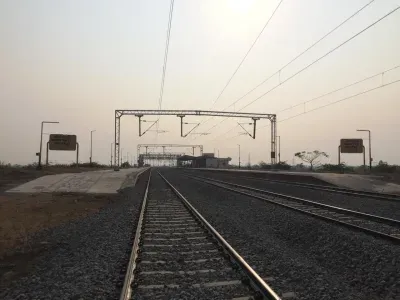
The new line will span approximately 134 km within Ahmedabad district, Gujarat, extending the existing Indian Railways network by that margin. The corridor will provide direct connectivity between Ahmedabad, the Dholera Special Investment Region (SIR), the upcoming Dholera Airport, and the Lothal National Maritime Heritage Complex (NHMC). Around 284 villages with a combined population of roughly 5 lakh are expected to benefit from enhanced connectivity.
Speed, Commuting, and Regional Impact
The semi-high-speed corridor is designed to cut passenger travel time between Ahmedabad and Dholera, enabling comfortable daily commuting and same-day return trips. According to the Cabinet statement, the project will benefit not just the two cities but also residents living hundreds of kilometres away. Officials described it as a pioneer project that will serve as a reference model for the phased expansion of semi-high-speed rail across India.
Infrastructure and Policy Alignment
The project has been planned in accordance with the PM-Gati Shakti National Master Plan, with a focus on multi-modal connectivity, logistics efficiency, and integrated stakeholder planning. It is intended to provide seamless movement of people, goods, and services across the region, improving both efficiency and service reliability for Indian Railways.
Environmental and Economic Benefits
The Cabinet statement highlighted that the project is projected to reduce oil imports by 0.48 crore litres and lower CO2 emissions by 2 crore kg — equivalent to planting 10 lakh trees. As an energy-efficient transport mode, the railway is expected to contribute to India's climate goals while also reducing the country's overall logistics costs. The government added that the project aligns with Prime Minister Modi's vision of a New India, with the aim of fostering self-reliance and expanding employment opportunities in the region.
Point of View
The case for replicating them nationally strengthens considerably; if they falter, it could set back the broader semi-high-speed rollout. The Dholera SIR linkage also signals that the government is doubling down on greenfield industrial cities, where connectivity investment must precede — and ideally catalyse — private capital. The ₹20,667 crore outlay is substantial, but the harder question is timeline: Gujarat's infrastructure projects have a mixed record on delivery against announced schedules, and that track record will determine whether this pioneer project truly becomes a reference model.
NationPress
27 Sept 2026
Frequently Asked Questions
What is the Ahmedabad-Dholera semi-high-speed railway project?
It is a ₹20,667 crore double line railway corridor approved by the Cabinet on Wednesday, connecting Ahmedabad (Sarkhej) to Dholera SIR, the upcoming Dholera Airport, and the Lothal National Maritime Heritage Complex. It is the first Indian Railways project planned using indigenously developed technology.
How long is the Ahmedabad-Dholera railway corridor?
The project will extend the Indian Railways network by approximately 134 km, entirely within Ahmedabad district in Gujarat.
How many villages will benefit from the Dholera railway project?
Around 284 villages with a combined population of about 5 lakh are expected to gain enhanced connectivity through the new rail line.
What are the environmental benefits of this railway project?
According to the Cabinet statement, the project is projected to reduce oil imports by 0.48 crore litres and lower CO2 emissions by 2 crore kg — equivalent to planting 10 lakh trees — by shifting travel to an energy-efficient rail mode.
How does this project fit into India's broader rail expansion plans?
The project is described as a pioneer corridor and reference model for the phased expansion of semi-high-speed rail across India. It is aligned with the PM-Gati Shakti National Master Plan, which focuses on multi-modal connectivity and integrated logistics planning.