Giriraj Singh Hails Cabinet Nod for Ahmedabad Metro Phase-2A
Synopsis
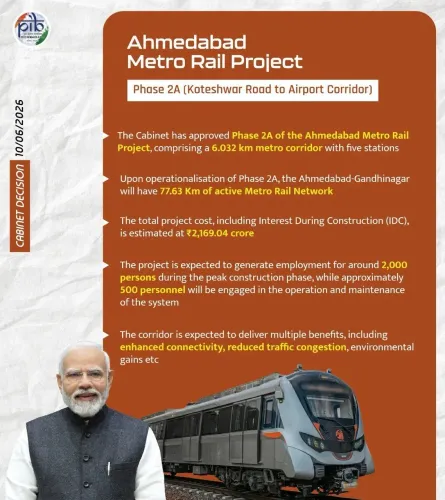
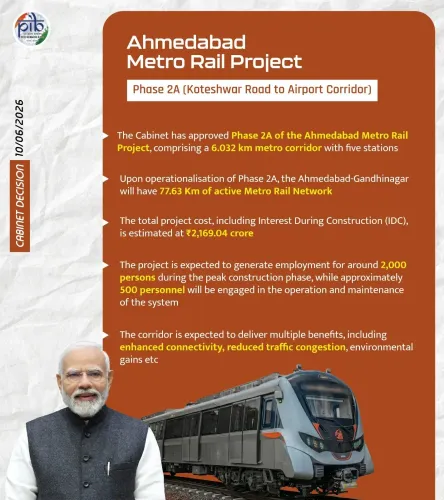
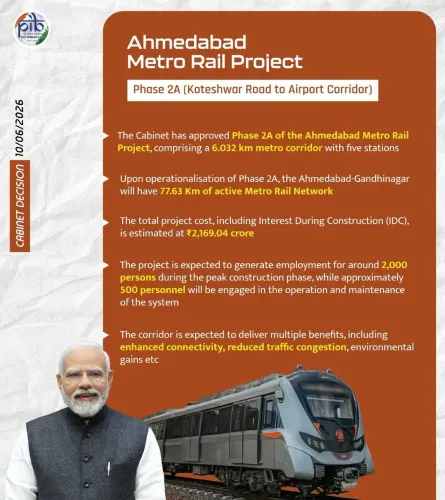
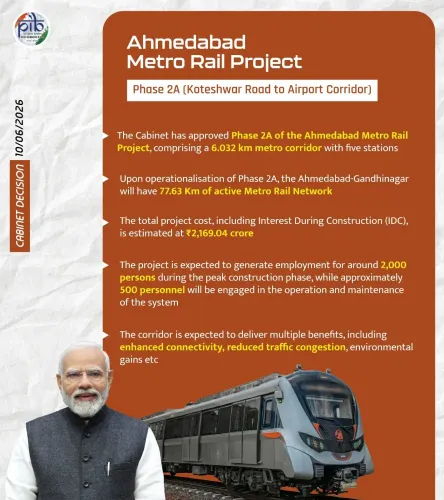
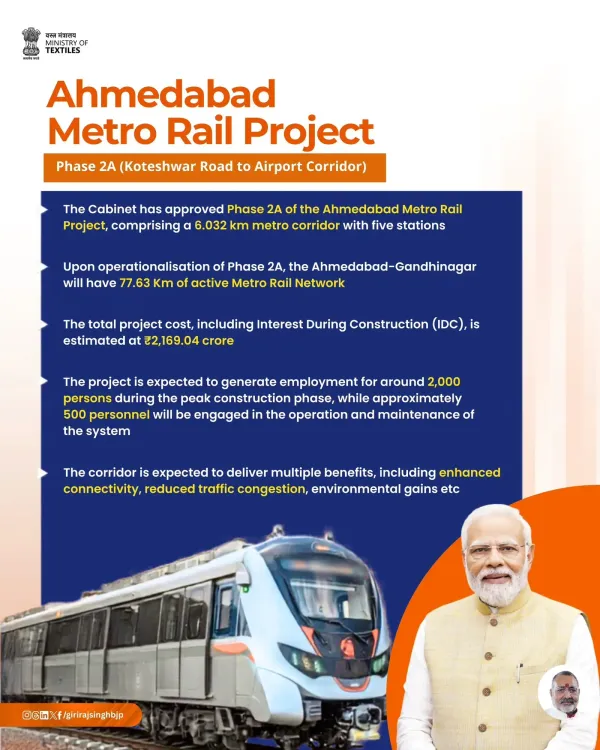
The Union Cabinet has approved Phase-2A of the Ahmedabad Metro Rail Project — the Koteshwar Road–Airport Corridor — at ₹2,169.04 crore. Union Textiles Minister Giriraj Singh hailed the decision as a major step in strengthening urban infrastructure under PM Modi, citing benefits for connectivity, traffic decongestion, and pollution reduction in Ahmedabad.
Key Takeaways
The Union Cabinet approved Phase-2A of the Ahmedabad Metro Rail Project — the Koteshwar Road–Airport Corridor .
The project carries an estimated cost of ₹2,169.04 crore .
Union Textiles Minister Giriraj Singh welcomed the approval on June 10, 2026 , attributing it to PM Narendra Modi's urban infrastructure push.
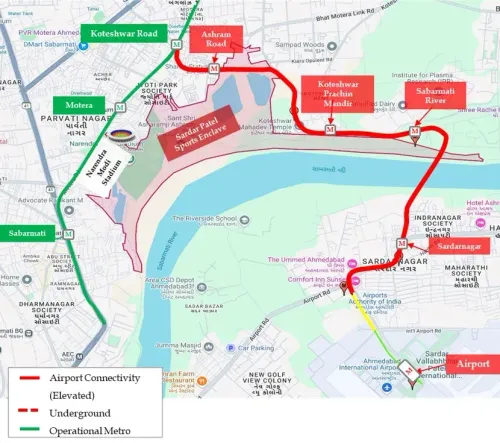
The corridor is expected to improve connectivity between residential zones and Ahmedabad International Airport while reducing traffic congestion and pollution.
The approval continues a national pattern of central government funding for metro rail expansion in major Indian cities since 2014.
Union Textiles Minister Giriraj Singh on Wednesday, June 10, 2026 welcomed the Union Cabinet's approval of Phase-2A of the Ahmedabad Metro Rail Project — the Koteshwar Road–Airport Corridor — at an estimated cost of ₹2,169.04 crore, calling it a significant step in strengthening urban infrastructure under Prime Minister Narendra Modi.
Context
Singh posted on X in Hindi, stating: 'केंद्रीय कैबिनेट द्वारा अहमदाबाद मेट्रो रेल परियोजना के फेज-2A (कोटेश्वर रोड–एयरपोर्ट कॉरिडोर) को मंजूरी दिया जाना इसी दिशा में एक महत्वपूर्ण कदम है' ['The Union Cabinet's approval of Phase-2A of the Ahmedabad Metro Rail Project (Koteshwar Road–Airport Corridor) is an important step in this direction']. The minister credited PM Modi's leadership for the country's 'continuous strengthening of urban basic infrastructure.' The new corridor is positioned to improve connectivity while simultaneously reducing traffic pressure and pollution in Ahmedabad, Gujarat's largest city.
Policy Backdrop
The Ahmedabad Metro Rail Project has been a centrepiece of the central government's urban mobility push since Phase-1 was approved around 2014–15. The project forms part of a broader national drive to expand metro rail networks in major Indian cities — aimed at easing road congestion, cutting vehicular emissions, and providing affordable mass rapid transit. The Union Cabinet has periodically approved new phases and corridors across cities including Delhi, Mumbai, Bengaluru, Pune, and Chennai under central funding frameworks that share project costs between the Centre and the respective state governments.
Ahmedabad, as a major economic and industrial hub, has seen sustained infrastructure investment in recent years, with the metro network intended to integrate key nodes including commercial zones, residential areas, and the city's international airport.
Stakeholders and Impact
The Koteshwar Road–Airport Corridor is expected to directly benefit daily commuters travelling between residential neighbourhoods and Ahmedabad's airport, reducing dependence on private vehicles and intermediate public transport. Urban residents across the city stand to gain from reduced congestion on arterial roads that feed into the airport zone. The project is also expected to generate employment during the construction phase and support ancillary economic activity along the corridor.
Environmental advocates and urban planners have long argued that metro connectivity in high-density corridors offers one of the most effective levers for reducing urban air pollution — a concern that Ahmedabad, like many Indian metros, faces acutely. Singh's post specifically flagged pollution reduction as a key anticipated outcome of the new corridor.
What's Next
Following Cabinet approval, the immediate milestones for the Phase-2A corridor will include tendering of civil and systems contracts, land acquisition processes, and the formal commencement of construction. Observers will also watch for any linked approvals covering remaining phases of the Ahmedabad Metro expansion, which could further extend the network's reach across the city. The pace of execution will be closely tracked given the project's visibility as a flagship urban infrastructure initiative ahead of future electoral cycles in Gujarat.
Point of View
Particularly in Gujarat, a politically significant state. The ₹2,169.04 crore outlay signals continued central fiscal commitment to mass rapid transit at a time when urban congestion and air quality are rising electoral concerns. How quickly the project moves from approval to ground-breaking will be the real test of execution credibility.
NationPress
26 Oct 2026
Frequently Asked Questions
What is the Ahmedabad Metro Phase-2A project?
Ahmedabad Metro Phase-2A refers to the Koteshwar Road–Airport Corridor, a new metro rail stretch approved by the Union Cabinet at an estimated cost of ₹2,169.04 crore to improve connectivity between the city and its international airport.
How much will the Ahmedabad Metro Phase-2A cost?
The Union Cabinet approved the Phase-2A corridor at an estimated cost of ₹2,169.04 crore, according to the post by Union Textiles Minister Giriraj Singh on June 10, 2026.
Why did Giriraj Singh comment on a metro rail project?
As a senior BJP leader and Union minister, Giriraj Singh regularly amplifies major Cabinet decisions on social media to highlight the government's infrastructure agenda, even when the announcement falls outside his direct ministerial portfolio of Textiles.
What are the benefits of the Koteshwar Road–Airport Corridor?
The new corridor is expected to provide faster connectivity between residential areas and Ahmedabad's airport, reduce traffic congestion on key arterial roads, and help lower vehicular pollution in the city.
What is the history of the Ahmedabad Metro Rail Project?
Phase-1 of the Ahmedabad Metro Rail Project was approved around 2014–15 as part of the central government's push to build mass rapid transit systems in major Indian cities, with subsequent phases expanding the network further across Ahmedabad.