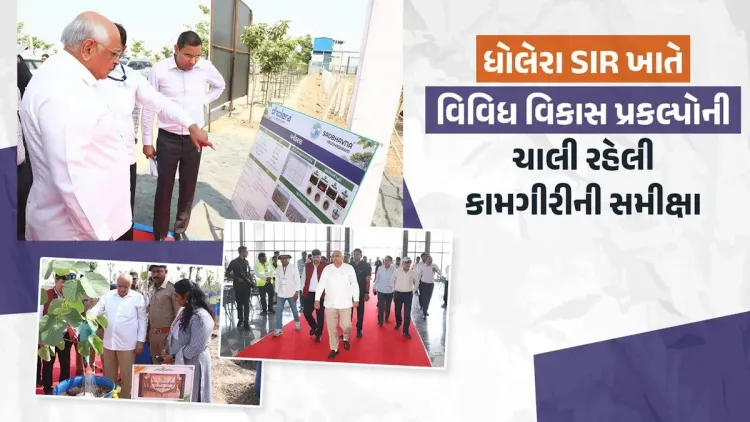
CM Bhupendra Patel inspects Dholera SIR flagship projects
Synopsis
Gujarat CM Bhupendra Patel conducted an on-ground inspection of Dholera SIR on 16 October 2026, reviewing social facilities, a 1.11 lakh-sapling green drive, an operational expressway, an airport calibration flight, and a newly approved ₹20,667 crore semi high-speed rail project.
Key Takeaways
CM Bhupendra Patel personally inspected ongoing flagship projects at Dholera SIR on 16 October 2026 .
Activation Area facilities under development include a 200-bed multi-specialty hospital , an integrated school, and a 600-capacity food court .
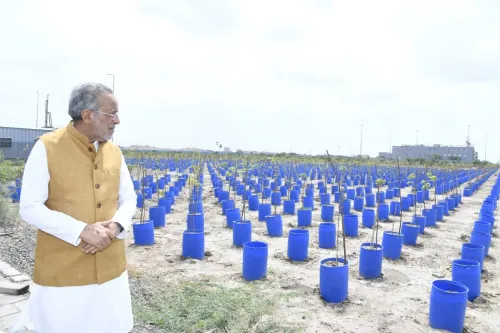
Over 1.11 lakh saplings planted across 53 hectares using the 'Drum Plantation' technique in partnership with the Forest Department and Sadbhavana Trust.
The Ahmedabad-Dholera Expressway is now operational and Dholera International Airport has completed a successful calibration flight landing.
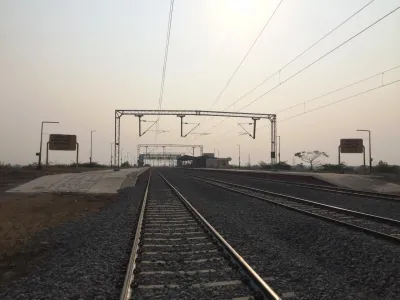
The ₹20,667 crore Ahmedabad-Dholera semi high-speed rail project has received government approval, with transformative implications for regional logistics.
Dholera SIR is a designated node under the Delhi-Mumbai Industrial Corridor , backed by the Gujarat Special Investment Region Act, 2009 .
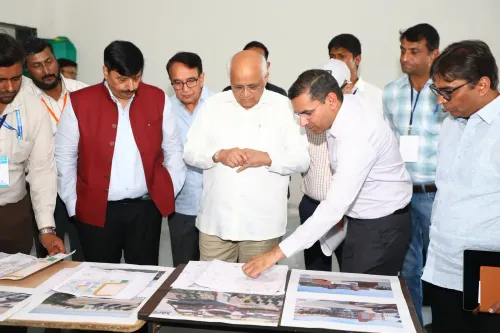
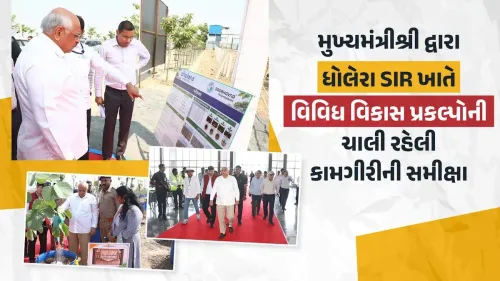
A greenfield city is moving from blueprint to bricks — and Gujarat Chief Minister Bhupendra Patel walked its construction sites personally on Friday, 16 October 2026, conducting a comprehensive on-ground inspection of ongoing development projects at Dholera Special Investment Region (SIR).
What Patel reviewed inside the Activation Area
The CM surveyed the rapid build-out of social and industrial facilities in Dholera's Activation Area — the first zone of the greenfield city to go live. The cluster under development includes a 200-bed multi-specialty hospital, an integrated school, a 600-capacity food court, a fire station, and incoming residential and commercial spaces. Together they form the backbone of a liveable urban environment designed to attract and retain a skilled industrial workforce.
Patel framed the inspection explicitly as an extension of Prime Minister Narendra Modi's vision for world-class infrastructure — a connection with deep roots, given that Modi, as Gujarat's Chief Minister for over a decade, was the original political champion of Dholera's ambitions.
Drum Plantation: green cover at industrial scale
Sustainability got equal billing alongside concrete. Patel assessed the 'Drum Plantation' technique, under which over 1.11 lakh saplings have been planted across 53 hectares of green space in a three-way collaboration between the state Forest Department and Sadbhavana Trust. The method uses drum-shaped structures to nurture saplings in arid conditions — an acknowledgement that turning a salt-flat marshland into a manufacturing metropolis demands deliberate ecological investment.
Three connectivity milestones converging at once
The inspection came as Dholera's connectivity picture sharpened on multiple fronts simultaneously. The Ahmedabad-Dholera Expressway is now operational, cutting travel time between the state capital and the SIR for freight and commuters alike. Dholera International Airport recently recorded a successful calibration flight landing — a technical milestone that marks the facility's progression toward commercial readiness.
Most consequentially, the government has approved the ₹20,667 crore Ahmedabad-Dholera semi high-speed rail project, which Patel described as transformative for logistics. A high-frequency, high-speed rail spine linking the SIR to Ahmedabad's urban and airport network would dramatically compress supply-chain timelines for manufacturers eyeing the zone.
Dholera's long road from policy to pavement
Dholera SIR draws its legal foundation from the Gujarat Special Investment Region Act, 2009, and was designated a flagship node under the Delhi-Mumbai Industrial Corridor (DMIC) project — one of the most ambitious freight-and-industry corridors ever conceived in Asia. For years, the project was a favourite exhibit of critics who argued that India's grand industrial townships existed mostly on presentation slides. The simultaneous activation of an expressway, a calibration flight, and a rail approval — alongside tangible social infrastructure on the ground — gives the government a concrete rebuttal to that narrative.
Gujarat governments across successive administrations have pursued integrated townships that bundle connectivity, social amenities, and green cover to differentiate the state as a premium manufacturing destination. Dholera, with its sheer scale and proximity to a planned international airport, is the most ambitious iteration of that strategy yet.
With the rail link approved and the airport edging toward readiness, the pressure now shifts to execution: land acquisition, funding disbursement, and construction timelines on the semi high-speed corridor will be the metrics that determine whether Dholera's 'global epicenter for advanced manufacturing' tag becomes self-fulfilling — or deferred once more.
Point of View
Airport, rail — either operational or approved simultaneously, the BJP government in Gujarat needs to demonstrate that ground-level social infrastructure is keeping pace with headline connectivity announcements. Tying the inspection explicitly to PM Modi's vision reinforces the narrative that Dholera is a pan-BJP flagship, not just a state-level project, ahead of any investor engagement events. The inclusion of the green-cover initiative signals a conscious effort to pre-empt environmental criticism that has historically dogged large industrial townships. The real test will be the execution timelines on the ₹20,667 crore rail corridor — approval and construction are very different milestones.
NationPress
16 Oct 2026
Frequently Asked Questions
What is Dholera SIR and why is it significant?
Dholera Special Investment Region (SIR) is a planned greenfield industrial city in Gujarat, designated as a key node under the Delhi-Mumbai Industrial Corridor and developed under the Gujarat Special Investment Region Act, 2009. It is intended to become a major hub for advanced manufacturing with integrated urban, social, and connectivity infrastructure.
What projects did CM Bhupendra Patel inspect at Dholera SIR?
On 16 October 2026, CM Patel reviewed a 200-bed multi-specialty hospital, an integrated school, a 600-capacity food court, a fire station, and upcoming residential and commercial spaces in the Activation Area, as well as the Drum Plantation green initiative spanning 53 hectares.
What is the Ahmedabad-Dholera semi high-speed rail project?
It is a newly approved ₹20,667 crore rail project connecting Ahmedabad to Dholera SIR, designed to transform logistics for the industrial region. The approval was highlighted by CM Patel as a key milestone in Dholera's connectivity push.
Has Dholera International Airport started flights?
The airport has not yet opened for commercial flights, but it recently completed a successful calibration flight landing — a technical milestone indicating the facility is progressing toward operational readiness.
What is the Drum Plantation technique used at Dholera?
The Drum Plantation technique uses drum-shaped structures to nurture saplings in arid or challenging soil conditions. At Dholera, it has been used to plant over 1.11 lakh saplings across 53 hectares in collaboration with the Forest Department and Sadbhavana Trust.