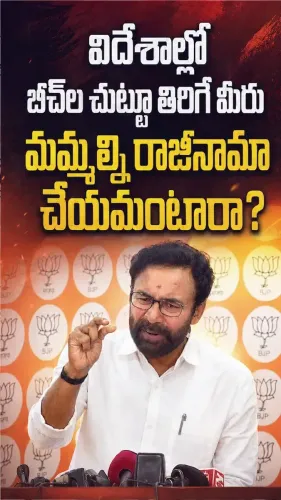
Kishan Reddy accuses Congress of 'regime-change' conspiracy
Synopsis
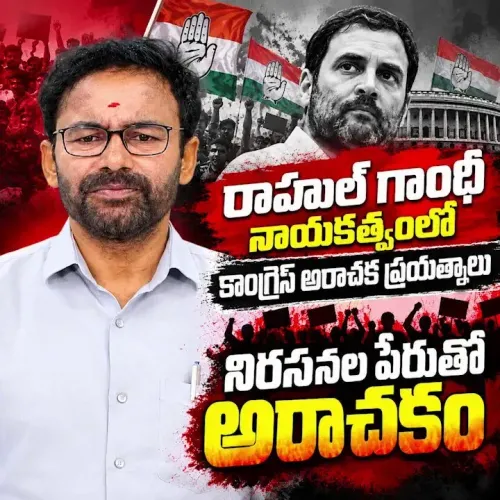
Union Coal and Mines Minister G. Kishan Reddy accused Congress and Rahul Gandhi on 16 October 2026 of running a premeditated 'regime-change operation' through manufactured electoral fraud claims, street escalation, and attacks on constitutional institutions — framing it as anti-national disruption of India's democratic order.
Key Takeaways
Kishan Reddy , Union Minister of Coal and Mines and BJP Telangana president, posted a sharp attack on Congress on 16 October 2026 .
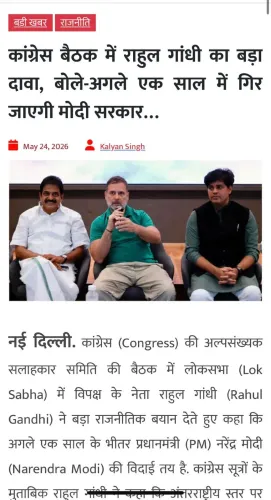
He accused Rahul Gandhi and Congress of pursuing 'street-veto anarchy' and a 'premeditated regime-change operation' after losing elections.
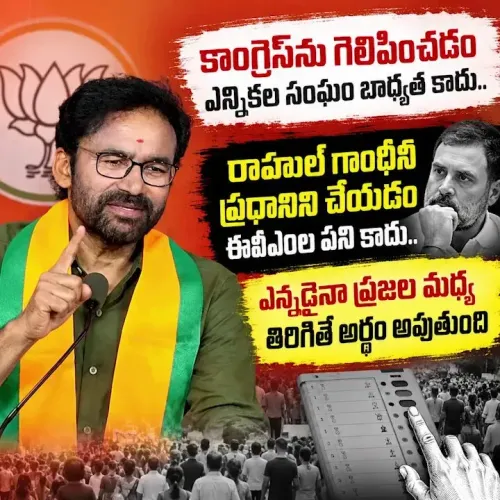
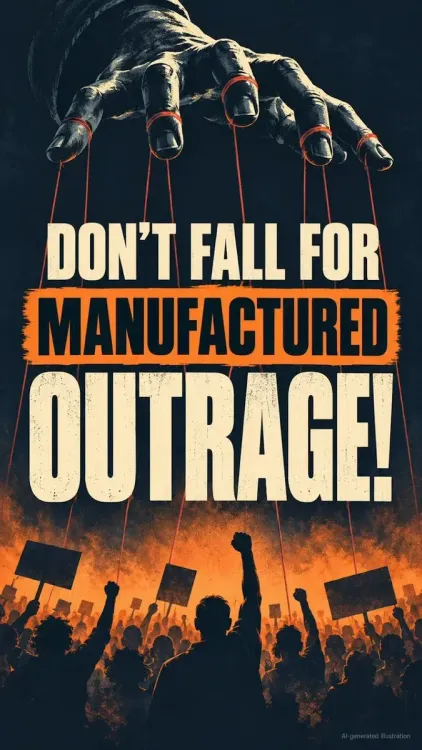
Reddy labelled Congress's 'vote chori' (vote-theft) claims as 'manufactured outrage' and part of a 'calculated script.' He drew an explicit comparison between Congress's alleged tactics and recent political instability in neighbouring countries.
The post invoked PM Narendra Modi's leadership of a 'resilient, fast-growing economy' serving 140 crore Indians as the democratic mandate under threat.
BJP has consistently used the institutional-threat framing against Congress since 2014 ; Reddy's post sharpens that narrative with a foreign-instability comparison.
A sharp political broadside landed on Friday, 16 October 2026, when Union Coal and Mines Minister G. Kishan Reddy accused the Indian National Congress and Rahul Gandhi of orchestrating a deliberate 'regime-change operation' — charging that the party, unable to win electoral mandates, had turned to street pressure, misinformation, and institutional sabotage to subvert India's constitutional order.
The 'vote chori' allegation and what Kishan Reddy is calling out
Reddy's post draws a direct, explicit line between Congress's domestic opposition tactics — what he labels 'manufactured outrage' and baseless 'vote chori' (vote-theft) claims — and episodes of political instability in neighbouring countries. He argues the playbook is identical: contest electoral outcomes loudly, amplify claims of institutional fraud, escalate on the streets, and attempt to force a change of government outside the democratic process. 'Whenever democratic electoral results reject them, their default strategy becomes manufacturing misinformation,' Reddy writes, framing it not as organic protest but as 'a calculated script.'
The minister specifically names Rahul Gandhi as the author of what he calls 'dangerous narratives of street-veto anarchy.' That phrasing — street veto — is pointed: it implies that Congress is seeking to override voter verdicts through crowd pressure rather than the ballot box.
BJP's institutional-threat framing, and its long history
This is not the first time BJP has deployed this line of argument. Since 2014, the party has consistently framed Congress's political campaigns — from protests against electoral bonds to street agitations over specific policy decisions — as attacks on the judiciary, the Election Commission of India, and other constitutional bodies. What makes Reddy's post notable is the explicit foreign-country comparison: by invoking regional instability, he is attempting to internationalise the stakes of what is, at its core, a domestic political dispute.
Reddy also anchors the defence in economic terms, citing Prime Minister Narendra Modi's leadership of a 'resilient, fast-growing economy' serving 140 crore Indians — the implicit argument being that disruptive politics threatens a prosperity story that the electorate has already endorsed at the polls.
What Congress has argued, and what comes next
The Congress party and Rahul Gandhi have, in turn, consistently accused the BJP of weakening independent institutions — from the central investigative agencies to the Election Commission — in order to entrench its electoral advantage. Their counter-narrative frames protest and public accountability as legitimate democratic tools, not subversion. That clash of framings is the fault line running through Indian political discourse, and it sharpens every time opposition agitations spill onto the streets.
Reddy, as BJP's Telangana state president, also has a regional stake in this battle: Telangana is governed by a Congress administration, making the state a live theatre for exactly the kind of BJP-Congress confrontation he is describing at the national level.
Whether Congress chooses to respond formally — in Parliament, on social media, or through a press briefing — will determine how long this particular exchange stays in the news cycle. Either way, Kishan Reddy has drawn the lines clearly: for BJP, the legitimacy of India's democratic institutions is the campaign itself.
Point of View
Designed to cast domestic opposition in a national-security register and put Congress on the defensive about intent rather than policy. As BJP Telangana president, Reddy also has a direct electoral incentive to keep this narrative sharp: Telangana is Congress-governed, making every national BJP-Congress clash a proxy battle for his home state. The exchange signals that Indian political temperature is running high well ahead of any formal electoral calendar.
NationPress
16 Oct 2026
Frequently Asked Questions
What did G. Kishan Reddy say about Congress on 16 October 2026?
Kishan Reddy accused Congress and Rahul Gandhi of orchestrating a 'premeditated regime-change operation' through manufactured 'vote chori' claims, street escalation, and attacks on India's judiciary and electoral bodies, calling it anti-national disruption.
What is 'vote chori' and why is BJP criticising it?
'Vote chori' literally means 'vote theft' in Hindi. BJP, through Kishan Reddy, is criticising Congress for using unverified claims of electoral fraud to delegitimise election outcomes they have lost, calling such claims baseless and destabilising.
Why did Kishan Reddy compare Congress to Bangladesh and Nepal instability?
Reddy drew the comparison to argue that the Congress tactic of contesting electoral results through street protests follows a similar script to episodes of political instability in neighbouring countries — though the research notes those specific foreign references remain unverified.
What is G. Kishan Reddy's political position?
G. Kishan Reddy is India's Union Minister of Coal and Mines and also serves as the BJP state president for Telangana.
How has Congress historically responded to BJP's anti-national charges?
Congress has consistently countered by accusing BJP of weakening independent institutions — from investigative agencies to the Election Commission — and argues that protest and public accountability are core democratic rights, not subversion.