Why Did NIA Charge Four More Maoists in Gopniya Sainik Murder?
Click to start listening
Synopsis
The NIA has intensified its investigation by charge sheeting four additional Maoists in the murder of a Gopniya Sainik in Chhattisgarh. This troubling incident underscores the ongoing violence and threats posed by Maoist groups to surrendered cadres and local communities. Stay informed on the latest developments.
Key Takeaways
- Four additional Maoists charged in the Gopniya Sainik murder case.
- Total of eight individuals now charged in connection with the case.
- The victim was a former Maoist who had surrendered to the police.
- The NIA's investigation is ongoing and active.
- Separate cases are also being pursued by the NIA related to terrorism.
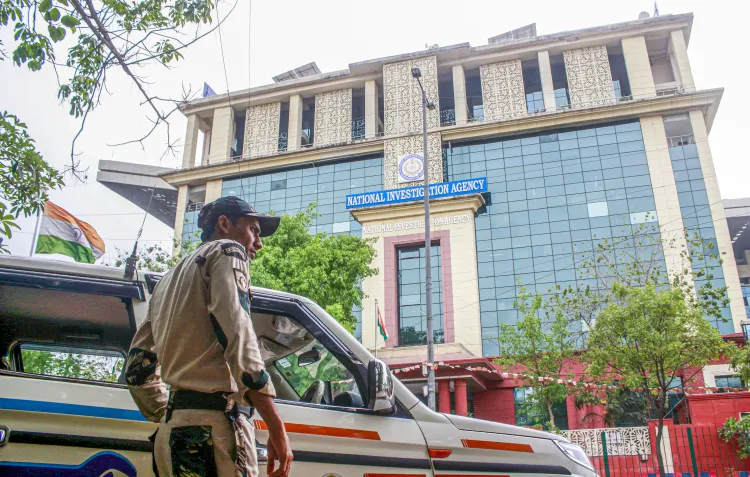
New Delhi, Jan 3 (NationPress) On Saturday, the National Investigation Agency (NIA) filed charges against four additional CPI (Maoist) members in relation to the assassination of a ‘Gopniya Sainik’ affiliated with the Bijapur district police in Chhattisgarh.
The individuals named in the charges are Raju Kursam, Sukku Kursam, Shankar Kursam, and Mannu Kursam. They face charges under various sections of the Indian Penal Code (IPC) and the Unlawful Activities (Prevention) Act, as stated in an official release.
With these new charges, the total number of individuals charged in this case rises to eight, following earlier indictments of four others. All eight have been apprehended in connection with the case RC-14/2024/NIA/RPR.
The deceased, Chotu, also known as Kishan Kursam, was murdered by the outlawed CPI (Maoist) group in December 2023 as part of a campaign to instill fear among surrendered members and the local community.
Chotu had previously been part of the CPI (Maoist) but had surrendered to the Bijapur police and integrated into society as their ‘Gopniya Sainik’.
In response to the increasing number of such 'defections,' CPI (Maoist) members in the area threatened surrendered individuals, conspiring to eliminate those who refused to rejoin and continued supporting the police.
The NIA took over the investigation in March 2024 and is actively pursuing leads in the case.
In a separate matter, on Thursday, the NIA also charged three individuals in the 2023 Bengaluru prison radicalisation case linked to the banned Lashkar-e-Taiba terrorist group.
The agency's second supplementary charge sheet identifies Anees Fathima, Chan Pasha A, and Dr Nagaraj S under multiple sections of the IPC, UA(P) Act, Explosive Substances Act, Prevention of Corruption Act, and the Karnataka Prisons Act.
The NIA, which assumed control of this case from local authorities in October 2023, had previously charged nine individuals, including fugitive Junaid Ahmed.
This case, initially filed by the Bengaluru City police in July 2023, involved the seizure of weapons, ammunition, and digital devices from habitual offenders who had planned to instigate terror in the city, aiming to undermine India's sovereignty and security.
These activities were part of a broader conspiracy to facilitate the escape of T Naseer, a life convict linked to several terror-related charges, while being transported from prison to court. At that time, Naseer was an under-trial prisoner in connection with the 2008 Bengaluru serial blast incidents.
Point of View
It is essential to recognize the ongoing threat posed by extremist groups like the CPI (Maoist) and their ruthless tactics. The murder of the Gopniya Sainik serves as a grim reminder of the challenges faced by law enforcement in ensuring the safety of individuals who have chosen to turn away from violence. The NIA's proactive approach in charge sheeting the accused is commendable and highlights the urgent need for continued vigilance in combatting terrorism in India.
NationPress
05/01/2026
Frequently Asked Questions
Who are the accused in the Gopniya Sainik murder case?
The accused include Raju Kursam, Sukku Kursam, Shankar Kursam, and Mannu Kursam, along with four others previously charged.
What was the motive behind the murder?
The murder was intended to instill fear among surrendered cadres and discourage defections from the CPI (Maoist) organization.
What actions has the NIA taken in this case?
The NIA has charge sheeted a total of eight individuals and continues to investigate the case actively.
What is the significance of the term 'Gopniya Sainik'?
'Gopniya Sainik' refers to individuals who have surrendered from Maoist groups and are cooperating with law enforcement.
Are there other cases linked to the NIA's investigation?
Yes, the NIA is also involved in the Bengaluru prison radicalization case, highlighting their broader efforts against terrorism.