Chhattisgarh Cabinet clears landmark Ease of Doing Business Bill 2026
Synopsis
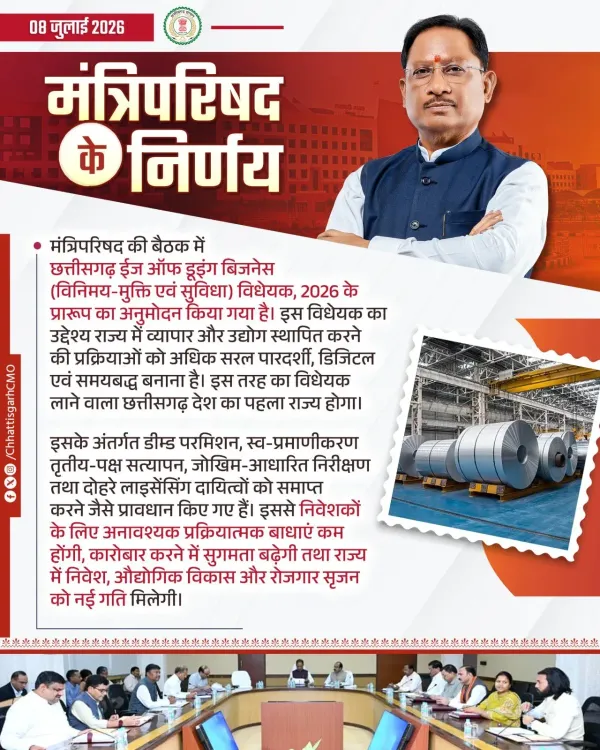
The Chhattisgarh cabinet has approved a draft Ease of Doing Business Bill 2026 that introduces deemed permissions, self-certification, and risk-based inspections. The government claims Chhattisgarh will be the first Indian state to enact such a dedicated law, aiming to attract investment and generate employment.
Key Takeaways
The Chhattisgarh cabinet approved the draft Ease of Doing Business (Exemption and Facilitation) Bill, 2026 on 8 July 2026 .
The government claims Chhattisgarh will be the first state in India to enact a dedicated ease-of-doing-business law.
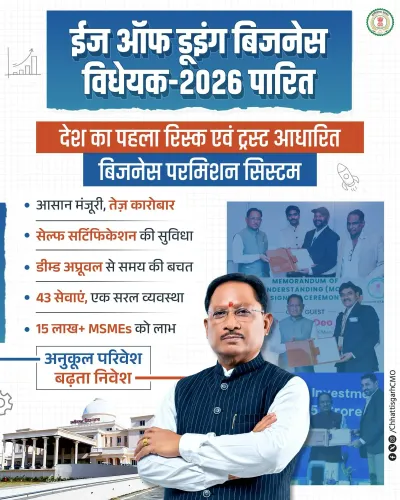
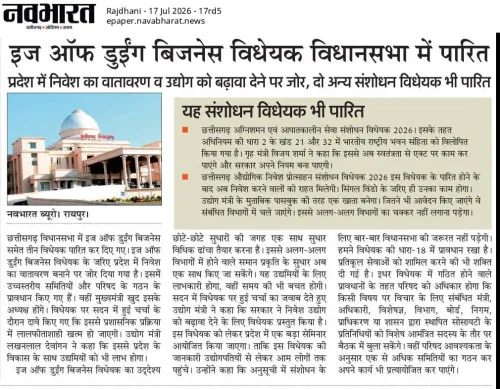
Key provisions include deemed permission , self-certification , third-party verification , risk-based inspections , and elimination of dual licensing obligations .
The bill is aimed at simplifying, digitising, and making business establishment processes time-bound for investors, entrepreneurs, and MSMEs .
The draft must now be introduced and passed by the Chhattisgarh Legislative Assembly before it becomes law.
The legislation aligns with the central government's Business Reform Action Plan (BRAP) and the broader Make in India framework.
The Chief Minister's Office of Chhattisgarh announced on Wednesday, 8 July 2026 that the state cabinet has approved the draft of the Chhattisgarh Ease of Doing Business (Exemption and Facilitation) Bill, 2026, a legislation that the government claims will make Chhattisgarh the first state in India to enact such a dedicated law for business facilitation.
Context
The cabinet resolution, shared via the official CMO account, states that the bill aims to make the process of establishing trade and industry in the state 'अधिक सरल, पारदर्शी, डिजिटल एवं समयबद्ध' ('more simple, transparent, digital and time-bound'). The government says the legislation will reduce unnecessary procedural hurdles for investors and accelerate industrial development and job creation in the state.
Key provisions outlined in the announcement include deemed permission, self-certification, third-party verification, risk-based inspections, and the elimination of dual licensing obligations. These mechanisms are designed to cut the compliance burden that businesses currently face when seeking regulatory approvals from multiple state agencies.
Policy Backdrop
The bill fits into a decade-long national push to improve the business climate at the state level. The central government's Business Reform Action Plan (BRAP), coordinated by the Department for Promotion of Industry and Internal Trade (DPIIT), has since 2015 ranked states on their ability to reduce regulatory compliance for businesses, creating strong competitive incentives among state governments.
The Make in India initiative, launched in 2014, explicitly called on states to introduce single-window clearance and deemed-approval systems. Several states including Maharashtra and Telangana have enacted reforms along similar lines, replacing physical licences with digital self-certification and risk-based oversight. Chhattisgarh's proposed bill represents a further step in this direction, with the government asserting it will be the first standalone legislative framework of its kind in the country.
Chhattisgarh is a mineral-rich central Indian state that has been actively seeking to diversify its industrial base beyond mining and attract manufacturing investment. Improving its BRAP ranking has been a stated administrative priority in recent years.
Stakeholders and Impact
The legislation is expected to benefit investors, industrial entrepreneurs, and the MSME sector most directly. By introducing deemed permissions — where regulatory approval is assumed if no objection is raised within a stipulated period — the bill would reduce the time businesses spend waiting for clearances from multiple departments.
The self-certification and third-party verification provisions shift the compliance model from inspector-driven approvals to a system where businesses take responsibility for meeting standards, with risk-based inspections targeting only high-risk operations. The removal of dual licensing requirements is aimed at eliminating situations where a business must obtain overlapping approvals from different state bodies for the same activity.
Formal employment generation is also cited as a downstream benefit, as reduced procedural friction is expected to encourage new project launches and expansions, particularly among smaller enterprises that are disproportionately affected by regulatory delays.
What's Next
The approved draft must now be introduced and debated in the Chhattisgarh Legislative Assembly before it can become law. Following passage, the state government will need to publish detailed implementation rules specifying timelines, nodal agencies, and the digital infrastructure required to operationalise deemed-permission and self-certification mechanisms.
Industry observers and policy analysts will watch whether the legislation's passage translates into measurable improvement in Chhattisgarh's performance in the next BRAP ranking cycle. If the state's claim of being the first in India to enact such a dedicated ease-of-doing-business law holds, it could set a legislative template that other states seek to replicate, intensifying the ongoing inter-state competition for private investment.
Point of View
It hands the ruling dispensation a concrete governance credential ahead of future electoral cycles. The emphasis on deemed permissions and self-certification reflects a broader national shift away from inspector-raj toward compliance-trust models, though the real test will be whether implementing rules are notified promptly and digital infrastructure is actually built. Chhattisgarh's mineral-dependent economy gives the bill added urgency: diversifying into manufacturing requires exactly the kind of procedural predictability that investors consistently cite as a prerequisite.
NationPress
7 Oct 2026
Frequently Asked Questions
What is the Chhattisgarh Ease of Doing Business Bill 2026?
It is a draft legislation approved by the Chhattisgarh cabinet on 8 July 2026 that seeks to simplify, digitise, and make time-bound the process of establishing businesses and industries in the state through provisions such as deemed permission, self-certification, third-party verification, risk-based inspections, and removal of dual licensing obligations.
Is Chhattisgarh really the first state in India to bring such a law?
The state government has claimed that Chhattisgarh will be the first Indian state to enact a dedicated ease-of-doing-business law of this kind. This claim will be formally verifiable once the bill is passed by the Chhattisgarh Legislative Assembly and published in the official gazette.
What is deemed permission and how does it help businesses?
Deemed permission is a mechanism under which a regulatory approval is treated as granted automatically if the concerned authority does not raise an objection within a specified time limit. This removes indefinite waiting periods for businesses seeking licences or clearances from government departments.
How does this bill relate to the central government's BRAP rankings?
The central government's Business Reform Action Plan, coordinated by DPIIT, ranks states on regulatory reforms that reduce compliance burdens for businesses. Enacting statutory provisions for self-certification, deemed approvals, and risk-based inspections directly improves a state's BRAP score and signals credibility to investors.
What happens next after the cabinet approval?
The approved draft bill must be introduced in the Chhattisgarh Legislative Assembly, debated, and passed before it becomes law. The government will then need to notify implementation rules covering timelines, digital systems, and nodal agencies for the new mechanisms to take effect.