Chhattisgarh Cabinet clears GST Amendment Bill 2026
Synopsis
The Chhattisgarh Cabinet has cleared the draft GST Amendment Bill 2026, seeking to simplify tax compliance, accelerate refunds for exporters and inverted-duty industries, and boost state revenue. The bill now heads to the state legislature for passage.
Key Takeaways
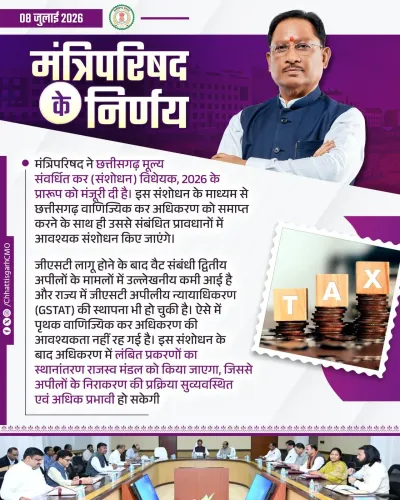
The Chhattisgarh Cabinet approved the draft Chhattisgarh Goods and Services Tax (Amendment) Bill, 2026 at its meeting on 8 July 2026 .
The amendment aims to simplify GST law and ease compliance procedures for all state taxpayers.
A key focus is making the refund process faster and more transparent for exporters and industries under an inverted duty structure.
The state government expects the changes to improve tax administration efficiency and increase state revenue .
The draft bill must now be introduced and passed in the Chhattisgarh Legislative Assembly before it takes effect.
The move aligns with a broader national pattern of states updating GST laws to address compliance friction since the regime's 2017 launch.
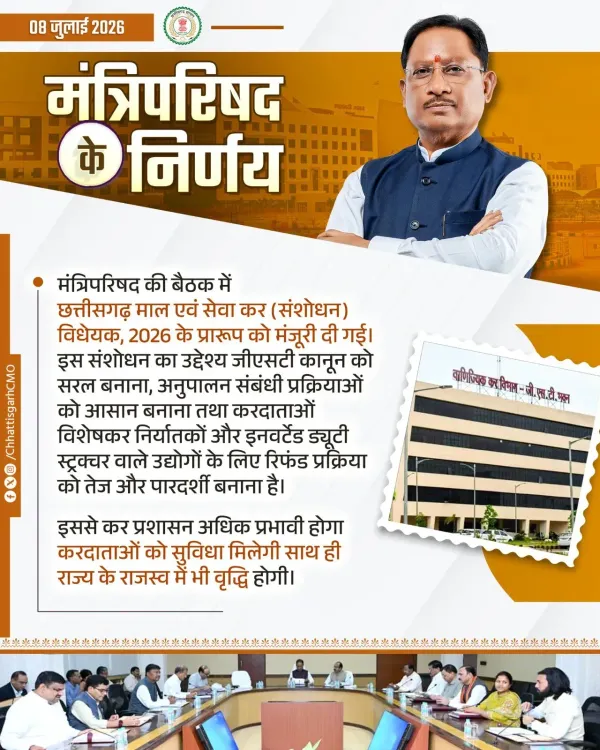
The Chief Minister's Office of Chhattisgarh announced on Wednesday, 8 July 2026 that the state Cabinet has approved the draft of the Chhattisgarh Goods and Services Tax (Amendment) Bill, 2026, aimed at simplifying the state's GST framework, easing compliance procedures, and accelerating refunds for exporters and industries operating under an inverted duty structure.
Context
The Cabinet communicated the decision via an official post, stating: 'मंत्रिपरिषद की बैठक में छत्तीसगढ़ माल एवं सेवा कर (संशोधन) विधेयक, 2026 के प्रारूप को मंजूरी दी गई' ('The Cabinet meeting approved the draft of the Chhattisgarh Goods and Services Tax (Amendment) Bill, 2026'). The announcement highlighted three core objectives: simplifying GST law, easing compliance processes, and making the refund mechanism faster and more transparent — particularly for exporters and industries with an inverted duty structure.
The state government added that the amendment is expected to make tax administration more effective, provide greater convenience to taxpayers, and contribute to an increase in state revenue.
Policy Backdrop
Chhattisgarh, like all Indian states, enacted its own GST legislation in 2017 in parallel with the central framework, following the 101st Constitutional Amendment that rolled out India's unified indirect tax regime from 1 July 2017. The national GST structure subsumed multiple central and state levies, requiring states to periodically update their laws to reflect GST Council recommendations and address on-ground compliance friction.
Refund delays for exporters and inverted-duty sectors — where the tax paid on inputs is higher than the tax collected on outputs, creating a credit surplus — have been a persistent pain point since the regime's launch. Accelerating such refunds directly improves working-capital liquidity for affected businesses and has been a recurring theme in state-level GST amendments across India.
Stakeholders and Impact
Exporters and manufacturers in inverted duty structure industries stand to benefit most immediately from the proposed changes, as faster and more transparent refund processing reduces the capital locked in pending claims. Broader taxpayer convenience measures within the bill are expected to lower compliance costs for small and medium enterprises operating in Chhattisgarh.
The state government also frames the amendment as a revenue-administration tool, suggesting that a more efficient and transparent system will help plug leakages and expand the state's own tax base — a priority for a mineral-rich state that has sought to diversify its fiscal sources beyond natural-resource royalties.
What's Next
The approved draft now moves toward introduction in the Chhattisgarh Legislative Assembly, where it will require passage before becoming law. Following enactment, the state tax department would be expected to notify corresponding changes in refund-processing systems and compliance workflows. Stakeholder groups — particularly export associations and industry bodies in the inverted-duty segments — will watch the bill's final text closely for the specific timelines and procedural safeguards it introduces.
If enacted as described, the amendment would mark one of the more substantive updates to Chhattisgarh's GST architecture since the original 2017 legislation, with implications for how the state positions itself as a business-friendly destination for manufacturing and export-oriented investment.
Point of View
The state government is threading a politically useful needle — projecting both pro-business credentials and fiscal responsibility. The move fits a broader pattern of BJP-governed states pushing GST administration reforms ahead of assembly sessions, using 'good governance' optics to differentiate on economic management. The real test will come in the bill's fine print and the tax department's implementation speed once the legislation clears the Assembly.
NationPress
7 Oct 2026
Frequently Asked Questions
What is the Chhattisgarh GST Amendment Bill 2026?
It is a draft amendment to the Chhattisgarh Goods and Services Tax Act, approved by the state Cabinet on 8 July 2026, that seeks to simplify the GST law, ease compliance procedures, and speed up refunds for exporters and inverted-duty industries.
Who benefits from the Chhattisgarh GST Amendment Bill 2026?
Exporters and industries operating under an inverted duty structure — where input taxes exceed output taxes — are the primary beneficiaries, as the bill targets faster and more transparent refund processing. All state taxpayers are expected to gain from simplified compliance procedures.
What is an inverted duty structure in GST?
An inverted duty structure arises when the GST rate on a business's inputs is higher than the rate on its final products, resulting in an accumulated input tax credit that the government owes back as a refund. Delays in these refunds have been a persistent liquidity problem for affected industries since 2017.
When will the Chhattisgarh GST Amendment Bill 2026 become law?
The Cabinet has approved only the draft. The bill must be introduced and passed by the Chhattisgarh Legislative Assembly and then notified before it becomes enforceable law. No specific Assembly session date has been announced.
How does this amendment relate to the national GST framework?
Chhattisgarh, like all states, enacted its own GST law in 2017 parallel to the central legislation after the 101st Constitutional Amendment. States periodically amend their acts to incorporate GST Council decisions and address compliance issues; this bill is part of that ongoing alignment process.