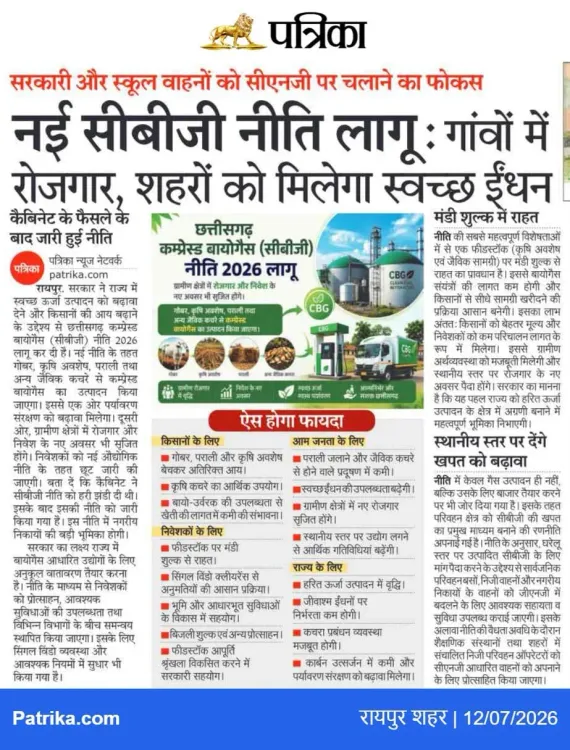
Chhattisgarh CMO unveils new CBG policy for rural jobs, clean fuel
Synopsis
The Chief Minister's Office of Chhattisgarh announced a new Compressed Biogas policy on 12 July 2026, aiming to create rural employment through organic-waste processing while channelling clean fuel to urban centres — part of India's broader push for circular-economy energy solutions under the SATAT framework.
Key Takeaways
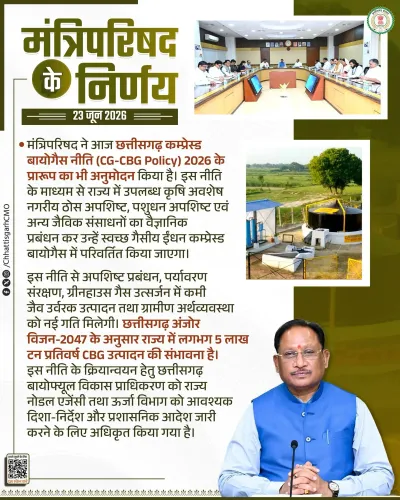
The Chief Minister's Office of Chhattisgarh announced a new Compressed Biogas (CBG) policy on 12 July 2026 .
The policy is designed to generate rural employment through feedstock collection and plant operations, and supply clean fuel to urban areas.
CBG is produced from agricultural residue, cattle dung and municipal solid waste, making it directly relevant to Chhattisgarh's agrarian economy.
The initiative aligns with the Union government's SATAT initiative (2018) and the National Policy on Biofuels 2018 , which guarantee offtake of CBG by oil marketing companies.
Detailed policy provisions — including plant targets, subsidies and offtake MoUs — are yet to be made public.
The announcement is framed under the state government's 'Sushasansarkar' (good governance) branding.
The Chief Minister's Office of Chhattisgarh announced a new Compressed Biogas (CBG) policy on Sunday, 12 July 2026, positioning it as a dual-purpose intervention to generate employment in villages and supply clean fuel to urban centres across the state.
Posting on X, the CMO said the policy would bring 'rozgaar' (employment) to villages while delivering clean fuel to cities, describing better waste management and a new path to development as the essence of 'sushasan' (good governance). The post was tagged under #CBGPolicy, #CleanEnergy, and #RuralDevelopment, signalling the government's intent to frame the initiative within a broader green-economy narrative.
Context
Compressed Biogas is produced by processing organic waste — including agricultural residue, cattle dung and municipal solid waste — through anaerobic digestion. The resulting gas is chemically equivalent to Compressed Natural Gas (CNG) and can be used as a transport and cooking fuel. Chhattisgarh, a state with a large rural and agrarian population, generates substantial quantities of organic feedstock that currently goes largely unused or is burned in fields. The CMO's announcement frames the new policy as addressing two simultaneous gaps: the absence of clean-fuel infrastructure in urban areas and the lack of non-farm income opportunities in villages, where feedstock collection and plant operation can create local jobs.Policy Backdrop
The Chhattisgarh CBG policy builds on a well-established national framework. The Union government launched the SATAT (Sustainable Alternative Towards Affordable Transportation) initiative in October 2018 under the Ministry of Petroleum and Natural Gas, inviting entrepreneurs to set up CBG plants with guaranteed offtake from oil marketing companies. The National Policy on Biofuels 2018 further recognised CBG as a priority clean transport fuel and set indicative blending targets. Since 2018, multiple Indian states have notified state-level CBG incentives to attract private investment in biomethanation infrastructure. Chhattisgarh's move aligns with this national circular-economy push, which also aims to reduce India's dependence on crude oil imports and curb the practice of stubble burning — a major seasonal air-pollution source in agricultural states.Stakeholders and Impact
The policy is expected to affect three broad groups. Rural farmers and waste aggregators stand to benefit from feedstock-supply contracts that convert agricultural residue and cattle dung into a revenue stream. Urban households and fleet operators could gain access to domestically produced clean fuel that can substitute for imported natural gas. Municipal bodies may find a structured outlet for organic fractions of municipal solid waste, easing pressure on landfills. Chhattisgarh's economy has historically been anchored in mining, forests and farming. A CBG ecosystem, if scaled, could diversify rural income sources and reduce the carbon intensity of the state's energy mix — both stated priorities of the current administration under the 'Sushasansarkar' (good-governance government) branding used in the post.What's Next
The detailed provisions of the new CBG policy — including plant-count targets, district-wise feedstock allocation, capital-subsidy structures and the status of offtake agreements with oil marketing companies — are yet to be made public. Observers will watch for the state government's formal gazette notification and whether it signs memoranda of understanding with national oil companies to guarantee purchase of CBG produced under the policy. The pace of private investment and the identification of anchor feedstock zones across Chhattisgarh's agricultural belts will determine how quickly the employment and clean-fuel benefits materialise on the ground.Point of View
The CMO is tying a technical energy-transition measure to an electoral identity, signalling that green-economy initiatives are now seen as viable vote-mobilisation tools even in states where the rural economy dominates. The dual emphasis on rural employment and urban clean fuel is notable: it attempts to bridge a political constituency divide that has historically made energy-transition policies harder to sell in agrarian states. The real test will be implementation speed — states that have announced similar CBG policies since 2018 have seen uneven private investment, and Chhattisgarh's ability to attract plant operators will depend heavily on the subsidy and offtake terms it eventually notifies.
NationPress
12 Jul 2026
Frequently Asked Questions
What is the new Chhattisgarh CBG policy about?
The Chhattisgarh government announced a new Compressed Biogas (CBG) policy on 12 July 2026 aimed at creating rural employment through organic-waste processing and supplying clean fuel to cities. Detailed provisions have not yet been made public.
What is Compressed Biogas (CBG) and how is it produced?
Compressed Biogas is produced by breaking down organic materials — such as agricultural residue, cattle dung and municipal solid waste — through anaerobic digestion. The resulting gas is equivalent to CNG and can be used as a transport and cooking fuel.
How does the Chhattisgarh CBG policy relate to the central government's SATAT scheme?
The SATAT (Sustainable Alternative Towards Affordable Transportation) initiative, launched by the Union government in October 2018, invites entrepreneurs to set up CBG plants with guaranteed offtake from oil marketing companies. Chhattisgarh's new policy builds on this national framework by adding state-level incentives.
Who benefits from the Chhattisgarh CBG policy?
Rural farmers and waste aggregators can earn income by supplying feedstock, urban households and fleet operators gain access to cleaner domestic fuel, and municipal bodies get a structured channel for processing organic solid waste.
What should we watch for next on the Chhattisgarh CBG policy?
The formal gazette notification of policy provisions, district-wise feedstock zone identification, capital-subsidy details and the signing of offtake agreements with national oil marketing companies are the key developments to track.