Chhattisgarh CMO: 11,808 Manuscripts Documented in 3 Months
Synopsis
The Chief Minister's Office of Chhattisgarh says 11,808 ancient manuscripts have been documented in three months under the Gyan Bharatam Mission. The state government has committed to conservation, digitisation and research to safeguard this cultural heritage for future generations.
Key Takeaways
11,808 ancient manuscripts documented in three months under the Gyan Bharatam Mission in Chhattisgarh.
The Chief Minister's Office of Chhattisgarh announced the milestone on 19 June 2026 .
The government has committed to conservation, digitisation and research as the next phases of the heritage programme.
Chhattisgarh holds manuscript collections spanning Sanskrit , regional languages and tribal knowledge systems.
The initiative aligns with India's National Mission for Manuscripts , established in 2003 by the Ministry of Culture.
Whether the documented manuscripts are integrated into a national database and supported by conservation infrastructure will determine the programme's long-term impact.
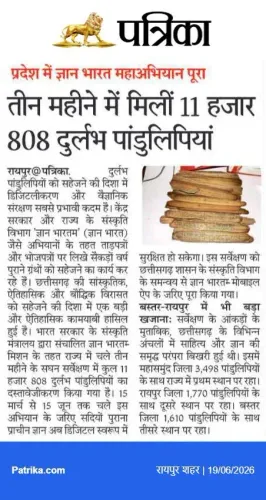
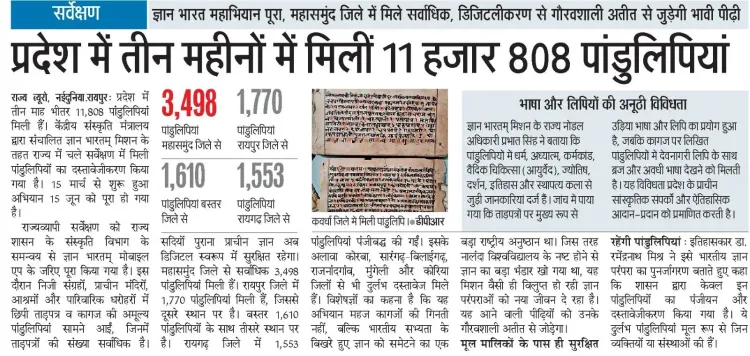
The Chief Minister's Office of Chhattisgarh announced on Friday, 19 June 2026, that the state has documented 11,808 ancient manuscripts in just three months under the Gyan Bharatam Mission (Knowledge India Mission), marking a significant milestone in heritage preservation.
The official post declared: 'Prachin pandulipiyan hamari sanskriti, gyan aur sabhyata ki amulya dharohar hain' — 'Ancient manuscripts are the invaluable heritage of our culture, knowledge and civilisation.' The CMO stated that the state government is committed to delivering this rich cultural identity to future generations through conservation, digitisation and research.
Context
Chhattisgarh, a central Indian state with deep-rooted temple traditions and manuscript collections spanning Sanskrit, regional languages and tribal knowledge systems, has been conducting a time-bound survey of manuscripts held in institutions and private collections across the state. The Gyan Bharatam Mission provides the framework under which this documentation drive is being carried out. The CMO's post carries the hashtags #GyanBharatamMission, #CulturalHeritage and #Chhattisgarh, signalling the state government's intent to publicly track progress on the initiative.Policy Backdrop
India's effort to preserve its manuscript heritage has a long institutional lineage. The National Mission for Manuscripts, launched in 2003 by the Ministry of Culture, established a nationwide network of manuscript resource centres tasked with locating, documenting, conserving and digitising ancient texts held in temples, monasteries, private homes and archives. By 2018, the Ministry had expanded digitisation targets under the mission to build a national database accessible to scholars and researchers. State-level surveys that feed data into this national register have become a standard mechanism through which individual states contribute to the broader preservation effort. Chhattisgarh's current drive appears to align with this established model of time-bound surveys followed by digitisation and archival. Successive central and state governments have pursued manuscript documentation as part of a wider cultural-heritage policy aimed at preventing the physical deterioration of fragile texts and enabling wider scholarly access. These efforts run alongside parallel programmes for digitising museum objects and safeguarding intangible cultural heritage.Stakeholders and Impact
Manuscript scholars, state archivists and cultural historians stand to benefit most directly from the documentation exercise. For local communities — particularly those whose oral and written traditions are embedded in the surveyed texts — the exercise offers recognition and a degree of institutional protection for knowledge systems that might otherwise be lost to physical decay or neglect. The sheer pace of the documentation — 11,808 manuscripts in three months — suggests a large-scale mobilisation of surveyors and archivists across the state, though the CMO's post does not specify the number of personnel or districts covered. Digitisation, the next stated step, would make these texts accessible to researchers nationally and internationally, reducing dependence on fragile originals and broadening the audience for Chhattisgarh's textual heritage.What's Next
The critical question following any documentation drive of this scale is whether the recorded manuscripts are uploaded to a national or publicly accessible database, and whether funds are subsequently allocated for conservation laboratories, trained conservators and research fellowships. The CMO's statement references conservation and research alongside digitisation as pillars of the effort, suggesting the government envisions a multi-stage programme rather than a one-time survey. Whether Chhattisgarh's manuscripts are integrated into the national manuscript database and what institutional infrastructure is built to sustain the effort will determine the long-term impact of this initial milestone.Point of View
Using a quantified milestone — 11,808 texts in three months — to demonstrate governance efficiency in the cultural domain. This sits within a broader pattern of state governments using heritage programmes to assert cultural identity and administrative credibility simultaneously. The invocation of Gyan Bharatam Mission as the policy vehicle suggests an attempt to brand a state-level effort with a nationally resonant name, potentially linking it to the Centre's wider knowledge-heritage agenda. The real test of political will, however, lies in the follow-through: digitisation infrastructure, scholarly access and long-term conservation funding are where such drives most often stall.
NationPress
18 Sept 2026
Frequently Asked Questions
What is the Gyan Bharatam Mission in Chhattisgarh?
The Gyan Bharatam Mission is a programme under which the Chhattisgarh government is documenting, conserving and digitising ancient manuscripts found across the state, as announced by the Chief Minister's Office.
How many manuscripts were documented in Chhattisgarh under Gyan Bharatam Mission?
According to the Chief Minister's Office of Chhattisgarh, 11,808 ancient manuscripts were documented in three months under the Gyan Bharatam Mission.
What is the National Mission for Manuscripts India?
The National Mission for Manuscripts is a scheme launched in 2003 by India's Ministry of Culture to locate, document, conserve and digitise ancient manuscripts held in institutions and private collections across the country.
What types of manuscripts are found in Chhattisgarh?
Chhattisgarh holds manuscript collections linked to Sanskrit , regional languages and tribal knowledge systems, reflecting the state's diverse temple traditions and cultural heritage.
What happens after manuscripts are documented in Chhattisgarh?
The Chhattisgarh government has stated that conservation, digitisation and research will follow documentation, with the aim of making this heritage accessible to future generations. Integration into a national database is a key next step to watch.