Chhattisgarh CMO: Tradition and Progress Walk Together
Synopsis
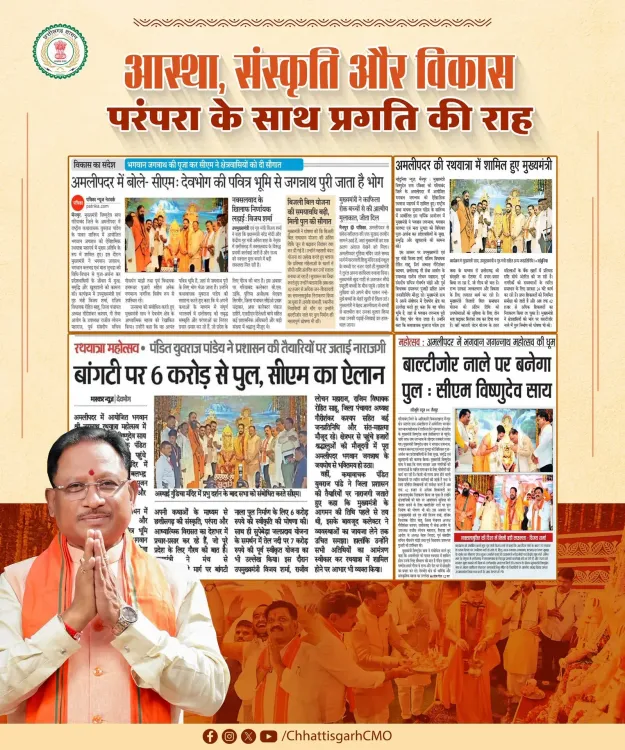
The Chief Minister's Office of Chhattisgarh declared on 24 July 2026 that the state is advancing rapidly on development while preserving its cultural heritage, using the phrase 'Parampara bhi, pragati bhi' to frame tradition and progress as complementary, not competing, priorities.
Key Takeaways
The Chief Minister's Office of Chhattisgarh posted on 24 July 2026 affirming a dual commitment to cultural preservation and development.
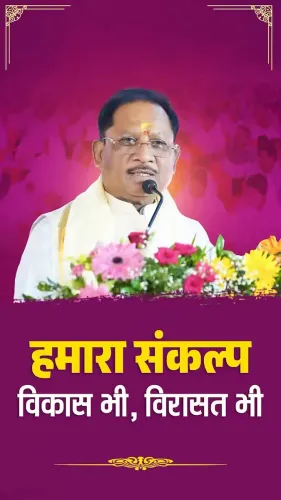
The governing slogan 'Parampara bhi, pragati bhi' translates as 'Tradition too, progress too,' framing heritage and growth as complementary goals.
Chhattisgarh was formed in November 2000 from Madhya Pradesh to provide focused governance for a region with significant tribal populations and mineral wealth.
The post used the hashtag #Sushasansarkar ('good governance government'), signalling the dual agenda as a brand of effective administration.
No specific scheme, budget figure, or deadline was announced; the post articulates intent rather than a concrete policy action.
State budget sessions and assembly debates remain the key forums where this cultural-development balance will be tested with actual allocations.
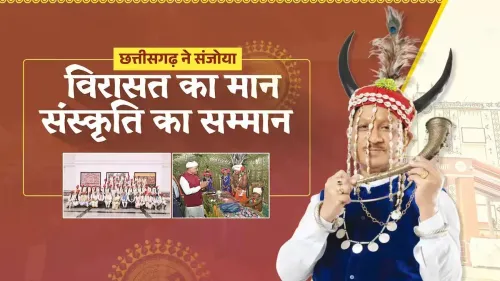
The Chief Minister's Office of Chhattisgarh on Friday, 24 July 2026, shared a message affirming the state's dual commitment to cultural preservation and accelerated development, capturing its governing philosophy in a single phrase: 'Parampara bhi, pragati bhi' ('Tradition too, progress too').
The post declared that Chhattisgarh is moving rapidly on the path of development while safeguarding its culture — a framing the state government has consistently used to signal that economic growth and heritage protection are not competing priorities but complementary goals.
Context
Chhattisgarh was carved out of Madhya Pradesh in November 2000 as a distinct state, partly to give sharper administrative focus to a region with deep tribal roots and vast mineral wealth. The state is home to a significant indigenous population whose customs, festivals, and art forms — from Bastar Dussehra to Panthi dance — are considered among the most distinctive in central India. Balancing this living heritage with the demands of modern infrastructure and economic growth has been a defining challenge for every government since statehood.Policy Backdrop
Across mineral-rich central and eastern Indian states, public messaging that pairs development with cultural identity has become a recognisable governance narrative. For Chhattisgarh, this plays out in state budgets that typically carry allocations for tribal welfare, folk-art promotion, and heritage conservation alongside outlays for roads, power, and industrial corridors. The hashtag #Sushasansarkar — roughly translating to 'good governance government' — used in the post signals the administration's intent to brand this dual agenda as a marker of effective rule. State assembly sessions and budget presentations remain the key forums where these commitments are translated into specific rupee figures and scheme timelines.Stakeholders and Impact
The communities most directly addressed by this messaging are Chhattisgarh's tribal populations, who constitute a substantial share of the state's roughly 3.3 crore people and whose cultural practices are the most visible expression of the identity the government says it is protecting. Cultural practitioners — musicians, dancers, artisans, and priests tied to indigenous traditions — stand to benefit if policy follows rhetoric through dedicated funding and institutional support. At the same time, the development half of the equation matters to a broader constituency: farmers seeking irrigation, workers seeking industry, and urban residents seeking services. The state's messaging positions these groups not as rivals for resources but as joint beneficiaries of a single vision.What's Next
The immediate signal from the Chief Minister's Office is one of intent rather than announcement — no specific scheme, figure, or deadline was named in the post. Watchers of Chhattisgarh politics and policy will look to upcoming state budget sessions and assembly debates for concrete allocations that test whether the 'tradition and progress' slogan translates into measurable commitments. If the government follows through with dedicated cultural-heritage budgets alongside infrastructure spending, the dual narrative could become a durable model for other states navigating similar tensions between indigenous identity and economic ambition.Point of View
The administration insulates itself from criticism on development gaps while reinforcing its legitimacy among indigenous constituencies. This dual narrative mirrors a pattern seen across central Indian states where mineral revenues coexist with strong tribal identities, and where governments must constantly negotiate between extraction-led growth and community-centred heritage. Whether the slogan hardens into policy will be visible in budget allocations — the gap between messaging and money is where such narratives are ultimately judged.
NationPress
23 Oct 2026
Frequently Asked Questions
What did the Chhattisgarh CMO post on 24 July 2026?
The Chief Minister's Office of Chhattisgarh posted a message on 24 July 2026 stating that the state is advancing rapidly on development while preserving its culture, summarised in the Hindi phrase 'Parampara bhi, pragati bhi' — meaning 'Tradition too, progress too.'
What does Sushasansarkar mean in the Chhattisgarh government context?
'Sushasansarkar' roughly translates to 'good governance government' in Hindi, and is used as a hashtag by the Chhattisgarh government to brand its administrative approach, including the linking of cultural preservation with development goals.
Why is cultural preservation important for Chhattisgarh?
Chhattisgarh has a large tribal population with distinct customs, festivals, and art forms. Since the state was formed in 2000 partly to give focused attention to this region, protecting indigenous culture alongside pursuing economic growth has been a core governance challenge.
When was Chhattisgarh formed and why?
Chhattisgarh was formed on 1 November 2000 by bifurcating Madhya Pradesh, with the aim of providing more targeted administration to a region rich in minerals and home to significant tribal communities with unique cultural identities.
What specific schemes did the Chhattisgarh government announce for culture and development?
The 24 July 2026 post from the Chief Minister's Office did not announce a specific scheme or budget figure; it articulated a policy intent. Concrete allocations would be detailed in state budget sessions and assembly proceedings.