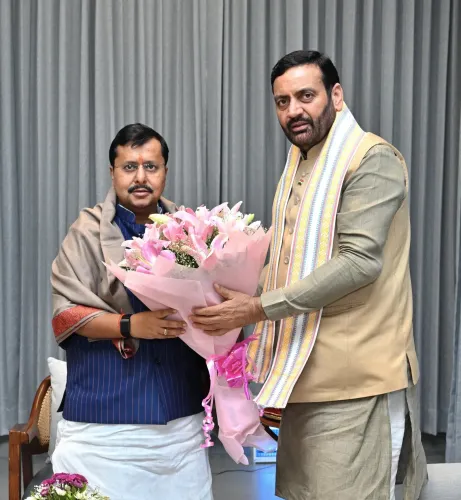
Smriti Irani meets Haryana CM Nayab Saini, discusses BJP org push
Synopsis
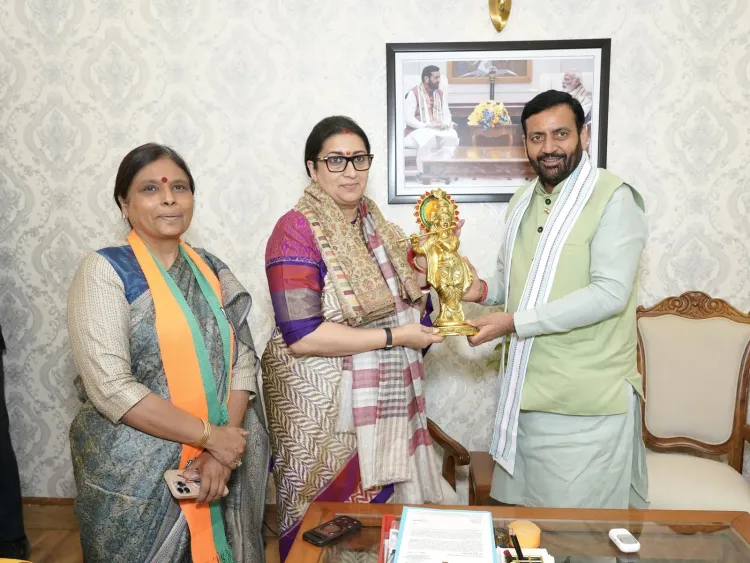
BJP leader Smriti Irani visited Haryana CM Nayab Saini at his official residence on October 22, 2026, for talks on strengthening party organisation and advancing PM Modi's public service agenda, joined by Union Minister Khattar and senior BJP leaders.
Key Takeaways
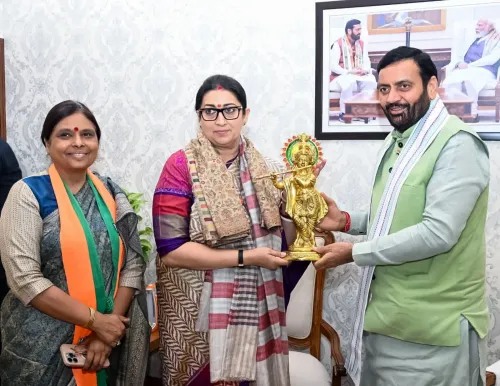
Smriti Irani met Haryana CM Nayab Saini at the Chief Minister's residence on October 22, 2026 .
Discussions focused on strengthening BJP's organisational activities in Haryana and advancing PM Modi's public service agenda.
Union Cabinet Minister Manohar Lal Khattar , Haryana co-in-charge Dr.
Bhola Singh , state president Dr.
Archana Gupta , and state general secretary (organisation) Pavan Rana were present.
Khattar, Haryana's Chief Minister from 2014 to 2024 , served as institutional bridge between the central government and state unit.
The BJP formed Haryana's government following the 2024 assembly elections with Nayab Saini as Chief Minister.
No specific decisions or outcomes from the meeting were made public.
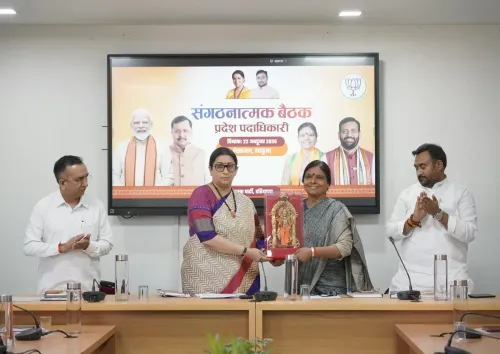
A high-level BJP huddle at the Chief Minister's residence in Chandigarh on Thursday, October 22, 2026 brought together some of the party's most prominent faces — a signal that the organisation's alignment exercise in Haryana is moving up a gear. BJP leader Smriti Irani called on Chief Minister Nayab Saini, and the conversation, by all accounts, went well beyond pleasantries.
Posting in Hindi on X, Irani described the meeting as a 'meaningful discussion' — sarthak charcha — on 'strengthening organisational activities in Haryana and advancing the resolve of public service under the leadership of Prime Minister Narendra Modi.' That framing — organisation first, public service second — is deliberate, and it tells you exactly what the BJP is doing in the state right now.Who was in the room — and why it matters
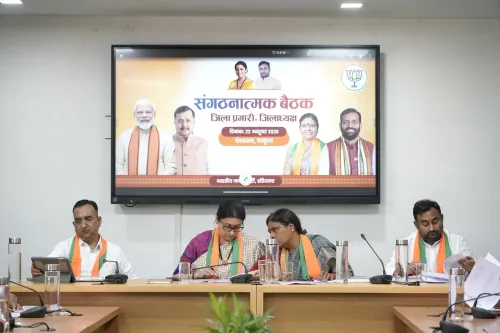
This was no bilateral chat. Alongside Irani and Saini sat Union Cabinet Minister Manohar Lal Khattar, BJP national secretary and Haryana co-in-charge Dr. Bhola Singh, state president Dr. Archana Gupta, and state general secretary (organisation) Pavan Rana. That combination — a central observer, the organisation secretary, the state president, and a senior Union minister who ran the state for a decade — is the BJP's standard formation when it wants to synchronise Delhi's priorities with ground-level party machinery.
Khattar's presence is particularly layered. He governed Haryana as Chief Minister from 2014 to 2024 before being elevated to the Union Cabinet, making him both institutional memory and a bridge between the state unit and the central government. His seat at the table sends a message of continuity.
The BJP's post-election consolidation in Haryana
The meeting arrives roughly two years after the BJP's assembly election victory in 2024, when Nayab Saini was installed as Chief Minister — a choice that itself signalled a strategic repositioning within the state. Party meetings of this configuration typically serve two purposes: auditing the health of the booth-level organisation and ensuring state-level delivery of central schemes stays visible and attributable to the BJP brand.
For Saini's government, the pressure is real. Haryana borders the national capital, has a politically active farming and service-class electorate, and sits in a competitive zone where organisational discipline can swing margins. Irani's visit, as a senior central leader with no ministerial portfolio currently in the Cabinet, signals that the party's organisational wing — not just the government machinery — is being activated.
Irani did not disclose the specific outcomes or decisions from the meeting, and none of the attending leaders have detailed any formal resolutions. What is clear is the intent: keep the Haryana unit sharp, aligned, and ready.
The next marker to watch is whether the Haryana BJP state executive schedules a broader organisational conclave or announces structural changes in the state leadership — the kind of step that usually follows exactly this sort of central-leadership review.
Point of View
The state CM, an organisational secretary, and a former chief minister now in the Union Cabinet — are the party's tried-and-tested mechanism for course-correcting state units between election cycles. Irani's role here is that of a central observer rather than a policy actor, suggesting the party is in active organisational audit mode in Haryana. With no ministerial portfolio in the current Cabinet, her political energy is being directed inward toward party building, a pattern consistent with BJP's practice of deploying senior leaders as organisational trouble-shooters. The gathering also reinforces Khattar's continuing relevance in Haryana affairs despite his transition to the Union Cabinet — a dynamic worth tracking as the next election cycle approaches.
NationPress
23 Oct 2026
Frequently Asked Questions
Why did Smriti Irani visit Haryana CM Nayab Saini?
Smriti Irani visited Chief Minister Nayab Saini at his official residence to hold discussions on strengthening BJP's organisational activities in Haryana and advancing Prime Minister Narendra Modi's public service agenda in the state.
Who attended the BJP meeting at Haryana CM's residence on October 22, 2026?
The meeting was attended by Smriti Irani, CM Nayab Saini, Union Cabinet Minister Manohar Lal Khattar, BJP national secretary and Haryana co-in-charge Dr. Bhola Singh, state president Dr. Archana Gupta, and state general secretary (organisation) Pavan Rana.
What is Nayab Saini's position in Haryana?
Nayab Saini is the Chief Minister of Haryana, installed by the BJP following its victory in the 2024 Haryana state assembly elections.
What is Manohar Lal Khattar's role now?
Manohar Lal Khattar is currently a Union Cabinet Minister in the central government. He previously served as Chief Minister of Haryana from 2014 to 2024.
What did Smriti Irani say about the Haryana BJP meeting?
Smriti Irani described the discussions as 'meaningful' — focused on strengthening BJP's organisational activities in Haryana and advancing the resolve of public service under PM Modi's leadership.