Chhattisgarh Cabinet Clears DDM for 240 E-Buses in 4 Cities
Synopsis
The Chhattisgarh Council of Ministers has approved forwarding a Direct Debit Mandate consent to the Union government under the PM e-Bus Sewa scheme's Payment Security Mechanism, unlocking the path for 240 electric buses across Raipur, Durg-Bhilai, Bilaspur, and Korba to deliver modern, affordable, and eco-friendly public transport.
Key Takeaways
The Chhattisgarh Council of Ministers approved transmission of a Direct Debit Mandate (DDM) consent to the Union government on 9 June 2026 .
The DDM is required under the Payment Security Mechanism (PSM) of the PM e-Bus Sewa scheme , launched by the Government of India in August 2023 .
A total of 240 electric buses have been sanctioned for four Chhattisgarh cities: Raipur, Durg-Bhilai, Bilaspur, and Korba .
The PM e-Bus Sewa scheme targets deployment of 10,000 electric buses across 169 cities nationally with central viability gap funding.
The buses are intended to provide modern, environment-friendly, safe, and affordable public transport to urban residents of the state.
The next steps involve central approval of the DDM, followed by tendering and deployment timelines for the four cities.
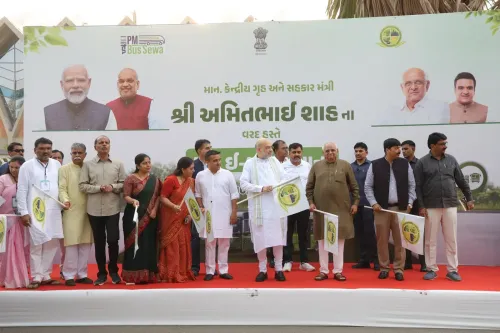
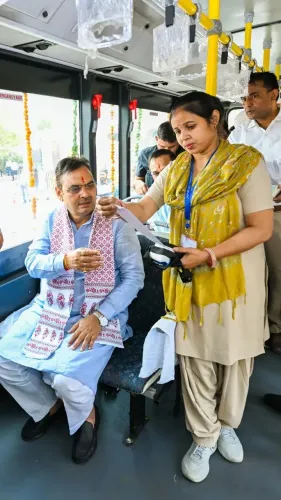
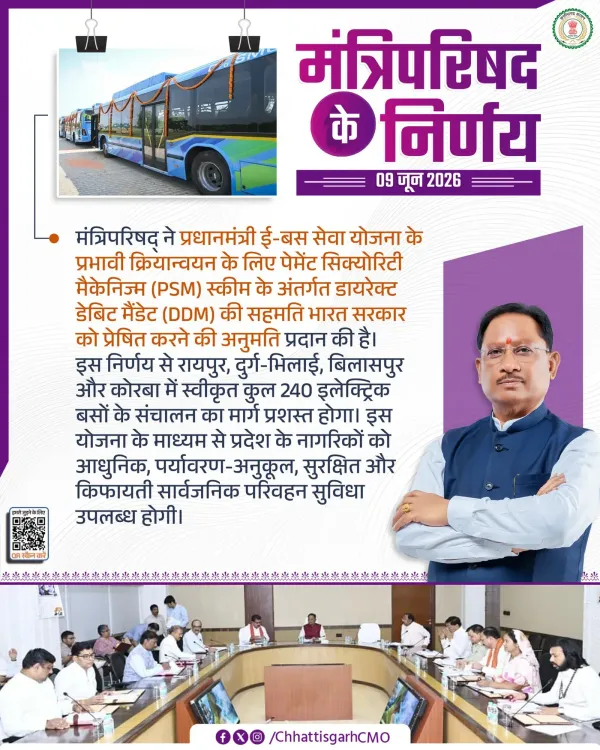
The Chief Minister's Office of Chhattisgarh announced on Tuesday, 9 June 2026 that the state's Council of Ministers has approved forwarding consent for a Direct Debit Mandate (DDM) under the Payment Security Mechanism (PSM) scheme to the Union government, a key step to operationalise the PM e-Bus Sewa scheme in the state. The decision paves the way for the deployment of 240 electric buses across four cities: Raipur, Durg-Bhilai, Bilaspur, and Korba.
Context
The cabinet decision, shared by the official CMO account, states: 'मंत्रिपरिषद् ने प्रधानमंत्री ई-बस सेवा योजना के प्रभावी क्रियान्वयन के लिए पेमेंट सिक्योरिटी मैकेनिज्म (PSM) स्कीम के अंतर्गत डायरेक्ट डेबिट मैंडेट (DDM) की सहमति भारत सरकार को प्रेषित करने की अनुमति प्रदान की है' — meaning the Council of Ministers has permitted the transmission of DDM consent to the Government of India for the effective implementation of the PM e-Bus Sewa scheme. The Direct Debit Mandate is a financial instrument that allows the central government to directly debit state accounts in case of payment defaults, providing assurance to bus operators and their lenders.
By formally communicating this consent, Chhattisgarh completes a critical procedural prerequisite that unlocks central assistance under the scheme. The four cities — Raipur, Durg-Bhilai, Bilaspur, and Korba — together account for a significant share of the state's urban population and commuter demand.
Policy Backdrop
The PM e-Bus Sewa scheme was approved by the Government of India in August 2023 to support the deployment of 10,000 electric buses across 169 cities nationwide, with central viability gap funding and a structured payment security architecture. The Payment Security Mechanism (PSM) sits at the heart of this architecture: it uses state-level guarantees and direct debit mandates to assure timely payments to private bus operators and financiers, reducing their risk exposure and making the model commercially viable without heavy upfront state expenditure.
The scheme builds on the policy lineage of the earlier FAME-II programme, which prioritised electrification of public transport fleets in mid-sized Indian cities. Several states have progressively cleared their respective payment security instruments over the past two years to unlock central funds, and Chhattisgarh's cabinet approval places the state in that advancing cohort.
Stakeholders and Impact
Urban commuters in Raipur, Durg-Bhilai, Bilaspur, and Korba stand to be the most direct beneficiaries. The CMO post describes the forthcoming service as offering 'आधुनिक, पर्यावरण-अनुकूल, सुरक्षित और किफायती सार्वजनिक परिवहन सुविधा' — 'modern, environment-friendly, safe, and affordable public transport facilities.' Electric buses produce zero tailpipe emissions, making them particularly significant for Korba, an industrial city with historically elevated air-pollution levels.
State transport corporations and private operators who will eventually run the fleet will benefit from the payment security guarantee, which substantially lowers financing risk. Residents of Durg-Bhilai, a densely populated industrial twin city, and Bilaspur, a major commercial and judicial hub, are also expected to see improved last-mile connectivity once the buses are operational.
What's Next
With the DDM consent now cleared for transmission to New Delhi, the next milestones will be the issuance of tenders or letters of award for the 240 electric buses and the finalisation of operational timelines for each of the four cities. Central approval of the DDM will formally activate the payment security cover, after which procurement and deployment processes can proceed. If Chhattisgarh follows the trajectory of other states that have cleared similar instruments, the first buses could enter service within the medium term — though no official rollout date has been announced. The move signals the state government's intent to align its urban transport infrastructure with India's broader electric mobility and net-zero commitments.
Point of View
The state removes a key financial-risk barrier for bus operators and lenders, making the central scheme commercially actionable rather than merely sanctioned on paper. The choice of four cities — including the industrial, pollution-burdened Korba — suggests a deliberate alignment with both urban mobility and air-quality imperatives. Watched alongside similar clearances in other states, this move reflects a maturing federal execution rhythm for India's electric public transport ambitions.
NationPress
28 Oct 2026
Frequently Asked Questions
What is the PM e-Bus Sewa scheme?
The PM e-Bus Sewa scheme is a Government of India programme approved in August 2023 to deploy 10,000 electric buses across 169 cities, supported by central viability gap funding and a Payment Security Mechanism to protect bus operators and lenders from payment risk.
What is a Direct Debit Mandate in the context of the e-bus scheme?
A Direct Debit Mandate (DDM) is a financial instrument under the Payment Security Mechanism that authorises the central government to directly debit a state's account if the state fails to make timely payments to bus operators, thereby reducing financial risk for operators and their lenders.
Which cities in Chhattisgarh will get electric buses under this scheme?
The four cities selected for electric bus deployment in Chhattisgarh are Raipur, Durg-Bhilai, Bilaspur, and Korba, with a combined sanction of 240 electric buses.
When did the Chhattisgarh cabinet approve the DDM consent?
The Chief Minister's Office of Chhattisgarh announced the Council of Ministers' approval on 9 June 2026, though the exact date of the cabinet meeting has not been officially specified.
When will electric buses start running in Chhattisgarh?
No official launch or operational date has been announced. The next steps are central approval of the Direct Debit Mandate, followed by tendering and procurement processes for the 240 buses across the four cities.