CM Sai Clears Direct Debit Mandate for 240 E-Buses in Chhattisgarh
Synopsis
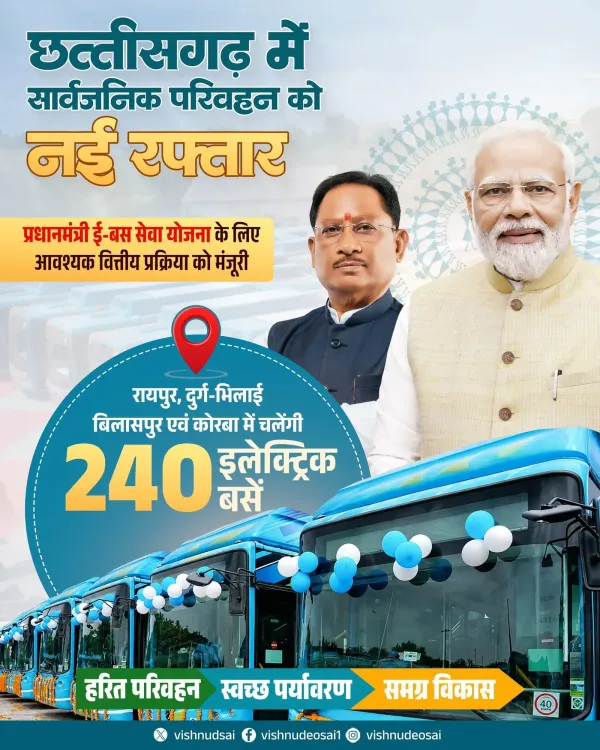
Chhattisgarh CM Vishnu Deo Sai has approved a Direct Debit Mandate under the PM e-Bus Sewa Yojana's Payment Security Mechanism, unlocking the rollout of 240 electric buses across Raipur, Durg-Bhilai, Bilaspur and Korba — a step the state frames as central to its clean-transport and sustainable development goals.
Key Takeaways
Chhattisgarh approved a Direct Debit Mandate under the Payment Security Mechanism of the PM e-Bus Sewa Yojana .
240 electric buses will be deployed across Raipur, Durg-Bhilai, Bilaspur and Korba .
The Union Cabinet approved PM e-Bus Sewa in August 2023 to deploy up to 10,000 electric buses in 169 cities nationally.
The Direct Debit Mandate provides financial assurance to private operators, de-risking fleet deployment.
The move aligns Chhattisgarh with central guidelines and positions it to access viability gap funding under the scheme.
CM Vishnu Deo Sai framed the decision as part of the state's commitment to clean environment and sustainable urban development.
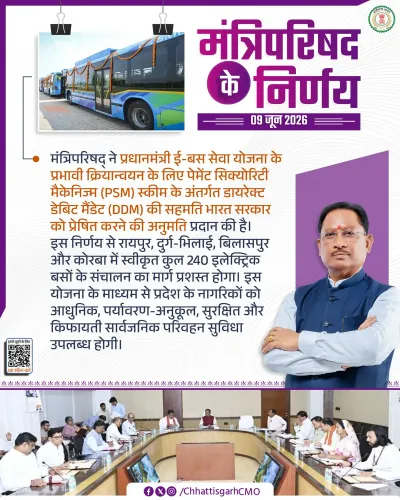
Chhattisgarh Chief Minister Vishnu Deo Sai announced on Thursday, 11 June 2026 that the state government has approved a Direct Debit Mandate under the Payment Security Mechanism of the Pradhan Mantri e-Bus Sewa Yojana, clearing a key financial hurdle for the rollout of 240 electric buses across four major cities in the state.
Posting on X, Chief Minister Sai wrote: 'हरित परिवहन - बेहतर भविष्य की ओर बढ़ते कदम' ('Green transport — steps towards a better future'), adding that the decision would pave the way for electric bus operations in Raipur, Durg-Bhilai, Bilaspur and Korba. He described the move as reinforcing the state's commitment to clean environment and sustainable development.
Context
The Direct Debit Mandate is a financial instrument through which the state government provides assurance to bus operators that their payments will not be delayed — a critical step before private operators commit to deploying electric fleets. The approval brings Chhattisgarh in line with central guidelines issued under the PM e-Bus Sewa Yojana, which the Union Cabinet cleared in August 2023.
The scheme targets deployment of up to 10,000 electric buses across 169 cities nationally, backed by viability gap funding and a structured payment security framework. Chhattisgarh's approval of the mandate is a prerequisite for the state to draw down central support and formally engage operators.
Policy Backdrop
India's push for electric public transport has evolved through successive central programmes, from FAME-II to the current PM e-Bus Sewa Yojana, all anchored to the country's Net Zero 2070 commitment and near-term urban air quality targets. The Payment Security Mechanism was specifically designed to de-risk operators in states where municipal transport bodies have historically struggled with payment timelines.
Several states have moved to align their treasury systems with the Direct Debit Mandate requirement since the 2023 central guidelines came into effect. Chhattisgarh's decision reflects a broader pattern of BJP-governed states accelerating adoption in tier-2 and tier-3 cities, where public transport infrastructure has lagged metropolitan centres.
Stakeholders and Impact
Urban commuters in Raipur, Durg-Bhilai, Bilaspur and Korba stand to gain the most directly. Chief Minister Sai said the electric buses would provide citizens with 'modern, safe, environment-friendly and affordable public transport.' The four cities together represent a significant share of Chhattisgarh's urban population and currently depend heavily on ageing diesel bus fleets and informal shared transport.
State transport operators and private bus service providers will benefit from the payment security assurance, reducing the financial risk that has historically slowed fleet procurement. The move is also expected to generate downstream demand in the electric vehicle supply chain, including charging infrastructure development across the selected cities.
What's Next
With the Direct Debit Mandate now approved, the focus shifts to the commencement of actual bus operations and the tendering or contracting process for the 240-bus fleet. Any subsequent expansion phases — covering additional cities or a larger fleet count — will depend on the operational performance of this initial rollout and the pace of central fund disbursement under PM e-Bus Sewa. The Chhattisgarh government's ability to maintain payment discipline under the mandate will be closely watched as a signal of the state's readiness for further tranches of the national scheme.
Point of View
CM Sai's administration removes the single biggest deterrent for private operators considering fleet investment in smaller cities. The choice of Durg-Bhilai, Bilaspur and Korba alongside the capital signals an intent to distribute green-transport gains beyond Raipur, which carries political weight in a state where industrial towns have long felt underserved. The real test will come when buses actually hit the road — execution timelines under central e-bus schemes have frequently slipped, and Chhattisgarh's performance here will shape its case for future tranches.
NationPress
26 Oct 2026
Frequently Asked Questions
What is the PM e-Bus Sewa Yojana?
PM e-Bus Sewa Yojana is a central government scheme approved in August 2023 to deploy up to 10,000 electric buses across 169 cities in India, supported by viability gap funding and a Payment Security Mechanism to assure operators of timely payments.
Which cities in Chhattisgarh will get electric buses under this scheme?
The 240 electric buses will operate in four cities: Raipur, Durg-Bhilai, Bilaspur and Korba.
What is a Direct Debit Mandate in the context of e-bus schemes?
A Direct Debit Mandate is a financial instrument through which the state government authorises automatic payment transfers to bus operators, providing them assurance against payment delays and reducing the financial risk of deploying electric fleets.
How many electric buses will Chhattisgarh get?
Chhattisgarh has cleared the path for 240 electric buses as part of the initial rollout under the PM e-Bus Sewa Yojana.
What did CM Vishnu Deo Sai say about the electric bus scheme?
CM Vishnu Deo Sai described the decision as a step towards green transport and a better future, saying the buses would give citizens modern, safe, environment-friendly and affordable public transport while strengthening the state's commitment to a clean environment and sustainable development.