CM Sai Launches Adarsh Shahar Samridhi Yojana for 32 Towns
Synopsis
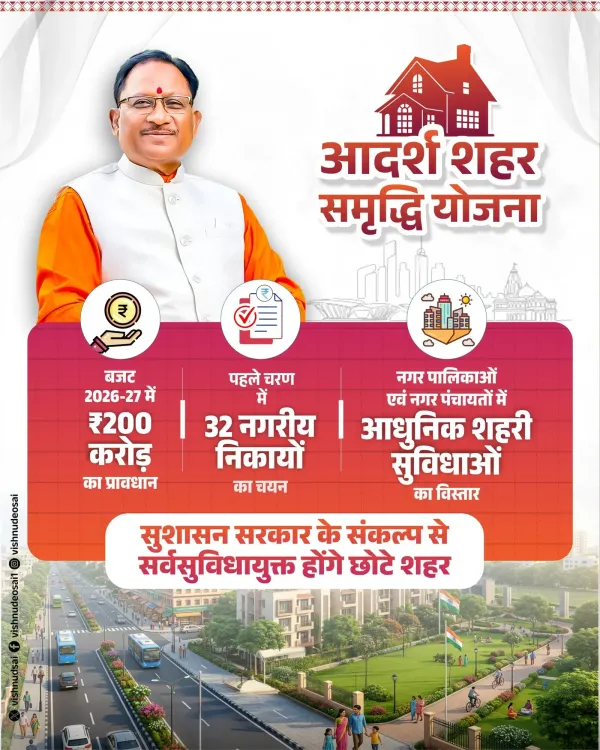
Chhattisgarh Chief Minister Vishnu Deo Sai has announced the Adarsh Shahar Samridhi Yojana, a state scheme to bring modern urban infrastructure to smaller towns. In its first phase, 32 Nagar Palikas and Nagar Panchayats have been selected for development.
Key Takeaways
Chhattisgarh CM Vishnu Deo Sai announced the Adarsh Shahar Samridhi Yojana on 28 May 2026 to extend modern urban amenities to smaller towns.
32 urban local bodies — Nagar Palikas and Nagar Panchayats — have been selected in the scheme's first phase.
The initiative targets orderly development, expansion of public amenities, and improved living standards in smaller municipalities.
The scheme addresses a gap left by earlier central programmes such as AMRUT and the Smart Cities Mission , which covered only larger cities like Raipur and Bilaspur .
Specific names of the 32 selected bodies and exact funding figures had not been officially published at the time of the announcement.
A second phase is implied, with selection criteria and timelines yet to be disclosed.
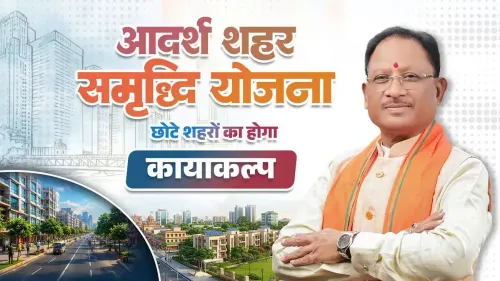
Chhattisgarh Chief Minister Vishnu Deo Sai announced on Thursday, 28 May 2026 that the state government's Adarsh Shahar Samridhi Yojana will extend modern urban amenities and improved infrastructure to smaller towns and townships across Chhattisgarh. In the scheme's first phase, 32 urban local bodies have been selected for development under the initiative.
Context
Posting in Hindi, CM Sai stated: 'सुशासन सरकार की आदर्श शहर समृद्धि योजना के माध्यम से अब प्रदेश के छोटे शहर और कस्बे भी आधुनिक शहरी सुविधाओं एवं बेहतर अधोसंरचना से जुड़ेंगे' ('Through the good-governance government's Adarsh Shahar Samridhi Yojana, the state's small cities and towns will now also be connected to modern urban facilities and better infrastructure'). He added that the initiative would serve as an important foundation for 'orderly development, expansion of public amenities, and a better standard of living for citizens' in Nagar Palikas and Nagar Panchayats.
The scheme's name invokes the BJP-led administration's 'Su-Shasan' (good governance) branding, a recurring motif in the government's public communications since CM Sai took office in December 2023 following the party's assembly election victory in the state.
Policy Backdrop
The announcement fits within a broader national pattern of extending urban infrastructure programmes beyond state capitals to tier-2 and tier-3 towns. Centrally, the Atal Mission for Rejuvenation and Urban Transformation (AMRUT), launched in 2015, provided a template for funding infrastructure upgrades in smaller cities, with Chhattisgarh among the participating states.
Earlier, the Smart Cities Mission (2015) covered only Raipur and Bilaspur within the state, leaving a large number of smaller municipalities outside its ambit. The Adarsh Shahar Samridhi Yojana appears designed to address precisely this gap by bringing civic upgrades to urban local bodies that previously fell below the threshold of major central programmes.
Stakeholders and Impact
The primary beneficiaries are residents of smaller towns and townships in Chhattisgarh — a state with a large tribal population and significant mineral wealth — who have historically received fewer urban development resources compared to the capital region. The 32 Nagar Palikas and Nagar Panchayats selected in the first phase will be the immediate implementing bodies, responsible for translating the scheme's goals into on-ground civic improvements.
Improved infrastructure in these municipalities could support local economic activity, reduce migration pressure toward larger cities, and raise service-delivery standards in areas such as water supply, sanitation, and road connectivity. The selection criteria and the specific list of the 32 urban bodies chosen have not been officially published as of the time of this announcement.
What's Next
Attention will now turn to the state government's budget allocations, detailed project reports, and the rollout timeline for the 32 selected bodies. Officials and civic administrators in the chosen municipalities will be expected to prepare implementation plans in line with scheme guidelines.
The government has indicated this is only the first phase, leaving open the question of how many additional urban local bodies will be covered in subsequent phases and what criteria will govern their selection. The pace and quality of execution in the first phase will likely shape the political and administrative case for expanding the scheme further across Chhattisgarh.
Point of View
The announcement is as much a branding exercise as a policy one, tying infrastructure delivery to the party's core electoral narrative. The selection of 32 urban local bodies in a single phase is a significant operational commitment, but the absence of published selection criteria and funding details leaves key questions open. How this scheme integrates with or supplements central urban missions like AMRUT 2.0 will determine whether it represents additionality or repackaging of existing flows.
NationPress
19 Sept 2026
Frequently Asked Questions
What is the Adarsh Shahar Samridhi Yojana in Chhattisgarh?
The Adarsh Shahar Samridhi Yojana is a Chhattisgarh state government scheme announced by CM Vishnu Deo Sai to provide modern urban amenities and improved infrastructure to smaller towns and municipalities, beginning with 32 urban local bodies in its first phase.
How many urban bodies are covered under the first phase of the scheme?
32 Nagar Palikas and Nagar Panchayats have been selected in the first phase of the Adarsh Shahar Samridhi Yojana. The specific names of these bodies had not been officially published at the time of the announcement.
What is the aim of the Adarsh Shahar Samridhi Yojana?
The scheme aims to bring orderly development, expanded public amenities, and a better standard of living to citizens in smaller towns and townships in Chhattisgarh that were previously outside the ambit of major urban development programmes.
Who announced the Adarsh Shahar Samridhi Yojana?
Chhattisgarh Chief Minister Vishnu Deo Sai announced the scheme on 28 May 2026 through a post on X, describing it as an initiative of his 'Su-Shasan' (good governance) government.
How does this scheme relate to central urban programmes like AMRUT?
The central AMRUT scheme (launched 2015) and the Smart Cities Mission covered larger cities such as Raipur and Bilaspur in Chhattisgarh. The Adarsh Shahar Samridhi Yojana is a state-level initiative intended to extend similar infrastructure benefits to smaller towns and municipalities not covered by those programmes.