Did the Union Budget 2026-27 Ignore Key Challenges?
Synopsis
Former Finance Minister P. Chidambaram harshly criticizes the Union Budget 2026-27, claiming it overlooks crucial economic challenges and lacks a coherent strategy. He emphasizes the need for genuine responses to the economic issues facing ordinary citizens. This analysis reveals the gaps in the budget presentation and its implications for the country's economic future.
Key Takeaways
Chidambaram criticizes the budget for ignoring economic challenges.
Key sectors faced significant budget cuts.
The budget lacks coherent strategy and leadership.
Disparity exists between official inflation and household expenses.
Fiscal management for previous years was deemed poor.
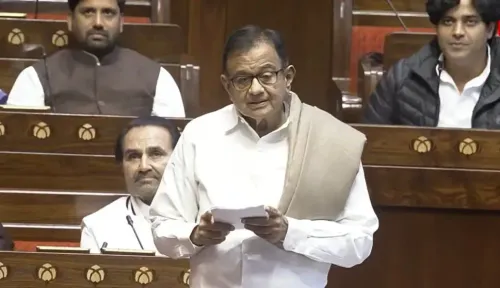
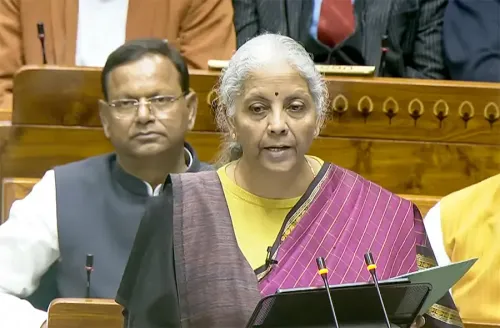
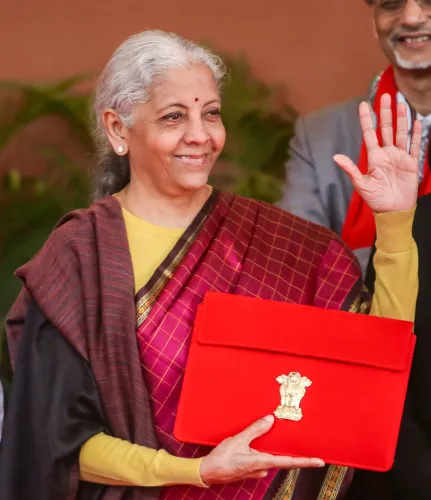
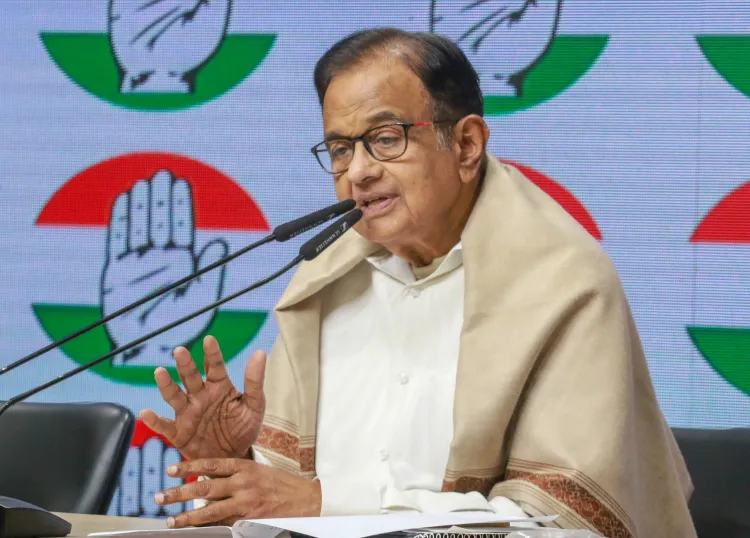
New Delhi, Feb 1 (NationPress) Senior Congress figure and former Finance Minister P. Chidambaram has delivered a pointed critique of the Union Budget 2026-27, presented by Finance Minister Nirmala Sitharaman on Sunday. He asserted that it "failed to meet the standards of economic strategy and statesmanship".
In a comprehensive statement, Chidambaram expressed his disbelief at the budget address, contending that it ignored the significant challenges outlined in the Economic Survey 2025-26, instead opting for an array of acronyms and new initiatives that failed to tackle urgent issues.
He underscored that a budget speech should articulate a unified narrative addressing the fundamental economic challenges identified in the Economic Survey, questioning whether the government and the Finance Minister had even considered the document, implying they had chosen to overlook it entirely.
Chidambaram enumerated at least ten crucial challenges noted by the Economic Survey and experts that were neglected in the budget outline.
These include the pressures on manufacturers and exporters stemming from punitive tariffs imposed by the United States, ongoing trade disputes that are stifling investment, the expanding trade deficit especially with China, and low Gross Fixed Capital Formation remaining around 30 percent alongside a private sector unwilling to invest. Additionally, uncertainties in foreign direct investment inflows and persistent foreign portfolio investment outflows over recent months, along with a slow pace of fiscal consolidation, were also highlighted. He pointed out that high fiscal and revenue deficits are in violation of the Fiscal Responsibility and Budget Management Act.
Chidambaram also noted the disparity between official inflation statistics and the actual rise in household costs for education, healthcare, and transportation; the closure of numerous micro, small, and medium enterprises, leaving those that remain struggling; the precarious job market characterized by high youth unemployment; and the challenges posed by rapid urbanization, which is leading to deteriorating urban infrastructure in municipalities and corporations.
He remarked that the budget speech's failure to address these realities resulted in subdued reactions in Parliament, with minimal applause, audience disinterest, and even occasional interruptions during the Sansad TV broadcast.
He characterized the financial management report for 2025-26 as lacking, even by basic accounting standards. Revenue receipts fell short by Rs 78,086 crore, total expenditure by Rs 1,00,503 crore, revenue expenditure by Rs 75,168 crore, and capital expenditure by a staggering Rs 1,44,376 crore, which includes Rs 25,335 crore at the Centre and Rs 1,19,041 crore for states.
The Centre's capital expenditure as a percentage of GDP decreased from 3.2 percent in 2024-25 to 3.1 percent in 2025-26, yet no rationale was provided for this underperformance.
The cuts disproportionately impacted sectors that directly affect the populace, with reductions in rural development by Rs 53,067 crore, urban development by Rs 39,573 crore, social welfare by Rs 9,999 crore, agriculture by Rs 6,985 crore, education by Rs 6,701 crore, and health by Rs 3,686 crore.
Chidambaram notably emphasized the significant reduction in the Jal Jeevan Mission from Rs 67,000 crore to Rs 17,000 crore, stating that the subsequent increase to Rs 67,670 crore for 2026-27 lacked credibility given the historical pattern of revisions.
On fiscal metrics, he criticized the revised fiscal deficit estimate for 2025-26, which adhered strictly to the projected 4.4 percent, and the anticipated decline of a mere 0.1 percent of GDP for 2026-27, with the revenue deficit maintaining at 1.5 percent, describing it as far from being a demonstration of bold fiscal prudence or consolidation.
The former Finance Minister reserved harsh words for the proliferation of new schemes, programs, missions, institutes, initiatives, funds, committees, and hubs—at least 24 by his count, many of which he predicted would be forgotten by the next budget.
Regarding taxation, he regarded the minor adjustments to rates following the Income Tax Act, 2026, as inconsequential for the majority of citizens who are not impacted by direct taxes, although he acknowledged limited indirect tax concessions in specific areas.
In conclusion, Chidambaram stated that the budget address and the proposals it contained fell short of providing meaningful economic guidance or leadership, prioritizing superficial announcements over genuine responses to the structural vulnerabilities of the economy and the needs of ordinary Indians.
Point of View
It is essential to recognize that while the criticism from Chidambaram highlights significant concerns, it is equally important to understand the broader context of fiscal policy and its implications for the nation's growth. Balancing immediate needs with long-term strategy is critical for sustainable development.
NationPress
22 Sept 2026
Frequently Asked Questions
What are the main criticisms of the Union Budget 2026-27?
The main criticisms include ignoring key challenges outlined in the Economic Survey 2025-26, lack of substantive economic strategy, and disproportionate cuts to essential sectors affecting ordinary citizens.
Who is P. Chidambaram?
P. Chidambaram is a senior Congress leader and former Finance Minister of India, known for his expertise in economic policy and fiscal management.
What impact do budget cuts have on different sectors?
Budget cuts can severely affect sectors like rural development, education, healthcare, and social welfare, leading to adverse effects on the livelihood of ordinary people.
How does the budget relate to the Economic Survey?
The budget should address the challenges highlighted in the Economic Survey; however, critics argue that the Union Budget 2026-27 has failed to do so.
What are the implications of fiscal deficit?
A high fiscal deficit can limit government spending on essential services, increase borrowing costs, and hinder economic growth.