Will FM Sitharaman Present a Game-Changing Union Budget 2026-27 Today?

Synopsis
Today, Finance Minister Nirmala Sitharaman will present the Union Budget for 2026-27 in a groundbreaking Sunday session, a historic first for independent India. As she navigates complex economic challenges, all eyes will be on how this Budget balances growth and fiscal discipline.
Key Takeaways
Historic Sunday Budget presentation.
Ninth consecutive Budget by a female finance minister.
Focus on defense and infrastructure.
Balancing growth with fiscal discipline.
Reduced fiscal deficit from 9.2% to 4.4%.
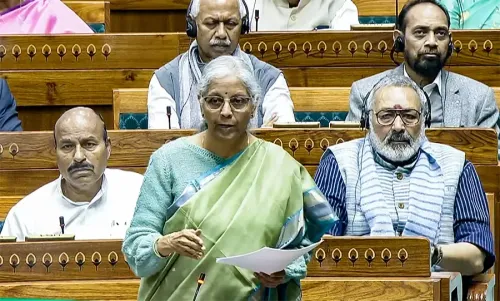
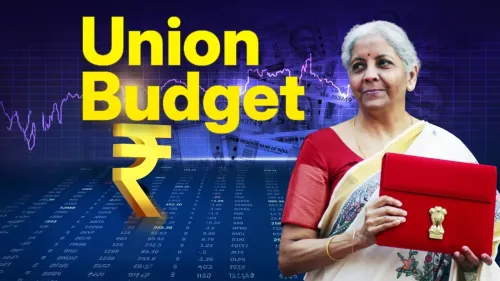
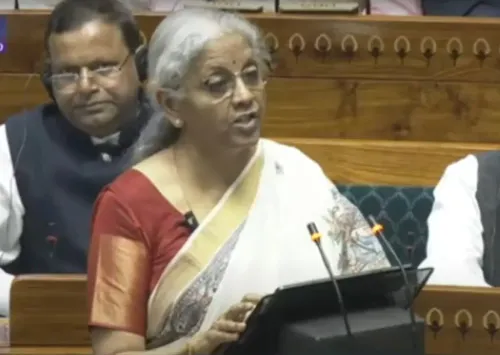
New Delhi, Feb 1 (NationPress) Finance Minister Nirmala Sitharaman is set to unveil the Union Budget for 2026–27 in Parliament, marking a significant event as it will be delivered on a Sunday for the very first time in the history of independent India.
This marks her ninth consecutive Budget presentation, making her the first female finance minister to reach this milestone, and it represents the 15th Budget under the Narendra Modi administration. Furthermore, it is the second complete Budget since the National Democratic Alliance (NDA) regained power for a third consecutive term in 2024.
The FY27 Budget is introduced amid a complex landscape for the Indian economy. Although domestic demand remains strong and inflation has eased from previous highs, the global economic environment is fraught with uncertainty.
Geopolitical tensions, fluctuating commodity prices, inconsistent monetary policies from major central banks, and increasing trade fragmentation continue to challenge economic stability. Additionally, punitive 50 percent tariffs imposed by US President Donald Trump on Indian exports have unsettled financial markets, leading to continuous foreign investor outflows and a record low for the rupee.
To date, substantial income tax and GST reductions, increased infrastructure investments, and interest rate cuts by the Reserve Bank of India have provided some relief to the economy amid these external challenges. However, these tax cuts have also impacted government revenues, limiting the fiscal space for growth support in the upcoming Budget.
Economists anticipate a focus this year on defense, infrastructure, capital spending, power, and affordable housing, while also trying to balance social welfare initiatives with fiscal responsibility. The aim is to sustain growth without undermining the government's commitment to fiscal discipline.
The government has consistently decreased the fiscal deficit from a Covid-induced high of 9.2 percent to an estimated 4.4 percent in FY26, and experts believe this path of fiscal responsibility will continue, with no major deviations expected.
In contrast to the FY26 Budget, which was more explicitly aimed at boosting middle-class consumption through tax benefits, the FY27 Budget is expected to take a more targeted approach towards consumption.
Overall, economists suggest that the Budget is likely to carefully balance the need for growth with fiscal responsibility, while addressing immediate challenges stemming from an unprecedented period of global geopolitical and economic change.
Point of View
I affirm that the Union Budget 2026-27 represents a pivotal moment for the nation. The careful balance between growth and fiscal discipline is of utmost importance as we navigate these unprecedented global challenges. Our commitment to a sustainable fiscal path must not come at the cost of social welfare and growth opportunities.
NationPress
28 Sept 2026
Frequently Asked Questions
What is the significance of the Union Budget 2026-27?
The Union Budget 2026-27 is historic as it will be presented on a Sunday for the first time in independent India's history. It represents the government's fiscal strategy amidst ongoing global economic challenges.
What are the key areas of focus in this Budget?
The Budget is expected to focus on defense, infrastructure, capital expenditure, power, and affordable housing while balancing social welfare initiatives with fiscal discipline.
How has the fiscal deficit changed in recent years?
The government has reduced the fiscal deficit from a peak of 9.2 percent during the Covid pandemic to an estimated 4.4 percent in FY26, maintaining a path of fiscal responsibility.