Chirag Paswan hails Rajya Sabha passage of exam anti-cheating bill

Synopsis
The Rajya Sabha passed the Public Examinations (Prevention of Unfair Means) Amendment Bill, 2026, strengthening India's 2024 anti-cheating law. Union Minister Chirag Paswan hailed it as a decisive step to protect student merit and dismantle paper-leak networks, under PM Modi's leadership.
Key Takeaways
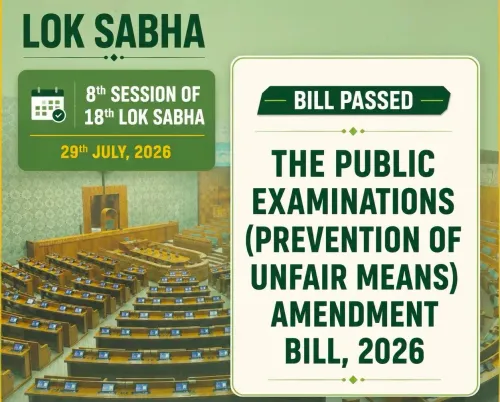
The Rajya Sabha passed the Public Examinations (Prevention of Unfair Means) Amendment Bill, 2026 on July 31, 2026 .
The bill amends the original Public Examinations (Prevention of Unfair Means) Act, 2024 , which targeted paper leaks and exam fraud.
Union Minister Chirag Paswan credited the legislation to PM Narendra Modi's leadership, calling it a historic step.
The law specifically targets paper leaks, impersonation, and organised 'nakl mafia' (cheating cartels) in exams run by UPSC, SSC , and NTA .
Implementation — including enforcement rules and agency action — is the critical next step following Rajya Sabha passage.
Millions of students who have spent years preparing for competitive government exams just got a legislative shield. The Rajya Sabha passed the 'Public Examinations (Prevention of Unfair Means) Amendment Bill, 2026' on Friday, July 31, 2026 — and Union Food Processing Minister Chirag Paswan called it a historic and decisive step toward securing the futures of India's hardworking youth.
Posting on X, Paswan described the bill as more than a law — 'yeh ek sashakt sankalp hai' (this is a powerful resolve) to protect the hard work, talent, and honesty of crores of students. He credited the legislation to the 'visionary leadership' of Prime Minister Narendra Modi, framing it as a direct answer to the organised malpractices that have repeatedly shaken public confidence in India's examination ecosystem.
What the 2024 Act built — and what the 2026 amendment adds
The amendment builds on the Public Examinations (Prevention of Unfair Means) Act, 2024, which Parliament enacted to crack down on paper leaks, impersonation, and other irregularities in competitive public examinations conducted by bodies such as UPSC, SSC, and the National Testing Agency (NTA). That original law was itself a legislative response to a wave of high-profile exam scandals that had triggered nationwide protests and court battles.
The 2026 amendment, now cleared by the upper house, is positioned as a tightening of that framework — aimed at plugging gaps that organised 'paper leak mafias' and cheating networks had continued to exploit. Paswan's post specifically names paper leaks and 'nakl mafia' (cheating cartels) as the targets the law is designed to neutralise.
Why exam integrity became a national political fault line
India's public recruitment examinations are among the most competitive in the world — millions of aspirants, a handful of seats, and years of preparation riding on a single test. When leaks or irregularities surface, the damage is not just administrative. It is deeply personal: careers derailed, families' sacrifices wasted, and trust in the state's fairness shattered.
Successive governments have faced this pressure, but the scale of the problem intensified visibly in recent years. The NTA controversy of 2024 — which saw allegations of paper leaks in the NEET-UG medical entrance examination — brought the issue to a boil, forcing the government to act legislatively and administratively. The 2024 Act was the first response. This amendment is the follow-through.
Rajya Sabha passage and what comes next
With the Rajya Sabha now having passed the bill, attention shifts to implementation — specifically, the notification of enforcement rules and the mechanisms by which investigative agencies will pursue organised cheating networks. The strength of any anti-exam-fraud law ultimately lies not in its text but in the speed and consistency of its enforcement on the ground.
For the millions of aspirants sitting at desks across India right now — grinding through mock tests, memorising statute books, mapping geography — this bill is a promise that the playing field will be cleaner. Whether the machinery of the state delivers on that promise is the question every exam hall in India will eventually answer.
Point of View
Legislating visibly against cheating cartels serves both a policy purpose and a political one: it signals responsiveness to a massive, politically active constituency of exam aspirants and their families. The harder test will be whether enforcement agencies, many of which have historically struggled to prosecute organised paper-leak networks, can translate the law into deterrence. If implementation lags, the legislative momentum risks becoming symbolic rather than structural.
NationPress
31 Jul 2026
Frequently Asked Questions
What is the Public Examinations (Prevention of Unfair Means) Amendment Bill 2026?
It is a parliamentary amendment to the 2024 Public Examinations (Prevention of Unfair Means) Act, passed by the Rajya Sabha on July 31, 2026, aimed at tightening laws against paper leaks, cheating networks, and other malpractices in competitive public examinations in India.
Which exams does the Public Examinations (Prevention of Unfair Means) Act cover?
The law covers public examinations conducted by central bodies including UPSC, SSC, and the National Testing Agency (NTA), which administer high-stakes recruitment and entrance tests across India.
What did Chirag Paswan say about the exam amendment bill?
Union Minister Chirag Paswan called the bill's passage a 'historic and decisive step,' saying it is a powerful resolve to protect students' hard work and talent, and to ensure no young person's dreams are undermined by paper leaks or cheating cartels.
What was the original Public Examinations (Prevention of Unfair Means) Act 2024?
Parliament passed the 2024 Act to create a dedicated legal framework penalising malpractices such as paper leaks, impersonation, and organised cheating in competitive public examinations — the first such central legislation in India.
What happens after the Rajya Sabha passes the exam bill?
Following Rajya Sabha passage, the next critical steps include notification of enforcement rules and the activation of investigative mechanisms to pursue organised cheating networks under the amended law.