US sanctions Mahan Air network over IRGC support, targets China and Russia firms

Synopsis
Washington's latest Mahan Air sanctions reach into China and Russia for the first time in this cycle, designating logistics firms and a travel agency as IRGC enablers — and separately accusing an Iranian tech startup of soliciting strike coordinates for US and Israeli targets in the Middle East. The secondary sanctions warning puts global banks and businesses on notice.
Key Takeaways
The US Treasury's OFAC designated six entities and individuals on 31 July for supporting Mahan Air and the IRGC .
China-based Shanghai Wings International Logistics Co , Shanghai Elite International Travel Co , and Chinese national Tang Xin are among those designated.
Russia-based Air Cargo Pro Limited and Iran's DadeNegar Startup Studio were also sanctioned.
DadeNegar is accused of soliciting locations of American and Israeli military equipment to support Iranian targeting operations.
Treasury Secretary Scott Bessent warned that entities supporting the IRGC or Mahan Air are 'helping sustain a terrorist enterprise.' Foreign financial institutions facilitating significant transactions with designated persons risk secondary sanctions .
The United States on 31 July imposed fresh sanctions on a global network accused of sustaining Iran's Mahan Air, designating six entities and individuals across Iran, China, and Russia that Washington says enable the sanctioned carrier's operations on behalf of the Islamic Revolutionary Guard Corps (IRGC). The action, executed by the US Department of the Treasury's Office of Foreign Assets Control (OFAC), marks a significant escalation in Washington's campaign to sever the IRGC's commercial lifelines.
What the Sanctions Target
The designated entities include Shanghai Wings International Logistics Co and Shanghai Elite International Travel Co — both China-based firms described as general sales agents for Mahan Air — along with Chinese national Tang Xin, identified as managing director of Shanghai Wings and owner of Shanghai Elite. Russia-based Air Cargo Pro Limited was also designated, alongside Iran's DadeNegar Startup Studio, which Washington described as an IRGC-affiliated front company.
Treasury alleged that DadeNegar went beyond commercial activity, operating an online platform that solicited the locations of American and Israeli military equipment to support Iranian targeting operations. 'DadeNegar solicited locations of American and Israeli equipment to support Iranian military targeting. In coordination with the IRGC, DadeNegar received strike requests for US targets in the Middle East,' the Treasury Department said.
What the US Says About Mahan Air
US officials have long maintained that Mahan Air operates well outside the bounds of a conventional civilian carrier. 'Although Mahan Air presents itself as a civilian carrier, it has long played a central role in enabling the Islamic Revolutionary Guard Corps (IRGC), providing travel services for IRGC-Qods Force personnel, facilitating military training, and supporting Iran's procurement and transport of unmanned aerial vehicle (UAV) systems and weapons,' the Treasury Department said.
The State Department similarly described Mahan Air as the IRGC's airline of choice for moving weapons, military personnel, and equipment — a characterisation Iran has consistently rejected.
Treasury Secretary's Warning
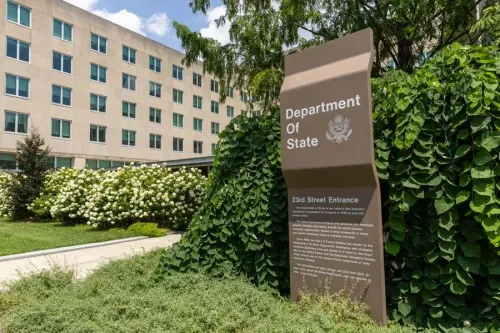
Treasury Secretary Scott Bessent issued a pointed warning to any entity considering commercial ties with Mahan Air or the IRGC. 'Those who provide financial services, logistics, or commercial support to the IRGC or Mahan Air are helping sustain a terrorist enterprise,' Bessent said. 'Treasury will continue to identify them, expose them, and cut them off from the US financial system.'
The warning carries legal weight: the sanctions freeze any US-jurisdiction assets of designated persons and prohibit US persons from transacting with them. Treasury also cautioned that foreign financial institutions facilitating significant transactions with designated entities could face secondary sanctions — a provision that extends Washington's reach well beyond American borders.
International Community Put on Notice
State Department spokesperson Tommy Pigott urged companies worldwide to reassess their exposure to sanctioned Iranian carriers. 'The United States calls on the international community, particularly companies and individuals doing business with Mahan Air or any other sanctioned Iranian carrier, to recognise the serious risks raised by continuing such engagement,' Pigott said.
He added that Washington 'will continue to expose and disrupt entities providing the IRGC with the tools and information it uses to threaten American personnel, our partners, and regional stability.' Notably, this round of designations is the latest in a sustained US effort to dismantle Mahan Air's international commercial infrastructure — a network that has reportedly rebuilt itself across multiple jurisdictions despite prior sanctions rounds.
Broader Context
Mahan Air has been under US sanctions since 2011, when it was first designated for providing support to the IRGC. Despite those restrictions, the airline has continued operating international routes, reportedly relying on intermediary companies — many based in jurisdictions with limited US enforcement reach — to maintain ticketing, logistics, and cargo operations. The inclusion of Chinese and Russian entities in this latest package signals Washington's intent to pressure third-country enablers more aggressively, even at the risk of diplomatic friction with Beijing and Moscow.
Point of View
A move that raises the diplomatic stakes with Beijing and Moscow considerably. The DadeNegar allegation, if substantiated, is also notable: it frames an Iranian tech startup as an active intelligence-gathering node for IRGC strike planning, not merely a commercial front. That framing matters because it expands the legal and political justification for future action beyond the airline sector. What this package does not resolve is the fundamental enforcement gap — Mahan Air has operated under US sanctions since 2011 and has continued flying internationally by cycling through intermediary networks. Designating the latest layer of that network is necessary but historically insufficient on its own.
NationPress
31 Jul 2026
Frequently Asked Questions
Why has the US sanctioned Mahan Air's network?
The US sanctioned six entities and individuals on 31 July for helping sustain Mahan Air's international operations on behalf of Iran's IRGC. Washington describes Mahan Air as the IRGC's airline of choice for transporting weapons, military personnel, and UAV systems.
Which companies were designated in the latest sanctions?
The designated entities include China-based Shanghai Wings International Logistics Co and Shanghai Elite International Travel Co, Chinese national Tang Xin, Russia-based Air Cargo Pro Limited, and Iran's DadeNegar Startup Studio, among others.
What is DadeNegar Startup Studio accused of?
DadeNegar is accused by the US Treasury of acting as an IRGC-affiliated front company that solicited the locations of American and Israeli military equipment to support Iranian targeting operations, including receiving strike requests for US targets in the Middle East.
What are secondary sanctions and who do they affect?
Secondary sanctions allow the US to penalise foreign financial institutions that facilitate significant transactions with designated persons, even if those institutions have no direct US connection. This extends Washington's enforcement reach to banks and businesses operating outside American jurisdiction.
How long has Mahan Air been under US sanctions?
Mahan Air was first designated by the US in 2011 for providing support to the IRGC. Despite over a decade of sanctions, the airline has reportedly continued international operations by relying on intermediary companies across multiple jurisdictions.