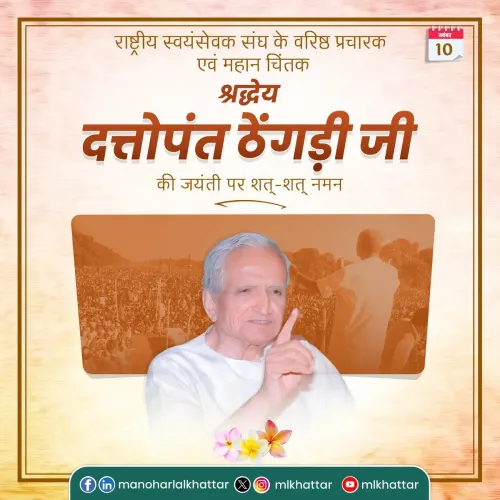
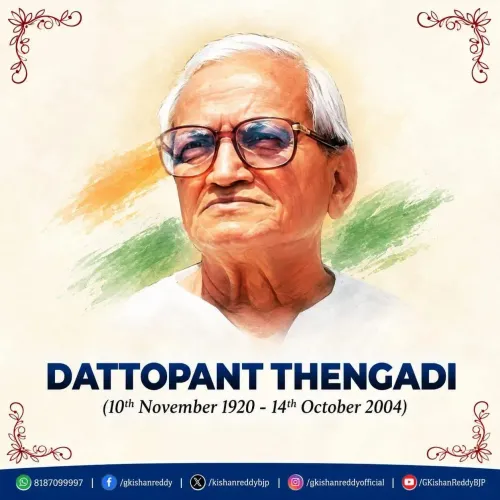
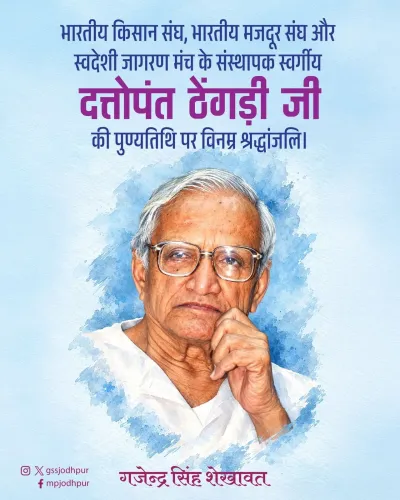
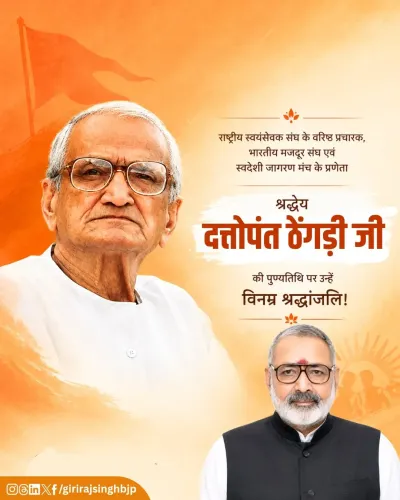
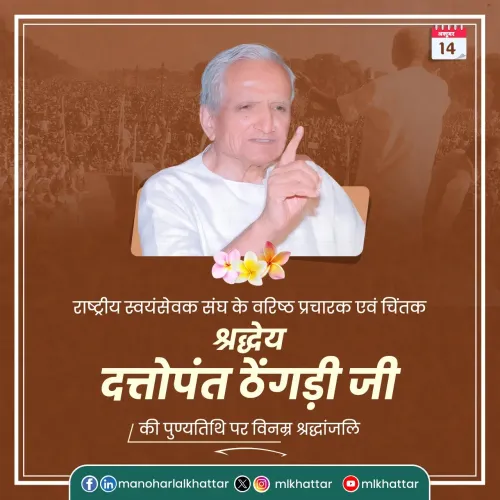
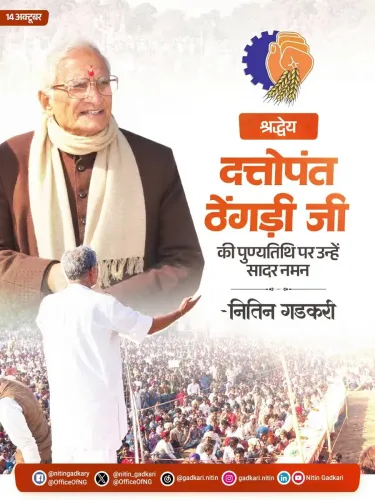
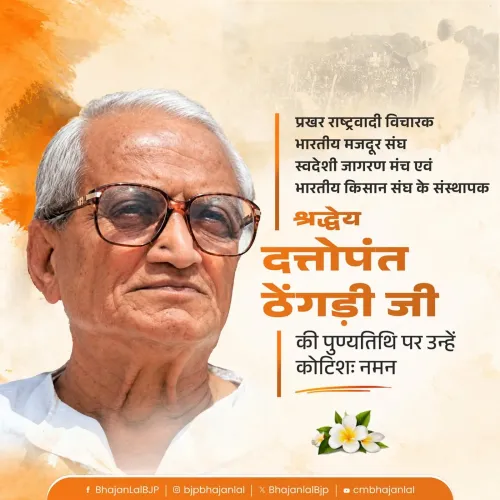
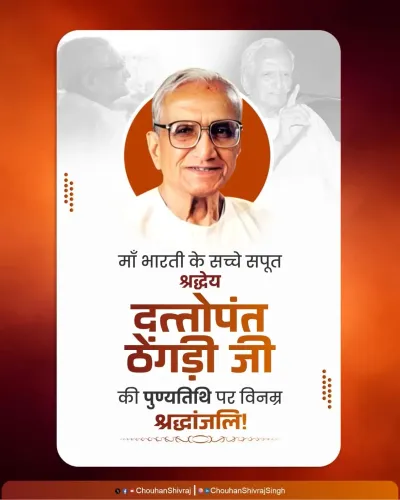
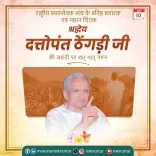
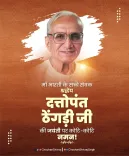
Shivraj Singh Chouhan pays tribute to Dattopant Thengdi on jayanti
Synopsis
Union Agriculture Minister Shivraj Singh Chouhan marked the birth anniversary of RSS pracharak Dattopant Thengdi on November 10, 2026, saluting the founder of the Bharatiya Mazdoor Sangh, Bharatiya Kisan Sangh, and Swadeshi Jagran Manch, and invoking his Antyodaya legacy as an inspiration for nation-building.
Key Takeaways
Shivraj Singh Chouhan paid tribute to Dattopant Thengdi on his birth anniversary on November 10, 2026 .
Thengdi founded three major RSS-affiliated bodies: Bharatiya Mazdoor Sangh (1955) , Bharatiya Kisan Sangh (1978) , and Swadeshi Jagran Manch (1991) .
Chouhan specifically invoked Thengdi's contributions to farmer welfare and the principle of Antyodaya (upliftment of the last person).
The Bharatiya Mazdoor Sangh is India's largest trade union by membership.
The tribute reflects the BJP's broader practice of publicly acknowledging RSS ideological lineage through birth anniversary observances.
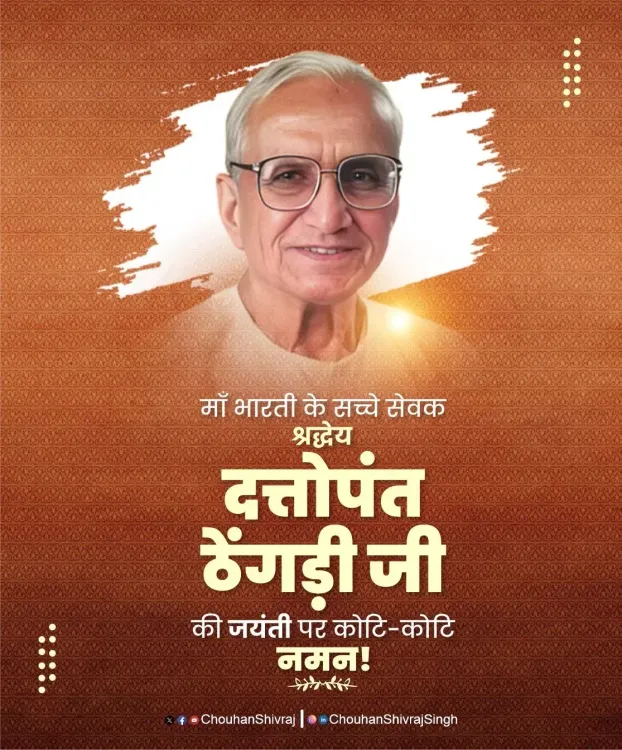
A farmer-welfare minister honoring the man who built India's largest farmers' union — the symmetry is deliberate. Union Agriculture Minister Shivraj Singh Chouhan on Tuesday, November 10, 2026, paid tribute to Dattopant Thengdi, the RSS pracharak who founded the Bharatiya Mazdoor Sangh, the Bharatiya Kisan Sangh, and the Swadeshi Jagran Manch, on the occasion of Thengdi's birth anniversary.
Posting on X in Hindi, Chouhan wrote: 'माँ भारती के सच्चे सेवक' — 'a true servant of Mother India' — saluting Thengdi with 'koti-koti naman' (countless salutations). He invoked Thengdi's work for 'the welfare of farmers and the upliftment of Antyodaya' as a source of enduring inspiration for nation-building.Who was Dattopant Thengdi and why does he matter
Dattopant Thengdi was one of the most consequential organisational architects within the broader RSS ecosystem of the twentieth century. He founded the Bharatiya Mazdoor Sangh (BMS) in 1955, which grew to become India's largest trade union by membership. His philosophy rejected both Western capitalism and Soviet-style communism, arguing for a distinctly Indian model of labour relations rooted in national interest over class conflict. His reach extended beyond labour. In 1978, he established the Bharatiya Kisan Sangh (BKS), a farmers' union that remains active on rural and agricultural policy debates. In 1991 — the very year India opened its economy — he co-founded the Swadeshi Jagran Manch (SJM), an advocacy body pushing back against unchecked economic liberalisation and championing indigenous industry. The timing was not coincidental: Thengdi believed globalisation needed a Swadeshi counterweight.Antyodaya — the idea at the heart of the tribute
Chouhan's specific mention of antyodaya — the welfare of the last person in line, the most marginalised — carries ideological weight beyond ceremonial courtesy. The concept, originally associated with Pandit Deendayal Upadhyaya, is a cornerstone of RSS-BJP social thought, and Thengdi championed it through his union and farmer-organisation work. For a sitting Agriculture Minister who oversees rural development, invoking antyodaya frames his own portfolio as a continuation of that lineage.BJP's annual Sangh Parivar calendar
Senior BJP leaders routinely mark the birth anniversaries of RSS ideologues — a practice that serves both as internal solidarity signaling and as a public articulation of the party's ideological roots. Chouhan, a four-term former Chief Minister of Madhya Pradesh and one of the BJP's most prominent mass leaders, is well-placed to anchor such tributes given his long association with both farmer-welfare politics and the broader Sangh universe. The BKS and BMS remain active in rural and labour policy spaces where the Agriculture Ministry's work intersects directly. Thengdi's legacy, quietly institutional rather than loudly political, keeps resurfacing in exactly the spaces where the BJP governs — farmers, workers, Swadeshi economics. That is precisely why the tribute lands where it does.Point of View
Not casual — linking his Agriculture Ministry's farmer-welfare mandate directly to the ideological lineage of Thengdi's Bharatiya Kisan Sangh signals that BJP governance of rural India is framed as a continuation of Sangh Parivar thought. The mention of Antyodaya is a recurring device that BJP leaders use to anchor welfare-state policy in indigenous ideology rather than imported frameworks. As a four-term former Chief Minister with a mass farmer base, Chouhan is among the most credible BJP voices to invoke this legacy. Collectively, these jayanti tributes function as an ideological map, reminding the cadre — and the public — of the deep-roots argument the party makes for its governance model.
NationPress
10 Nov 2026
Frequently Asked Questions
Who was Dattopant Thengdi?
Dattopant Thengdi was an RSS pracharak and influential ideologue who founded the Bharatiya Mazdoor Sangh in 1955, the Bharatiya Kisan Sangh in 1978, and the Swadeshi Jagran Manch in 1991. He advocated a distinctly Indian model of labour and economic relations, rejecting both Western capitalism and Soviet communism.
What is Dattopant Thengdi's birth anniversary date?
Dattopant Thengdi's birth anniversary (jayanti) is observed on November 10 each year. Senior BJP leaders and RSS-affiliated organisations regularly mark the occasion with tributes.
What is the Bharatiya Mazdoor Sangh?
The Bharatiya Mazdoor Sangh (BMS) is India's largest trade union by membership, founded by Dattopant Thengdi in 1955. It is affiliated with the RSS and focuses on labour welfare within a framework of national interest rather than class conflict.
What does Antyodaya mean and why did Chouhan mention it?
Antyodaya refers to the welfare of the last and most marginalised person in society, a concept central to RSS-BJP social thought. Chouhan invoked it to highlight Thengdi's commitment to the poorest citizens and to frame his own Agriculture Ministry's work as a continuation of that philosophy.
What is the Swadeshi Jagran Manch?
The Swadeshi Jagran Manch (SJM) is an RSS-linked body co-founded by Dattopant Thengdi in 1991 that advocates economic self-reliance, the promotion of indigenous industry, and a measured approach to economic globalisation.