CJI Surya Kant swears in three new Supreme Court judges on 6 October
Synopsis
Three High Court Chief Justices — Sunita Agarwal, Devendra Kumar Upadhyaya, and Aparesh Kumar Singh — were sworn in as Supreme Court judges on 6 October 2026 by CJI Surya Kant, just days after the Collegium recommended their elevation. The Centre's rapid approval and an unusually timed 3:30 pm ceremony signal a notable shift in the pace and transparency of apex court appointments.
Key Takeaways
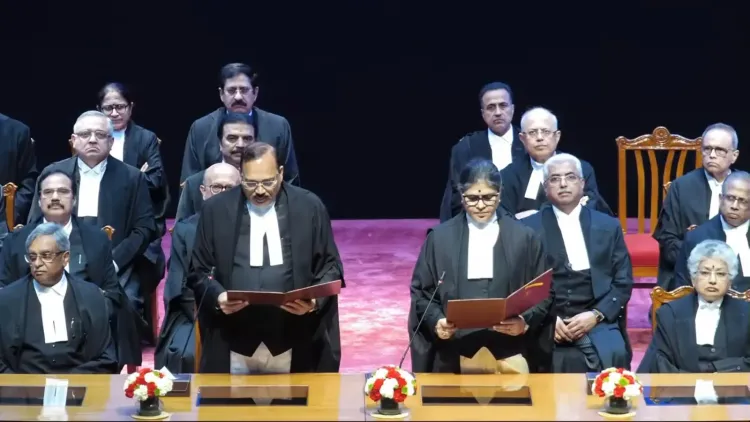
CJI Surya Kant administered the oath to Justices Sunita Agarwal, Devendra Kumar Upadhyaya, and Aparesh Kumar Singh on 6 October 2026 .
The swearing-in was held at 3:30 pm IST , departing from the customary 10:30 am convention.
The Supreme Court Collegium recommended the elevations at its meeting on 28 September 2026 ; the Centre approved them the very next day after the date of the ceremony.
Union Minister Arjun Ram Meghwal confirmed the appointments via a post on X, citing the President's approval after consultation with CJI Surya Kant .
The appointments move the Supreme Court closer to its revised sanctioned strength of 37 judges (excluding the CJI).
Chief Justice of India (CJI) Surya Kant on Tuesday, 6 October 2026, administered the oath of office to three newly elevated judges of the Supreme Court of India — Justice Sunita Agarwal, Justice Devendra Kumar Upadhyaya, and Justice Aparesh Kumar Singh. The swearing-in ceremony, held at 3:30 pm IST and live-streamed for public viewing, marked a notable departure from the convention of inducting new Supreme Court judges at 10:30 am, the hour when the apex court typically assembles for hearings.
Background: Collegium Recommendation and Centre's Swift Approval
The elevation followed a recommendation made by the Supreme Court Collegium at its meeting on 28 September 2026, which proposed the appointment of all three sitting Chief Justices of High Courts as judges of the apex court. The Centre moved quickly, approving the appointments on Monday, 5 October — within days of the Collegium's formal proposal. Union Minister for Law and Justice Arjun Ram Meghwal announced the development in a post on X, stating that the President of India, after consultation with CJI Surya Kant, had formally appointed the three jurists to the Supreme Court bench.
Profiles of the Three New Judges
Justice Sunita Agarwal, born on 30 April 1966, was first appointed as a judge of the Allahabad High Court on 21 November 2011. She went on to serve as Chief Justice of the Gujarat High Court from 23 July 2023, before her elevation to the Supreme Court.
Justice Devendra Kumar Upadhyaya, born on 16 June 1965, was also appointed to the Allahabad High Court on 21 November 2011 as a puisne judge, becoming a permanent judge on 6 August 2013. He subsequently served as Chief Justice of the Bombay High Court from 29 July 2023 before being transferred as Chief Justice of the Delhi High Court, a position he assumed on 21 January 2025.
Justice Aparesh Kumar Singh, born on 7 July 1965, was appointed as an Additional Judge of the Jharkhand High Court on 24 January 2012 and confirmed as a Permanent Judge on 16 January 2014. He served as Acting Chief Justice of the Jharkhand High Court from 20 December 2022 to 19 February 2023, took oath as Chief Justice of the Tripura High Court on 17 April 2023, and was subsequently transferred to the Telangana High Court as Chief Justice, where he assumed charge on 19 July 2025.
Impact on Supreme Court Strength
The three appointments come as part of a broader effort to shore up judicial capacity at the apex level. Earlier this year, the Centre approved an increase in the Supreme Court's sanctioned strength to 37 judges, excluding the CJI. These inductions move the court closer to that revised ceiling and are expected to help reduce pendency of cases before the nation's highest judicial forum. Notably, all three elevated jurists bring extensive High Court experience spanning multiple states, adding geographic and jurisdictional breadth to the bench.
Significance of the Afternoon Ceremony
The choice of a 3:30 pm timeslot for the oath-taking drew attention given the well-established practice of morning sittings. The ceremony was live-streamed, continuing the Supreme Court's recent emphasis on greater transparency in judicial proceedings. This is the latest in a series of collegium-recommended elevations that have been acted upon by the Centre within a compressed timeframe, signalling a degree of coordination between the executive and the judiciary on judicial appointments — a dynamic that has at times been contentious in the past.
With these three additions, the composition of India's highest court continues to evolve, and observers will watch whether the expanded bench accelerates the disposal of long-pending constitutional matters.
Point of View
While minor in isolation, underscores that the Supreme Court is increasingly willing to depart from convention — a small but telling signal of institutional confidence. More substantively, filling vacancies toward a 37-judge bench matters: pendency at the apex level remains a structural problem, and every addition to the bench directly affects how quickly constitutional matters get heard.
NationPress
6 Oct 2026
Frequently Asked Questions
Who are the three new Supreme Court judges sworn in on 6 October 2026?
The three new Supreme Court judges are Justice Sunita Agarwal, Justice Devendra Kumar Upadhyaya, and Justice Aparesh Kumar Singh — all former Chief Justices of High Courts. They were sworn in by Chief Justice of India Surya Kant on 6 October 2026 at 3:30 pm IST.
Why was the oath administered in the afternoon instead of the usual morning time?
The ceremony was held at 3:30 pm IST, departing from the established practice of swearing in new Supreme Court judges at 10:30 am when the court assembles for hearings. No official reason was stated for the change in timing, but the ceremony was live-streamed for transparency.
How quickly did the Centre act on the Collegium's recommendation?
The Supreme Court Collegium recommended the three elevations at its meeting on 28 September 2026, and the Centre approved the appointments by Monday, 5 October — within a week of the formal recommendation. Law Minister Arjun Ram Meghwal announced the approvals via a post on X.
What is the current sanctioned strength of the Supreme Court?
The Centre earlier in 2026 approved an increase in the Supreme Court's sanctioned strength to 37 judges, excluding the Chief Justice of India. The three new inductions bring the court closer to this revised ceiling.
What are the judicial backgrounds of the newly elevated judges?
Justice Sunita Agarwal served as Chief Justice of the Gujarat High Court; Justice Devendra Kumar Upadhyaya was Chief Justice of the Delhi High Court after earlier serving as Chief Justice of the Bombay High Court; and Justice Aparesh Kumar Singh was Chief Justice of the Telangana High Court, having previously served as Chief Justice of the Tripura High Court.