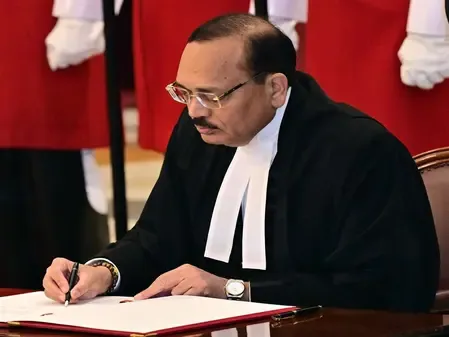
CJI Surya Kant Criticizes Litigant's Father's Actions; Contempt Threat Issued
Synopsis
The Supreme Court has taken a strong stance against attempts to influence its proceedings, as CJI Surya Kant warns a litigant's father of potential contempt charges for contacting his family. This incident raises critical questions about judicial integrity and misconduct.
Key Takeaways
CJI Surya Kant issued a warning against attempts to influence judicial proceedings.
The Supreme Court is scrutinizing the legitimacy of minority status claims.
Guidelines for issuing minority certificates are being reviewed.
Individuals converting to other religions cannot claim Scheduled Caste benefits.
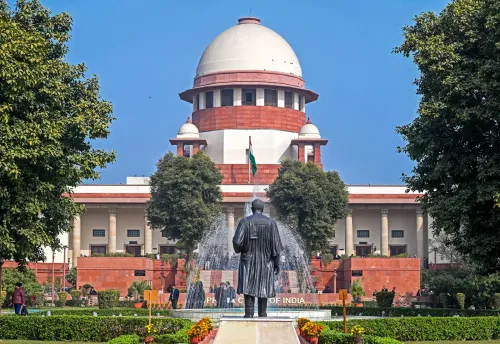
New Delhi, March 25 (NationPress) The Supreme Court expressed grave concern on Wednesday regarding an alleged attempt to sway judicial proceedings. Chief Justice of India (CJI) Surya Kant issued a stern warning of potential criminal contempt actions after a litigant's relative reportedly made contact with a family member concerning an order issued by the apex court.
While presiding over a case related to medical admissions, CJI Kant voiced his strong disapproval of the situation and scrutinized the actions of the petitioner’s father.
“Why shouldn’t there be contempt proceedings against him? He has the audacity to call my brother and question how the CJI has made his ruling? Is he trying to dictate terms to me?” the CJI articulated during the session.
Instructing the attorney representing the case to investigate the matter, CJI Kant stated: “You must verify this — and as a lawyer, you should consider withdrawing if your client is engaging in misconduct.” He added, “Even if he attempts to evade the consequences from abroad, I know how to handle such individuals. Never attempt this again. I’ve dealt with similar matters for 23 years,” the CJI remarked.
The counsel, admitting ignorance about the alleged misconduct, offered an apology before the Supreme Court.
This incident arose in connection with a petition filed by two candidates from Haryana who were seeking admission to a postgraduate medical course under the Buddhist minority quota at a private medical institution in Uttar Pradesh.
The petitioners asserted their eligibility for the Buddhist minority quota based on conversion certificates issued by a Sub-Divisional Officer in Haryana.
Previously, the Bench, which included Justice Joymalya Bagchi, had raised significant doubts regarding the legitimacy of the conversion claims.
The apex court had noted that the petitioners participated in the NEET-PG as General Category candidates and stated they did not belong to the Economically Weaker Sections. “This represents a new form of fraud. We won’t hesitate to elaborate further,” it cautioned, warning against the misuse of minority status for gaining admissions.
Additionally, the Supreme Court highlighted that the petitioners were part of the “Punia” community, questioning how individuals from a traditionally non-minority background could seek such advantages after previously applying as general category candidates.
Considering the broader implications, the apex court instructed the Chief Secretary of Haryana to provide guidelines on the issuance of minority certificates and to clarify whether candidates who had previously classified themselves as General Category and exceeded the EWS threshold could later claim minority status.
It mandated the Chief Secretary to define the policy framework and the criteria for issuing such certificates.
In a separate but related ruling on the implications of religious conversion, the Supreme Court determined on Tuesday that individuals practicing a religion other than Hinduism, Sikhism, or Buddhism cannot assert Scheduled Caste status.
A Bench comprising Justices Prashant Kumar Mishra and N. V. Anjaria upheld a ruling from the Andhra Pradesh High Court, affirming that conversion to Christianity results in the “immediate and complete loss” of Scheduled Caste status as per the Constitution (Scheduled Castes) Order of 1950.
“The prohibition is absolute and allows no exceptions,” the court remarked, asserting that one cannot simultaneously adhere to a different religion while claiming benefits intended for Scheduled Castes.
Point of View
It is crucial to recognize the Supreme Court's firm stance on maintaining the integrity of judicial processes. The court's actions reflect a commitment to uphold justice and prevent any form of external influence, reinforcing the importance of accountability in legal proceedings.
NationPress
23 Sept 2026
Frequently Asked Questions
What prompted CJI Surya Kant's warning?
CJI Surya Kant warned about potential contempt actions after a litigant's father allegedly contacted a family member regarding a court order.
What was the context of the Supreme Court's hearing?
The hearing involved a case concerning medical admissions for two candidates seeking entry under the Buddhist minority quota.
What doubts did the Supreme Court express regarding the petitioners?
The court raised concerns over the legitimacy of the petitioners' claimed conversion to Buddhism, questioning their eligibility for minority status.
What did the Supreme Court instruct the Chief Secretary of Haryana?
The court directed the Chief Secretary to clarify guidelines for issuing minority certificates and assess the validity of previous declarations made by candidates.
What was the outcome of the related ruling on Scheduled Caste status?
The Supreme Court ruled that individuals converting from Hinduism, Sikhism, or Buddhism cannot claim Scheduled Caste status, emphasizing the absolute nature of this prohibition.