CJI Surya Kant Urges Immediate Action to Combat Cybercrime Challenges
Synopsis
CJI Surya Kant's call for real-time enforcement mechanisms highlights the urgent need to combat the rising threat of cybercrime in India. He emphasizes systemic gaps and the necessity for collaborative efforts among key stakeholders.
Key Takeaways
Real-time enforcement is crucial to address cybercrime effectively.
Collaboration among banks, telecom providers, and law enforcement is essential.
Adopting technology-driven solutions can enhance detection and response.
Capacity building in digital forensics is necessary for investigative agencies. 'ABHAY', an AI chatbot, helps citizens verify CBI notices.
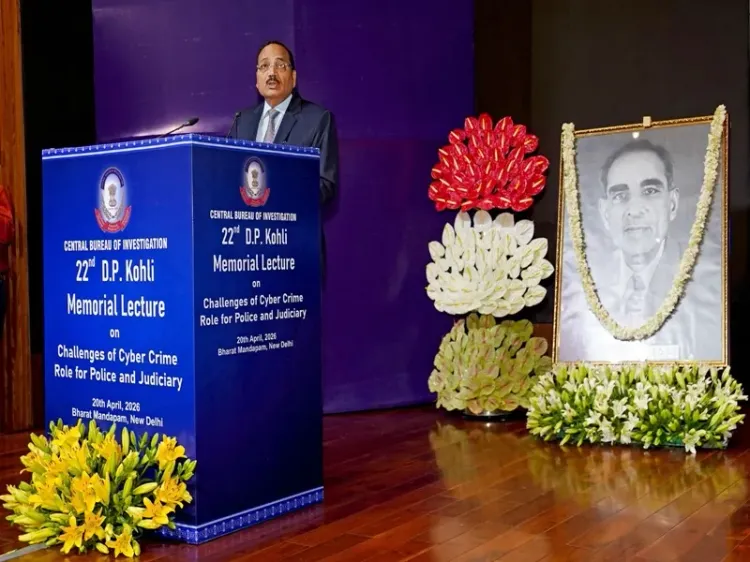
New Delhi, April 20 (NationPress) Chief Justice of India (CJI) Surya Kant emphasized the pressing necessity for transitioning to real-time enforcement mechanisms to effectively address the swiftly changing landscape of cybercrime in the nation.
While delivering the 22nd D.P. Kohli Memorial Lecture at Bharat Mandapam, the CJI noted that traditional methods of enforcement are increasingly falling short against cyber offences that are transnational, rapid, and anonymous.
The event, organized by the Central Bureau of Investigation (CBI), revolved around the theme “Challenges of Cyber Crime: Role for Police and Judiciary,” uniting various stakeholders from law enforcement and the legal community.
Addressing the systemic shortcomings in the existing framework, the CJI highlighted the disconnect between the immediate execution of cybercrimes and the often sluggish and fragmented responses from institutions.
He advocated for real-time collaboration among crucial stakeholders, including banks, telecom providers, digital platforms, and investigative entities, to facilitate prompt detection, response, and mitigation of cyber threats.
Advocating for a broader paradigm shift, CJI Kant emphasized the significance of embracing technology-driven solutions, such as automated detection systems, early warning systems, and integrated command structures.
He underscored the urgent need to enhance capabilities in digital forensics, cyber intelligence, and specialized training within investigative and enforcement agencies to tackle complex cyber threats effectively.
“Addressing cybercrime effectively demands a coordinated, anticipatory, and collaborative strategy,” he stated, emphasizing that judicial adaptability and robust technological protections must support enforcement efforts.
The CJI identified capacity building, inter-agency cooperation, and technology-led governance as fundamental elements in fortifying the institutional response to cybercrime in India.
During the event, the CJI also introduced ‘ABHAY’, an AI-driven chatbot designed to assist citizens in verifying the legitimacy of notices allegedly issued by the CBI, especially amidst the surge of so-called “digital arrest” scams involving impersonation.
The CBI hosts this annual lecture series to honor its founding Director, Dharamnath Prasad Kohli, whose leadership established the agency's foundational framework in its formative years.
Founded by a Union government resolution on April 1, 1963, the CBI was tasked with investigating bribery and corruption cases, violations of central fiscal laws, and other significant crimes, evolving into India’s leading investigative authority over the decades.
Kohli, who previously led the Delhi Special Police Establishment (DSPE) before becoming the inaugural Director of the CBI, is widely recognized for enhancing investigative processes, institutional credibility, and organizational integrity.
Point of View
It is clear that the urgent call by CJI Surya Kant for a shift towards real-time cybercrime enforcement reflects a necessary evolution in our legal and technological response to mounting digital threats. This demand for proactive collaboration among stakeholders is essential for safeguarding our society against increasingly sophisticated cybercriminals.
NationPress
19 Sept 2026
Frequently Asked Questions
What did CJI Surya Kant emphasize in the lecture?
CJI Surya Kant emphasized the urgent need for real-time enforcement mechanisms to combat the evolving threat of cybercrime in India.
What systemic gaps did the CJI point out?
He highlighted the mismatch between the rapid execution of cybercrimes and the often delayed and fragmented responses from authorities.
What role do technology-driven solutions play in combating cybercrime?
CJI Kant advocated for technology-driven solutions like automated detection systems and early warning mechanisms to enhance the response to cyber threats.
Who was Dharamnath Prasad Kohli?
Dharamnath Prasad Kohli was the founding Director of the CBI, credited with laying the agency's foundational framework and enhancing its credibility.