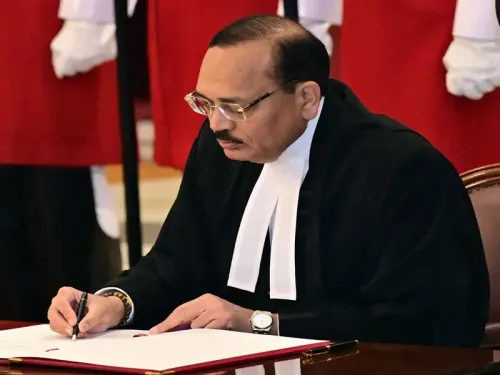
CJI Surya Kant meets Uzbekistan Supreme Court chief, discusses AI in judiciary
Synopsis
Chief Justice of India Surya Kant carried India's judicial diplomacy to Tashkent, meeting Uzbekistan's Supreme Court chief to discuss AI-enabled justice — days after addressing the AACC Congress in Samarkand. Combined with his June Moscow visit, a clear pattern is emerging: India's top court is actively positioning itself as a global voice on technology and judicial reform.
Key Takeaways
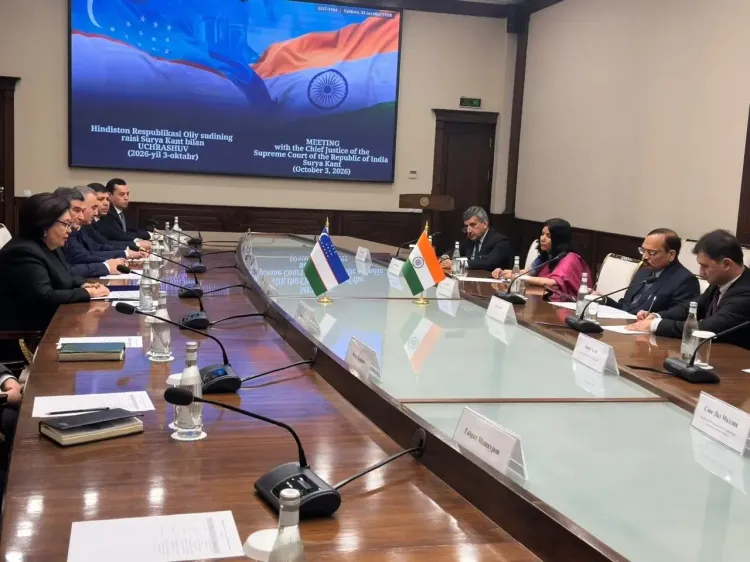
CJI Surya Kant met Robakhon Makhmudova , Chairperson of the Supreme Court of Uzbekistan , in Tashkent on 4 October 2026 .
Discussions covered bilateral judicial cooperation and the use of AI and digital technology in court systems.
Earlier that week, the CJI participated in the 7th AACC Congress in Samarkand and delivered a speech on 'Digitising Justice' .
In June 2026 , CJI Surya Kant met Russian Supreme Court Chairman Igor Krasnov in Moscow , stressing technology's role alongside human values in justice.
The engagements reflect a broader effort to position the Supreme Court of India as a leading voice in Asian and Eurasian judicial diplomacy.
Chief Justice of India (CJI) Surya Kant on Sunday, 4 October 2026, held a bilateral meeting with Robakhon Makhmudova, Chairperson of the Supreme Court of Uzbekistan, in Tashkent, focusing on judicial cooperation between the two countries and the integration of artificial intelligence and digital technologies in court systems. The meeting marks a deepening of India's judicial diplomacy across Central Asia.
Key Developments in Tashkent
According to the Embassy of India in Tashkent, the two senior jurists discussed frameworks for bilateral judicial cooperation alongside the efficient deployment of AI and digital technology in their respective judicial systems. The embassy's account confirmed the meeting's scope, which extended beyond protocol to substantive exchange on court modernisation.
Earlier in the week, on Thursday, CJI Surya Kant participated in the 7th Congress of the Association of Asian Constitutional Courts (AACC) held in the Uzbek city of Samarkand. He delivered a speech titled 'Digitising Justice: Charting the Supreme Court of India's Course', outlining India's roadmap for technology-enabled judicial reform. The AACC Congress is a significant multilateral forum for constitutional courts across Asia.
India's Broader Judicial Diplomacy Push
The Tashkent visit is part of a broader pattern of international judicial outreach by CJI Surya Kant. In June, he travelled to Russia and met Igor Krasnov, Chairman of Russia's Supreme Court, in Moscow. During that meeting, he drew attention to the shared challenges faced by large, diverse democracies in maintaining public trust in justice delivery.
He noted that while India and Russia have evolved through different legal traditions, both nations grapple with a common imperative — preserving public confidence in the administration of justice while adapting to a rapidly changing world. CJI Surya Kant had also referenced his earlier visit to Russia in 2024 for the BRICS Chief Justices Conference in Sochi, describing the experience as deepening his appreciation of the parallels between the two jurisdictions.
CJI on Technology and Human Values in Justice
Across his recent international engagements, CJI Surya Kant has consistently underscored both the promise and the limits of technology in courts. He has argued that modern judiciaries must harness technological tools responsibly, ensuring that efficiency gains do not erode the human foundation of justice.
'The future of justice will depend upon our ability to combine technological innovation with enduring human values,' he said during his Russia visit, adding that while technology can expand access to courts and improve efficiency, the administration of justice must remain a fundamentally human endeavour. These themes resonate directly with the AI discussion he carried into his Uzbekistan meeting.
What This Signals
India's judiciary has been accelerating its digital transformation — from e-filing and virtual hearings to AI-assisted case management — and the Supreme Court of India is increasingly positioning itself as a model for courts in the Global South. Bilateral judicial dialogues of this kind serve to export best practices, explore mutual legal assistance frameworks, and build institutional goodwill. With both Uzbekistan and Russia engaged within months, CJI Surya Kant's international schedule reflects a deliberate strategy to anchor India's judiciary at the centre of Asian and Eurasian legal diplomacy. Further such engagements are widely expected as the Supreme Court's digitalisation agenda matures.
Point of View
Tashkent, and Moscow earlier in the year — are not routine courtesy calls. They signal a deliberate effort by the Supreme Court of India to lead the narrative on AI and digitalisation in Asian judiciaries, a space where India has genuine implementation experience but faces scrutiny over case pendency. The irony is notable: a court still working through millions of pending cases is being held up internationally as a model for digital justice. That credibility gap is the CJI's real challenge to manage, at home and abroad.
NationPress
4 Oct 2026
Frequently Asked Questions
What did CJI Surya Kant discuss with Uzbekistan's Supreme Court chief?
CJI Surya Kant met Uzbekistan Supreme Court Chairperson Robakhon Makhmudova in Tashkent on 4 October 2026 to discuss bilateral judicial cooperation and the use of AI and digital technologies in their respective court systems. The meeting was confirmed by the Embassy of India in Tashkent.
What is the AACC Congress and why did the CJI attend?
The Association of Asian Constitutional Courts (AACC) Congress is a multilateral forum for senior jurists from across Asia. CJI Surya Kant participated in its 7th Congress in Samarkand, Uzbekistan, where he delivered a speech focused on India's digitalisation of its judicial system.
Has CJI Surya Kant held other similar international meetings recently?
Yes. In June 2026, CJI Surya Kant travelled to Moscow and met Russian Supreme Court Chairman Igor Krasnov, discussing shared challenges in maintaining public confidence in justice amid rapid technological change. He had also visited Russia in 2024 for the BRICS Chief Justices Conference in Sochi.
What is CJI Surya Kant's position on AI in the judiciary?
CJI Surya Kant has consistently supported responsible use of technology in courts, arguing that AI can expand access and improve efficiency. However, he has stressed that justice must remain a fundamentally human endeavour, with technological innovation balanced against enduring human values.
Why is India's judicial diplomacy with Uzbekistan and Russia significant?
These engagements reflect India's strategy to position its Supreme Court as a regional model for court modernisation and digital justice, particularly across Asia and Eurasia. Bilateral judicial dialogues also lay the groundwork for mutual legal assistance frameworks and institutional cooperation.