White House: Trump Locks In $17 Billion in Commercial Deals
Synopsis
The White House announced that President Trump secured $17 billion in commercial deals and strategic investments for U.S. companies, framing the milestone as evidence of his singular focus on American economic interests — with partner details still to follow.
Key Takeaways
$17 billion in commercial deals and strategic investments for U.S. companies announced by the White House.
The White House attributed the deals to President Trump's stated priority of serving the American people.
No partner country, sector breakdown, or deal timeline was disclosed in the announcement.
The announcement follows a recurring America First pattern of publicising large investment figures as a measure of diplomatic success.
Further disclosures on specific deals, sectors, and partner nations are anticipated in follow-up communications.
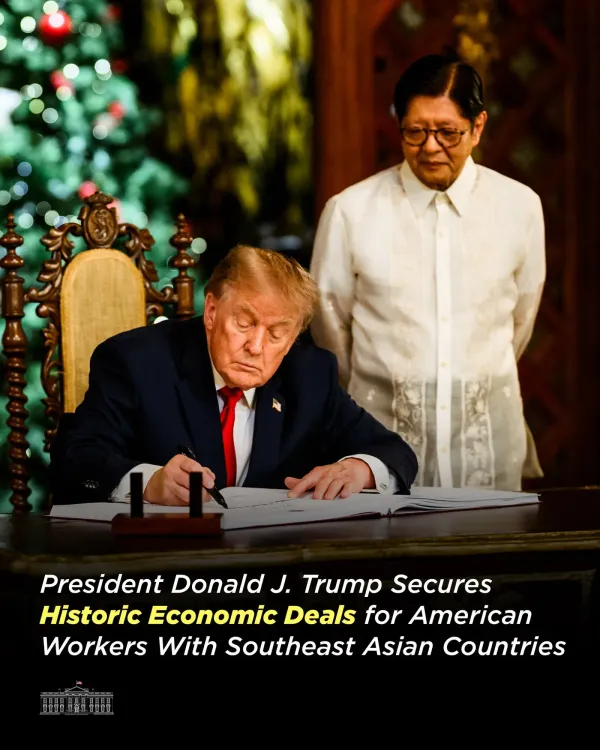
The numbers are in — and the White House wants the world to know them. The official communications account of The White House announced on Wednesday, November 19, 2026, that President Donald Trump had secured $17 billion in commercial deals and strategic investments for U.S. companies, framing the haul as proof of a singular presidential priority: the American people.
The post, brief but pointed, declared: 'President Trump has one priority on his mind: the American people. $17 billion in commercial deals and strategic investments for U.S. companies secured.' No partner countries, no deal names — just the headline figure, planted like a flag.
America First, Deal by Deal
The announcement fits a well-worn playbook. Since his first term, Trump has consistently used large investment-commitment announcements as a primary language of foreign engagement — translating diplomatic trips and bilateral meetings into dollar figures that land on front pages and factory floors alike. The logic is direct: a headline number signals jobs, supply chains, and commercial relevance before a single contract is signed. The phrase 'strategic investments' alongside 'commercial deals' hints at a dual-track effort — part pure business, part something closer to economic statecraft, where capital flows are steered by national-interest calculus as much as by market returns. For U.S. companies, particularly in sectors like energy, defence manufacturing, and advanced technology, that distinction matters enormously.What the $17 Billion Figure Signals
The White House did not name the partner country or countries involved, the sectors covered, or the timeline for fund deployment — details that will determine whether the number represents firm contracts, letters of intent, or longer-horizon commitments. That ambiguity is itself a political choice: the top-line figure does its work in the news cycle while specifics remain to be unpacked. What is clear is that the administration is signalling momentum on the economic front, using a single, memorable number to anchor a broader narrative of presidential effectiveness. For Indian businesses and policymakers watching U.S. trade posture — particularly those exposed to American capital markets, technology partnerships, or export relationships — the direction of travel matters: a Washington that measures diplomatic success in investment scorecards is one that will continue to press partners for commercially visible commitments. The devil, as always, lives in the deal sheets. Watch for follow-up announcements naming the partner nations and sector-by-sector breakdowns — that is where the real story will begin.Point of View
Quotable number and lead with it. The absence of partner country names or sector details is deliberate — the top-line figure does the political heavy lifting while specifics remain manageable. For observers in India and the broader Indo-Pacific, the signal is strategic: an administration that scorecards diplomacy in investment figures will continue to expect commercially visible returns from partner nations. The real test arrives when deal sheets become public and commitments must translate into actual capital flows.
NationPress
19 Nov 2026
Frequently Asked Questions
What are the $17 billion commercial deals announced by the White House?
The White House announced that President Trump secured $17 billion in commercial deals and strategic investments for U.S. companies, though no partner country names, sector details, or timelines were disclosed in the initial announcement.
Which countries are involved in Trump's $17 billion investment deals?
The White House did not name the partner countries involved. Further announcements detailing specific deals and partner nations are expected.
What does 'strategic investments' mean in the White House announcement?
The term 'strategic investments' suggests a mix of market-driven commercial deals and capital flows shaped by national-interest priorities, potentially covering sectors like energy, defence manufacturing, and advanced technology.
How does Trump use investment announcements in his foreign policy?
Since his first term, Trump has consistently converted diplomatic engagements into headline investment figures, using large dollar commitments to signal economic benefits for the U.S. and domestic audiences.
Why does the White House not reveal deal details upfront?
Leading with a top-line figure maximises immediate impact in the news cycle, while sector-by-sector and country-by-country details — which invite more scrutiny — are typically released in follow-up communications.