White House signals Trump holds leverage in key negotiations
Synopsis
The White House posted on June 11, 2026, declaring President Trump 'holds all the cards' — a signature phrase from his first term now revived in his second, signalling assertive U.S. leverage ahead of what observers expect to be a significant diplomatic or trade development.
Key Takeaways
The White House posted on June 11, 2026 that President Trump 'holds all the cards,' without specifying the negotiation in question.
The phrase is a recurring rhetorical device from Trump's first term , previously used during U.S.–North Korea and U.S.–China trade talks.
The post aligns with the administration's 'America First' doctrine of publicly signalling leverage before formal negotiations.
Foreign governments with active dealings in Washington — including India — are likely paying close attention to the signal.
Analysts expect a concrete bilateral or trade announcement to follow such public assertions of U.S. strength.
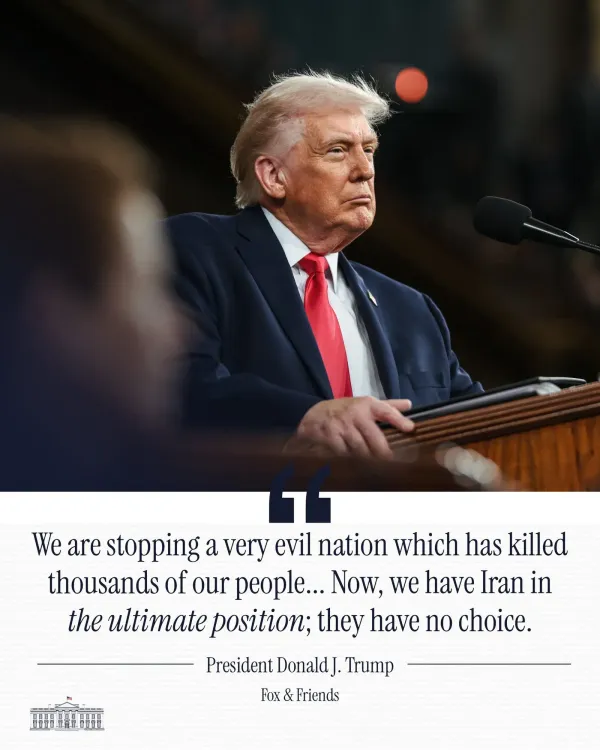
The White House, the official communications account of the Executive Office of the President of the United States, posted a pointed message on Thursday, June 11, 2026, declaring that President Donald Trump 'holds all the cards' — a phrase long associated with his administration's assertive negotiating posture on the world stage.
Context
The post, accompanied by an image, offered no explicit detail about the specific negotiation or diplomatic matter it referenced. However, the language is far from new: the phrase 'holds all the cards' has been a recurring rhetorical device in the Trump administration's public communications, deployed to signal American dominance in high-stakes dealings.
During Trump's first term (2017–2021), identical or near-identical language was used during the U.S.–North Korea summits of 2018–2019 and throughout the prolonged U.S.–China trade war. The White House's deployment of this phrase in his second term suggests a continuity of that communication strategy.
Policy Backdrop
The declaration fits squarely within the broader 'America First' foreign policy doctrine that has defined both of Trump's presidential tenures. Rather than emphasising multilateral consensus or quiet diplomacy, the administration has consistently preferred public displays of leverage — a strategy intended to shape the expectations of counterpart governments before formal talks begin.
Analysts who have tracked this pattern note that such statements are rarely accidental. They are typically timed to precede or accompany a specific diplomatic or economic move, serving as a public signal to foreign capitals about Washington's negotiating floor. The phrase has previously appeared in contexts ranging from tariff negotiations to sanctions discussions.
Stakeholders and Impact
Foreign governments with active or pending negotiations with Washington are the most immediate audience for this kind of messaging. Capitals across Asia, Europe, and the Middle East routinely monitor White House social media for signals about the administration's mood and posture ahead of formal diplomatic engagements.
For India, which has maintained a complex but strategically significant relationship with the United States — spanning trade, defence, and technology — such signals from the White House carry weight. Bilateral trade negotiations and defence procurement discussions between New Delhi and Washington remain active, making the administration's negotiating tone a matter of close attention in Indian policy circles.
Markets and business communities in countries with open trade disputes or pending agreements with the U.S. may also read this statement as a hardening of the American position ahead of any upcoming announcements.
What's Next
The specific trigger for this post remains unconfirmed. Observers will watch closely for any bilateral summit announcements, trade deal disclosures, or sanctions-related decisions in the days following this signal. If history is a guide, a concrete policy action or diplomatic development is likely to follow shortly after such public assertions of leverage from the White House.
The broader implication is clear: the Trump administration intends to enter whatever negotiation is at hand from a position of publicly declared strength, a posture that will shape how counterpart nations calibrate their own opening offers and red lines.
Point of View
Not casual social media. This administration has consistently used public platforms to set psychological terms before formal talks begin — a tactic that proved effective in extracting concessions during the first-term China trade war. The revival of this exact phrase in the second term suggests the White House is either at or approaching a critical juncture in a major bilateral negotiation. For countries like India navigating a delicate balance between trade interests and strategic alignment with Washington, such signals demand careful reading.
NationPress
21 Sept 2026
Frequently Asked Questions
What does 'Trump holds all the cards' mean?
It is a phrase used by the Trump administration to signal that the United States holds dominant leverage in an ongoing negotiation — whether trade, diplomatic, or security-related. The White House posted this on June 11, 2026, without specifying the exact context.
Has Trump used this phrase before?
Yes. During his first term, President Trump used near-identical language during U.S.–North Korea summit preparations in 2018–2019 and throughout the U.S.–China trade war , typically to signal American strength before a major move.
What negotiation is the White House referring to in June 2026?
The specific context of the June 11, 2026 post has not been officially clarified. The linked image was not described in detail, and no named country or deal was mentioned in the post itself.
How does this affect India?
India and the United States have active discussions on trade, defence, and technology. Assertive signals from the White House about U.S. negotiating leverage are closely monitored by New Delhi , as they can influence the terms and tone of bilateral engagements.
What should we expect after this White House post?
Based on past patterns, such public declarations of leverage from the Trump White House have often preceded a concrete policy action — a tariff announcement, a summit, or a sanctions decision. Observers are watching for a follow-up development in the days ahead.