Trump Says Time Is on US Side, Tells Negotiators Not to Rush Deal
Synopsis
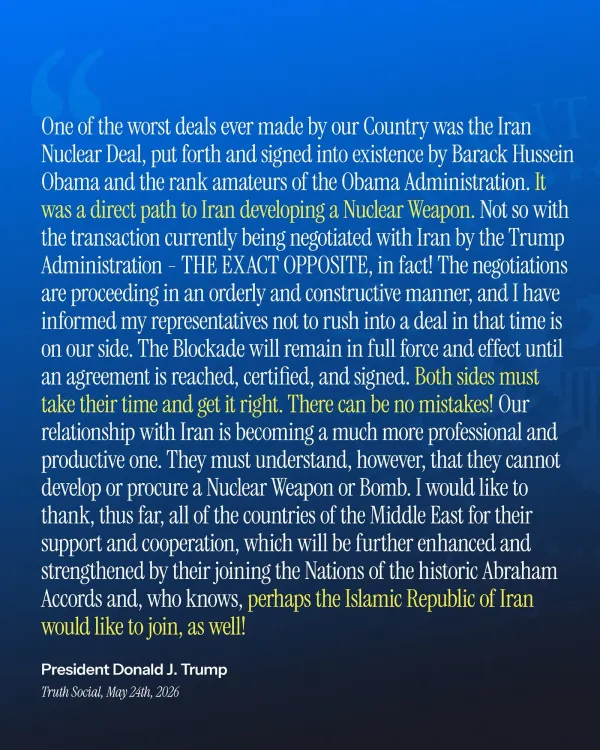
President Donald J. Trump, in a statement posted by the White House on May 24, 2026, declared that ongoing negotiations are proceeding constructively and directed his representatives not to rush, arguing that time is on the side of the United States.
Key Takeaways
President Trump described the negotiations as proceeding in an 'orderly and constructive manner' in a May 24, 2026 White House post.
He explicitly instructed his representatives 'not to rush into a deal,' framing extended timelines as advantageous for the United States .
The statement does not name the counterpart country or the specific subject of the negotiations.
The posture mirrors Trump 's first-term approach during trade talks with China and the USMCA renegotiation, where duration was used as leverage.
The warning 'there can be no mistakes' signals a preference for deal quality over speed.
Markets, trade partners, and domestic industries face continued uncertainty until a counterpart or timeline is publicly identified.
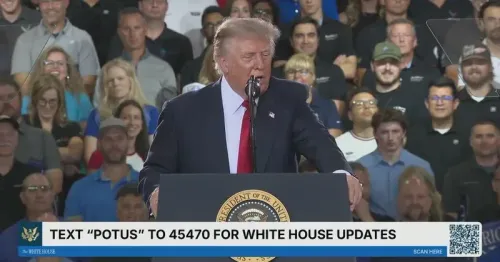
Washington DC, May 24, 2026 — The White House on Sunday quoted President Donald J. Trump as saying that ongoing negotiations are proceeding in an 'orderly and constructive manner,' while directing his representatives not to rush toward a deal, asserting that time favours the United States. The statement, posted on the official White House account on X, underscores Trump's publicly declared patience as a core negotiating posture.
Context
In his own words, Trump stated: 'The negotiations are proceeding in an orderly and constructive manner, and I have informed my representatives not to rush into a deal in that time is on our side… Both sides must take their time and get it right. There can be no mistakes!' The statement does not name a specific country or subject matter, leaving the counterpart and issue area unspecified in the public post.
The tone is deliberate: by signalling that the United States is in no hurry, Trump frames duration itself as a strategic asset rather than a sign of stalled progress. This is consistent with how his administration has publicly communicated on high-stakes talks in the past.
Policy Backdrop
This posture echoes the approach Trump adopted during his first term (2017–2021), when his administration used phased tariff measures and extended timelines to renegotiate trade terms with China and to replace NAFTA with the USMCA. In those instances, prolonged talks were publicly presented as strengthening the US bargaining position, pressuring counterparts to make concessions rather than walk away.
The phrase 'there can be no mistakes' signals that Trump is prioritising the quality of any eventual agreement over the speed of its conclusion — a framing that gives his team political cover to extend negotiations without appearing to falter.
Stakeholders and Impact
US industries and trade partners watching the talks face uncertainty in the interim, as an open-ended timeline can delay supply-chain decisions, investment commitments, and tariff planning. For counterpart governments, the message is clear: Washington will not blink first, and any pressure to close quickly is unlikely to move the US side.
Domestic audiences, particularly American manufacturers and exporters, may read the statement as reassurance that the administration is not trading away leverage for a quick political win. At the same time, prolonged uncertainty carries its own costs for businesses on both sides.
What's Next
Observers will watch for subsequent White House communications that identify the specific country or issue area involved, as well as any scheduled bilateral meetings, tariff adjustments, or negotiating-round announcements. A named counterpart or a concrete deadline would significantly sharpen the stakes of Trump's statement.
Until then, the public posture from 1600 Pennsylvania Avenue is one of calibrated patience — a signal to markets, allies, and adversaries alike that the current administration views the passage of time as a negotiating tool, not a concession.
Point of View
The administration signals institutional backing for this patience strategy. For India and other major US trade partners currently in sensitive bilateral discussions, the message carries weight: Washington is not under pressure to close, and any counterpart that is will be at a disadvantage. The deliberate vagueness about the counterpart country may itself be intentional, keeping multiple parties guessing and maximising leverage across the board.
NationPress
10 Oct 2026
Frequently Asked Questions
What did Trump say about the ongoing negotiations on May 24 2026?
President Trump said the negotiations are proceeding in an 'orderly and constructive manner' and that he has told his representatives not to rush into a deal, arguing that time is on the side of the United States.
Which country is Trump negotiating with?
The White House statement does not name a specific counterpart country or identify the subject of the negotiations. No further details have been officially confirmed.
Why is Trump telling his team not to rush the deal?
Trump's stated reasoning is that 'time is on our side,' meaning he believes the US gains leverage the longer talks continue, making it strategically preferable to wait for favourable terms rather than accept an early or imperfect agreement.
How does this compare to Trump's first-term negotiating style?
During his first term, Trump used similar rhetoric and extended timelines during trade talks with China and the NAFTA renegotiation, presenting prolonged negotiations as a tool to strengthen the US bargaining position.
What does 'there can be no mistakes' mean in Trump's statement?
The phrase signals that Trump is prioritising the quality and completeness of any eventual agreement over reaching a quick deal, giving his negotiating team political cover to extend talks without it being seen as a failure.