Rajasthan CMO marks World Population Day, urges citizens to embrace population balance
Synopsis
On World Population Day, 11 July 2026, the Chief Minister's Office of Rajasthan called on citizens to embrace population balance as a civic duty, linking demographic stability to resource conservation and the welfare of future generations.
Key Takeaways
The Chief Minister's Office of Rajasthan posted a World Population Day message on 11 July 2026 , urging population balance.
World Population Day has been observed annually on 11 July since 1989 , established by the UNDP .
The post framed population balance as essential for conserving limited resources and securing the future of coming generations .
India has maintained an official population policy since 1952 , with the National Population Policy 2000 targeting stabilisation by 2045 .
The communication adopts a voluntary, awareness-led tone consistent with national family welfare guidelines.
Observers will watch for follow-up programmatic announcements from the Rajasthan government on family welfare and reproductive health.
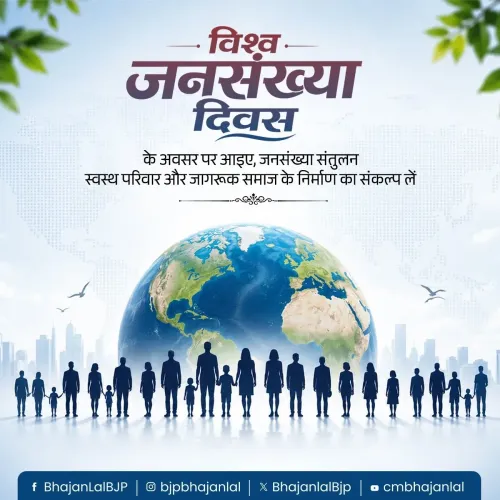
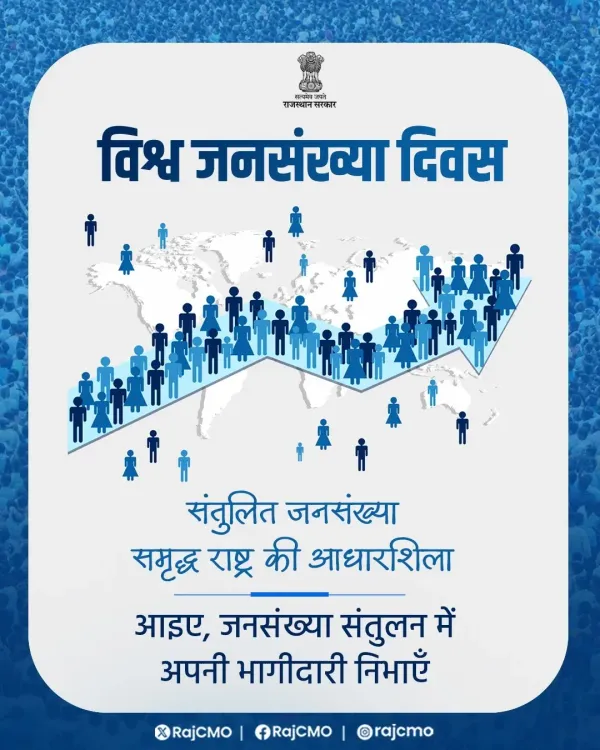
The Chief Minister's Office of Rajasthan on Saturday, 11 July 2026 used the occasion of World Population Day to call on citizens to understand the importance of population balance and act as responsible individuals for the conservation of limited resources and the security of future generations.
Posting in Hindi, the official handle of the Government of Rajasthan stated: 'सीमित संसाधनों के संरक्षण एवं भावी पीढ़ियों के सुरक्षित भविष्य के लिए, जनसंख्या संतुलन आवश्यक है' — ('Population balance is essential for the conservation of limited resources and the secure future of coming generations'). The message urged citizens to play their role as responsible individuals on the occasion of #WorldPopulationDay.
Context
World Population Day is observed every year on 11 July and was established by the United Nations Development Programme (UNDP) in 1989 to draw global attention to population issues and their links with sustainable development. The day serves as an annual platform for governments, civil society, and communities to reflect on demographic trends, reproductive health, and resource sustainability. Rajasthan, one of India's largest states by area with a significant rural population, has historically been an active participant in national family welfare messaging, using occasions such as this to reinforce public awareness campaigns.Policy Backdrop
India launched its first national family planning programme in 1952, making it among the earliest countries in the world to adopt an official population policy. The landmark National Population Policy 2000 set a long-term goal of population stabilisation by 2045, while firmly grounding the approach in voluntary family planning and reproductive health rights. Successive governments at both the central and state levels have framed population balance as integral to resource sustainability and economic development. Across Indian states, the emphasis has varied — ranging from awareness campaigns to incentive-linked schemes — but the underlying policy consensus has consistently linked demographic stability with improved quality of life and equitable resource distribution. Rajasthan has periodically woven population messaging into its broader welfare and resource-planning communications, and the 11 July 2026 post continues this established pattern.Stakeholders and Impact
The message is directed primarily at Rajasthan's residents, particularly young families and communities in both urban and rural areas where awareness of reproductive health and family planning services may vary. By framing population balance as a civic responsibility rather than a state directive, the communication adopts a voluntary, rights-respecting tone consistent with national policy guidelines. For frontline health workers and district-level administrators, such high-visibility messaging from the Chief Minister's Office reinforces the salience of population-related programmes within the state's welfare agenda. Civil society organisations engaged in maternal health, child welfare, and family planning also take cues from such official communications to align their outreach calendars.What's Next
Attention will now turn to whether the Government of Rajasthan follows the World Population Day message with concrete programmatic announcements — such as updates to family welfare scheme targets, enhanced allocations for reproductive health infrastructure, or district-level awareness drives. At the national level, the release of updated census data and any revision to family welfare scheme benchmarks will shape how states including Rajasthan recalibrate their population-related priorities in the months ahead. The broader trajectory of India's demographic transition will continue to inform both central and state-level policy conversations well beyond this annual observance.Point of View
Positioning population balance as a shared civic value rather than a top-down directive. By invoking 'limited resources' and 'future generations,' the communication taps into a well-worn policy frame that successive Indian governments have used to build public consent for family welfare programmes without triggering the political sensitivities associated with coercive population control. The voluntary, awareness-first tone is consistent with the rights-based approach enshrined in the National Population Policy 2000, suggesting the state is staying within that consensus rather than pushing for more prescriptive measures. The message also sets a soft agenda: if census data or state welfare reviews follow, this day's communication provides a rhetorical foundation for any forthcoming policy announcements.
NationPress
9 Oct 2026
Frequently Asked Questions
Why does Rajasthan observe World Population Day?
Rajasthan, like other Indian states, observes World Population Day on 11 July each year to raise public awareness about population balance, family welfare, and sustainable use of resources, in line with the global observance established by the UNDP in 1989 .
What did the Rajasthan Chief Minister's Office say on World Population Day 2026?
The Chief Minister's Office of Rajasthan posted a message on 11 July 2026 stating that population balance is essential for conserving limited resources and securing the future of coming generations, urging citizens to act responsibly.
What is India's population policy?
India launched its first family planning programme in 1952 and adopted the National Population Policy 2000 , which set a goal of population stabilisation by 2045 through voluntary family planning and reproductive health measures.
What is World Population Day and when is it observed?
World Population Day is an annual global observance held on 11 July , established by the United Nations Development Programme in 1989 to highlight population issues and their connection to sustainable development.
What are Rajasthan's family welfare programmes?
Rajasthan implements family welfare and population stabilisation programmes under the broader national family planning framework, with district-level outreach targeting reproductive health, maternal care, and awareness of voluntary family planning services.