CM Sukhu calls for population balance on World Population Day
Synopsis
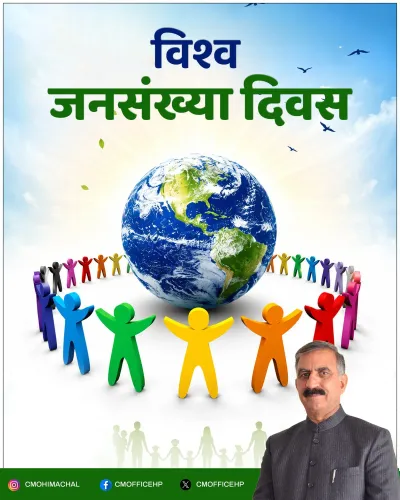
On World Population Day, 11 July 2026, Himachal Pradesh Chief Minister Sukhvinder Singh Sukhu urged citizens to pledge awareness on population balance, linking demographic stability to family welfare, social strength, and national progress amid growing resource pressures.
Key Takeaways
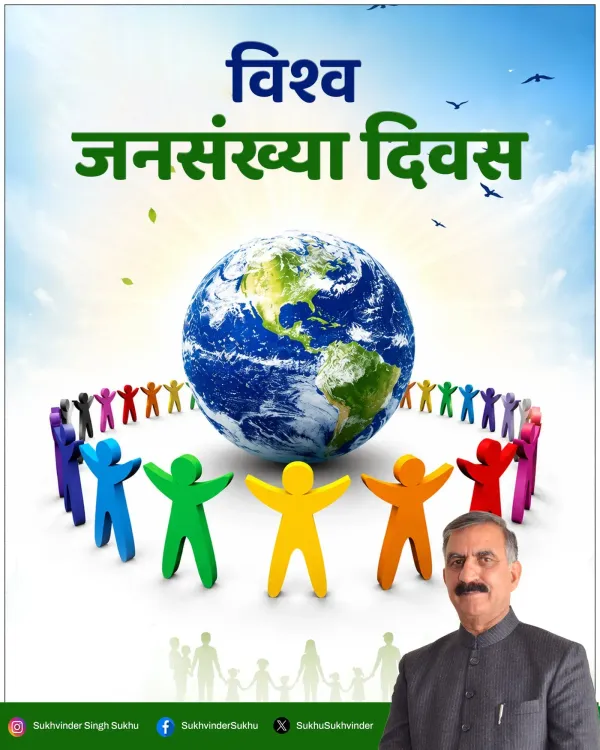
CM Sukhvinder Singh Sukhu posted a message on World Population Day, 11 July 2026 , calling for population balance awareness.
He stated that growing population puts pressure on limited resources and creates social, economic, and environmental challenges.
World Population Day was established by the United Nations in 1989 to highlight global population issues.
India launched the world's first state-led family planning programme in 1952 and formalised goals under the National Population Policy 2000 .
Himachal Pradesh records one of India's lowest population growth rates and high literacy levels, aligning with national demographic transition goals.
Sukhu's message reinforces voluntary awareness as the preferred policy approach to demographic stabilisation.
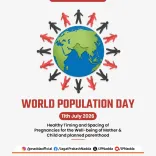
Himachal Pradesh Chief Minister Sukhvinder Singh Sukhu on Friday, 11 July 2026, marked World Population Day by calling on citizens to spread awareness about population balance as a cornerstone of family welfare, social strength, and national progress.
Posting in Hindi on the occasion, CM Sukhu wrote: 'परिवार की खुशहाली, समाज की मजबूती और राष्ट्र की प्रगति के लिए जनसंख्या का संतुलन बेहद आवश्यक है' — 'Population balance is extremely necessary for family happiness, social strength, and national progress.' He added that a growing population puts pressure on limited resources and gives rise to numerous social, economic, and environmental challenges.
Context
World Population Day, observed every year on 11 July, was established by the United Nations in 1989 to focus global attention on the urgency and importance of population issues. The day traces its origins to 11 July 1987, when the world's population crossed the five-billion mark. In 2026, the observance comes as global and national conversations around demographic pressures, resource sustainability, and reproductive health remain active.
CM Sukhu used the occasion to call for a collective resolve: 'आइए, विश्व जनसंख्या दिवस पर संकल्प लें' — 'Let us take a pledge on World Population Day' — to contribute toward building a better, prosperous, and empowered future by raising awareness about the importance of population balance.
Policy Backdrop
India launched its national family planning programme in 1952, becoming the first country in the world to adopt a state-led population policy. The National Population Policy 2000 established a comprehensive framework targeting population stabilisation by 2045, with medium-term goals including reducing the total fertility rate to replacement level through voluntary family planning and reproductive health services.
Himachal Pradesh stands as one of India's better-performing states on demographic indicators, recording one of the country's lowest population growth rates alongside high literacy levels. The state's trajectory aligns closely with national demographic transition patterns and the Sustainable Development Goals on health and environment, making it a reference point in policy discussions on population stabilisation.
Stakeholders and Impact
The primary stakeholders in population awareness campaigns are rural families and women of reproductive age, who are the direct beneficiaries of family planning services and health education. Sustained awareness drives on World Population Day have historically amplified outreach for government health schemes at the grassroots level.
Indian policy has consistently linked population stabilisation to resource sustainability and economic development since the 1950s. States that achieve replacement-level fertility earlier tend to see improved per-capita resource availability, better educational outcomes, and stronger economic growth — a pattern that Himachal Pradesh has broadly demonstrated over recent decades.
What's Next
Attention will now turn to the release of the latest Sample Registration System fertility data, which will provide an updated picture of demographic trends across Indian states. State governments, including Himachal Pradesh, are expected to follow the observance with targeted population awareness drives reaching district and panchayat levels.
CM Sukhu's message reinforces the broader national consensus that voluntary awareness — rather than coercive measures — remains the preferred policy instrument for achieving demographic balance, a principle embedded in India's population framework since 2000.
Point of View
Sukhu distances himself from coercive policy proposals that have periodically surfaced in national discourse. For a state like Himachal Pradesh, which already performs well on fertility indicators, the message doubles as a quiet assertion of governance success. The timing also positions the Congress party as a responsible stakeholder in India's long-term demographic planning ahead of any fresh policy announcements at the national level.
NationPress
11 Jul 2026
Frequently Asked Questions
What did CM Sukhu say on World Population Day 2026?
Himachal Pradesh Chief Minister Sukhvinder Singh Sukhu said that population balance is essential for family happiness, social strength, and national progress, and urged citizens to pledge awareness on the issue on 11 July 2026 .
When is World Population Day and why is it observed?
World Population Day is observed every year on 11 July . It was established by the United Nations in 1989 to raise global awareness about the urgency of population issues, including resource sustainability, reproductive health, and economic development.
What is India's population policy?
India launched the world's first state-led family planning programme in 1952 . The National Population Policy 2000 set a framework for population stabilisation by 2045 through voluntary family planning and reproductive health services, targeting replacement-level fertility.
What is Himachal Pradesh's population growth rate?
Himachal Pradesh is among the Indian states with the lowest population growth rates and high literacy levels, making it a reference point in national demographic transition discussions.
Who is Sukhvinder Singh Sukhu?
Sukhvinder Singh Sukhu is a senior Indian National Congress leader who has served as Chief Minister of Himachal Pradesh since December 2022 .