CM Bhajan Lal calls for population balance on World Population Day
Synopsis
On World Population Day, 11 July 2026, Rajasthan Chief Minister Bhajan Lal Sharma called for a public pledge toward population balance, healthy families, and an aware society, linking demographic stability to the Viksit Bharat vision of a developed India by 2047.
Key Takeaways
Rajasthan Chief Minister Bhajan Lal Sharma posted a message on 11 July 2026 to mark World Population Day .
He urged citizens to resolve to build population balance, healthy families, and an aware society.
The post links a balanced population to an empowered society, a prosperous nation, and sustainable development.
The message invokes the Viksit Bharat vision, the central government's goal of a developed India by 2047 .
India has maintained a national Family Planning Programme since 1952 , one of the world's earliest such efforts.
Rajasthan's next population policy steps and upcoming census fertility data will be key indicators to watch.
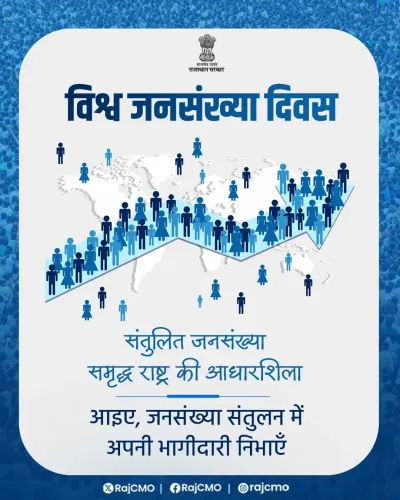
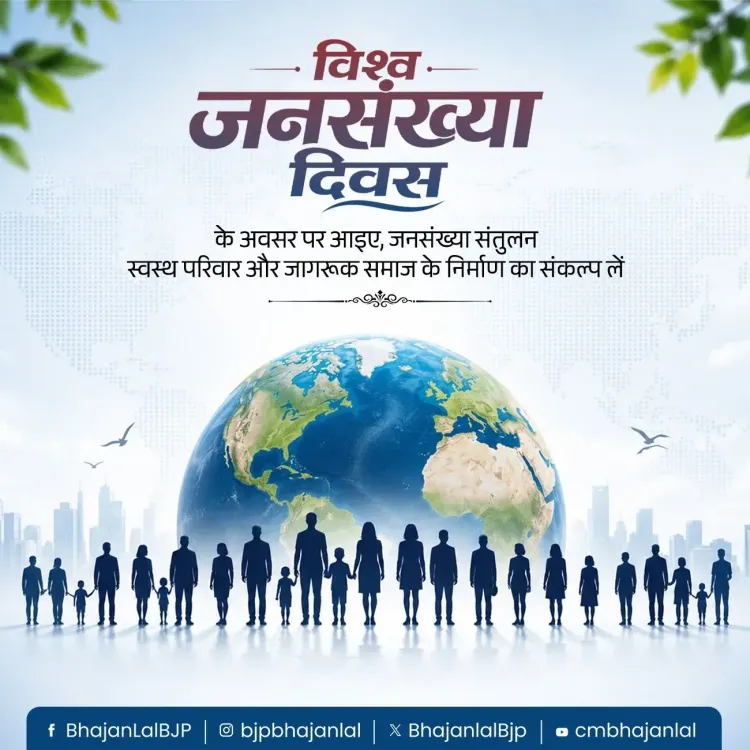
Rajasthan Chief Minister Bhajan Lal Sharma on Saturday, 11 July 2026, marked World Population Day by calling on citizens to pledge commitment to population balance, healthy families, and an aware society, framing these as the foundation of a strong nation and sustainable development.
In his post on X, Sharma wrote: 'विश्व जनसंख्या दिवस के अवसर पर आइए, जनसंख्या संतुलन, स्वस्थ परिवार और जागरूक समाज के निर्माण का संकल्प लें!' — translating to: 'On the occasion of World Population Day, let us resolve to build population balance, healthy families, and an aware society!' He added that a balanced population is the foundation of an empowered society, a prosperous nation, and sustainable development, and urged citizens to participate actively in building a Viksit Bharat (Developed India).
Context
World Population Day is observed every year on 11 July to draw global attention to population-related challenges including family planning, gender equality, and reproductive health. India, now the world's most populous nation, uses the occasion to reinforce awareness campaigns tied to demographic goals. Sharma's message aligns with the day's international theme of sustainable population management.
Policy Backdrop
India launched its national Family Planning Programme in 1952, one of the earliest such initiatives globally. The National Population Policy 2000 set formal targets for population stabilisation and improved reproductive health services across states. Several states introduced two-child norms for elected representatives and access to government benefits during the 1990s and 2000s, reflecting long-standing legislative interest in the issue.
Rajasthan has historically been among the states where family planning outreach has been a significant component of public health programming. BJP-led administrations at the centre and in states have periodically renewed emphasis on balanced population growth alongside economic and infrastructure priorities, often linking smaller family sizes to household prosperity and national progress.
Stakeholders and Impact
The message is directed at families, women, and the broader citizenry of Rajasthan and beyond. Population stabilisation efforts directly affect maternal and child health outcomes, access to education, and the state's capacity to deliver welfare services. Women remain central stakeholders, as family planning decisions and reproductive health services disproportionately involve them.
The invocation of Viksit Bharat — the central government's vision for a developed India by 2047 — connects state-level awareness messaging to a broader national development framework frequently cited by BJP leaders. This framing positions population balance not merely as a health issue but as a prerequisite for economic advancement.
What's Next
Observers will watch whether Rajasthan follows this awareness message with concrete policy updates, such as revised incentives for family planning or expanded reproductive health infrastructure in the state. At the national level, the anticipated release of fresh census fertility data is expected to sharpen the policy debate around population trends. Sharma's post signals that population balance will remain a recurring theme in BJP-governed Rajasthan's public communication as the state aligns itself with the Viksit Bharat agenda.
Point of View
Connecting a global observance to a domestic political vision. By framing population balance as a prerequisite for national prosperity rather than a coercive policy goal, the messaging sidesteps the controversy that has historically surrounded two-child norm proposals. The post signals that Rajasthan's leadership intends to keep demographic stability on the public agenda, potentially as a precursor to policy announcements. It also reflects a wider pattern among BJP-governed states of aligning welfare and health communication with the 2047 development timeline.
NationPress
9 Oct 2026
Frequently Asked Questions
Why did Rajasthan CM Bhajan Lal Sharma post about World Population Day?
Rajasthan CM Bhajan Lal Sharma posted on World Population Day, observed on 11 July every year, to urge citizens to commit to population balance, healthy families, and an aware society as pillars of national development.
What is World Population Day and why is it observed on 11 July?
World Population Day is observed on 11 July each year to raise awareness about global population challenges including family planning, gender equality, and reproductive health. The date marks the approximate day in 1987 when the world population reached five billion.
What is Viksit Bharat and how does it relate to population policy?
Viksit Bharat is the central government's vision for India to become a fully developed nation by 2047. BJP leaders, including CM Sharma, link population balance and family planning awareness to achieving the economic and social goals of this vision.
What is India's history with family planning policy?
India launched its national Family Planning Programme in 1952, making it one of the first countries in the world to do so. The National Population Policy 2000 further set targets for population stabilisation and improved reproductive health services.
What population policy changes could Rajasthan announce next?
Observers are watching for possible updates to Rajasthan's family planning incentives or reproductive health infrastructure following CM Sharma's awareness message. Fresh national census fertility data, expected in coming years, is also likely to shape the state's next policy steps.